eISSN: 2377-4304


Research Article Volume 16 Issue 3
 Amr Abbassy,2 Alaa Hamed Alarshal,3 Asmaa MM Abdellah,1 Seif Ali,4 Ahmed Khalil,5 Waleed F Gharib1
1Obstetrics and Gynecology department, Suez Canal University, Egypt
2Reproductive health and family planning, National |research Centre, Egypt
3Obstetrics and Gynecology department, Alazhar University, Egypt
4Obstetrics and Gynecology department, Assiut University, Egypt
5Obstetrics and Gynecology department, university hospital Schleswig Holstein, Campus Lubeck, Germany
Correspondence: Mahmoud Alalfy, Obstetrics and Gynecology Department, National Research Centre, Egypt, Tel 01002611058
Received: May 12, 2025 | Published: May 23, 2025
Citation: Greash MAM, Alalfy M, Abbassy A, et al. Effects of intraovarian injection of autologous platelet-rich plasma on ovarian rejuvenation in women with primary ovarian insufficiency. Obstet Gynecol Int J. 2025;16(2):88-92. DOI: 10.15406/ogij.2025.16.00792
Background and study aim: Primary Ovarian insufficiency, which is described by significantly reduced ovarian reserve, menstrual irregularity, or amenorrhea earlier than 40 years of age, affects 1% of women at reproductive age. Recently, platelet-rich plasma (PRP) has been widely used in regenerative treatment in different fields, as it is rich with cytokines and growth factors. Accumulation of platelet in a tissue stimulates cell proliferation and tissue regeneration through protein secretion in response to cytokines, and growth factors. Recently, it has been investigated in the cases of ovarian insufficiency. This study aimed to evaluate whether the intra-ovarian injection of autologous PRP would improve ovarian reserve through ovarian rejuvenation thus causing spontaneous pregnancy or menstrual recovery in women with primary ovarian insufficiency.
Patients and Methods: This Quazi-Expermental study was conducted in the department of Obstetrics & Gynecology, Suez Canal University hospital. It was conducted on 38 Women of childbearing period presenting at the outpatient clinic of the Department of Obstetrics and Gynecology complaining of Primary ovarian insufficiency diagnosed according to ESHRE guideline.
Results: Our study showed that FSH levels rose considerably, indicating a reduction in ovarian reserve. Although AMH levels remained relatively stable, there was a slight decrease in the median value, which could suggest a potential trend towards diminished reserve. AFC demonstrated a statistically significant decrease, with an increasing number of patients exhibiting 0 or 1 follicle after a two-month period.These results indicate a significant deterioration in ovarian reserve markers over 2 months, especially reflected by a rise in FSH and a drop in AFC.
Conclusion: In contrast to previous reports demonstrating improved ovarian reserve markers following PRP treatment, this study did not observe a favorable change in ovarian reserve two months post-intraovarian PRP in women with established POI. The findings underscore the need for longer follow-up, larger sample sizes, and standardization of PRP protocols. Future research should focus on identifying patient subgroups most likely to benefit from PRP and establishing biological markers predictive of response.
Keywords: platelet-rich plasma, ovarian insufficiency, Antral follicular count, antimullerian hormone
FSH, follicle stimulating hormone; AMH, antimullerian hormone; PRP, platelet rich plasma; AFC, antral follicular count; OPU, oocyte pick up
Women with primary ovarian insufficiency (POI) are considered the main challenges of reproductive science. POI, which is described by significantly reduced ovarian reserve, menstrual irregularity, or amenorrhea earlier than 40 years of age, affects 1% of women at reproductive age.1
At present, egg donation is the only treatment option for women with POI, and infertile couples who desire to have their own genetic offspring do not usually welcome that. Recently, platelet-rich plasma (PRP) has been widely used in regenerative treatment in different fields such as orthopedics, dermatology, dentistry, and aesthetic surgery.2,3
PRP is platelet-rich blood plasma supplemented with cytokines and growth factors. Accumulation of platelet in a tissue stimulates cell proliferation and tissue regeneration through protein secretion in response to cytokines, and growth factors lead to revert the cellular damage and tissue rejuvenation.4
In the field of infertility, PRP was primarily used for the treatment of thin endometrium and recurrent implantation failure.5,6
Recently, it has been investigated in the cases of ovarian insufficiency.7,8 Since the studies which assessed the PRP beneficial effects on ovarian parameters are limited, So the aim of this study to evaluate whether the intra-ovarian injection of autologous PRP would improve ovarian reserve through ovarian rejuvenation thus causing spontaneous pregnancy or menstrual recovery in women with primary ovarian insufficiency.
Type of study: A Quazi-Expermental study.
Site of study: The department of Obstetrics & Gynecology, Suez Canal University hospital.
Study population: Women of childbearing period presenting at the outpatient clinic of the Department of Obstetrics and Gynecology complaining of Primary ovarian insufficiency diagnosed according to ESHRE guideline.
Criteria of selection
Inclusion criteria: POI patients were diagnosed according to ESHRE guideline: onset prior to 40 years of age, oligo-/amenorrhea for at least 4 months, and an elevated FSH level > 25 IU/l on two occasions > 4 weeks apart.
We excluded the subjects who had:
Study methods
Data was collected in pre organized data sheet by the researcher from patients fulfilling inclusion and exclusion criteria. All patients of our study were subjected to the following:
Sample preparation
PRP was prepared from autologous blood using the manufacturer’s instruction (Rooyagen, Tehran, Iran). Briefly, for each PRP infusion, approximately 20 ml of peripheral venous blood was drawn in the syringe that contained 3 ml of acid citrate A anticoagulant solution (ACD-A) (Arya Mabna Tashkhis, Iran) and centrifuged immediately at 1600g for 10 min.
The blood was divided into three layers including red blood cells at the bottom, a buffy coat layer, and cellular plasma as the supernatant. The plasma layer and buffy coat were transferred to another tube and centrifuged at 3500g for 5 min to achieve 3 ml PRP of 3 to 5 times higher than basal blood samples.
Prepared PRP was stored for 1 h at a temperature of 4°C before injection, and PRP activation was performed using calcium gluconate (CG) in a 1:9 ratio.
Blood products such as PRP fall under the prevue of FDA's Center for Biologics Evaluation and Research (CBER). CBER is responsible for regulating human cells, tissues, and cellular and tissue-based products. The regulatory process for these products is described in the FDA's 21 CFR 1271 of the Code of Regulations. Under these regulations, certain products including blood products such as PRP are exempt and therefore do not follow the FDA's traditional regulatory pathway that includes animal studies and clinical trials.
Intraovarian injection
The injection was randomly scheduled in POI women with amenorrhea, whereas in POI women who were oligomenorrheic, PRP injection was done 10 days after the beginning of menstrual bleeding. PRP injection was done according to the previously defined method.9,10
The injection of PRP is mostly an empirical process, Injecting PRP into the ovaries is a technique based on the method of trans-vaginal paracentesis employed during the oocyte pick up (OPU) procedure, Minimal sedation was administered to the patients. Injection and diffusion into the ovarian stroma were performed under a non-surgical, trans-vaginal ultrasound-guided multifocal intramedullary procedure, allowing approximately 4 ml PRP for each of both ovaries.
In a more detailed description, the ovaries were identified with the guidance of trans-vaginal ultrasonography. Following identification, a needle was inserted, penetrating the ovarian tissue, accompanied by a resistance felt by the practitioner. Prior to initiating the injection procedure, the needle guide was aligned with the ovaries to ensure that any surrounding structures, such as vessels, were not compromised.
Taking into account the anatomical position of the ovary, a 17-gauge single lumen needle was employed, moving across the central part of the ovary, carefully covering the distance from one side to the other, practicing extreme caution so as to avoid penetrating the germinal epithelium of the outer wall of the ovary into the peritoneal cavity.
In the case of POI, a quantity of the injected PRP leaked into the peritoneal cavity due to atrophic ovaries with decreased volume.
By the end of the procedure, accurate ultrasonography was performed to evaluate the pelvic area concerning the amount of leakage and vascular integrity.
The majority of women received the second PRP injection with a twofold increase in the dosage to 3ml, 3 months after the first injection (Figure 1).
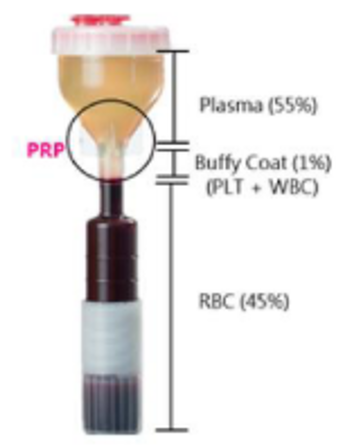
Figure 1 PRP preparation.
PRP insertion:
Statistical analysis
Data were coded and entered into the computer statistical program. All statistical analyses were performed using the Statistical Package for Social Science (SPSS) version (25).
In this study, we assessed and compared the effect of intraovarian PRP injection on ovarian rejuvenation in women with Primary Ovarian Insufficiency (POI).
We included 38 subjects (3 did not complete the study so the final number was 35) diagnosed according to ESHRE guideline: onset prior to 40 years of age, oligo-/amenorrhea for at least 4 months, and an elevated FSH level > 25 IU/l on two occasions > 4 weeks apart.
Table 1 shows that the studied group comprises women in their early 30s, with a relatively long mean duration of infertility (6 years).
|
|
No. (%) |
|
Age |
|
|
Min. – Max. |
25.0 – 39.0 |
|
Mean ± SD. |
32.03 ± 3.89 |
|
Median (IQR) |
32.0 (29.0 – 35.0) |
|
Duration of infertility |
|
|
Min. – Max. |
2.0 – 17.0 |
|
Mean ± SD. |
6.09 ± 3.48 |
|
Median (IQR) |
5.0 (3.0 – 8.50) |
|
Previous pregnancy |
|
|
0 |
21 (60.0%) |
|
1 |
11 (31.4%) |
|
2 |
3 (8.6%) |
|
Pregnancy outcome |
|
|
No |
35 (100.0%) |
|
Yes |
0 (0.0%) |
Table 1 Distribution of the studied cases according to different parameters (n = 35)
It also shows that a majority had never been pregnant, and none achieved pregnancy, suggesting a population with significant reproductive challenges.
Table 2 shows that FSH levels rose considerably, indicating a reduction in ovarian reserve.
|
|
Baseline (n = 35) |
After 2 Month (n = 35) |
Test of Sig |
p |
|
FSH |
||||
|
Min. – Max. |
25.0 – 60.0 |
23.0 – 58.0 |
Z= |
0.035* |
|
Mean ± SD. |
32.03 ± 9.10 |
32.91 ± 9.64 |
2.111* |
|
|
Median (IQR) |
28.0 (26.0 – 36.5) |
30.0 (26.0 – 40.0) |
||
|
AMH |
||||
|
Min. – Max. |
0.001 – 0.40 |
0.001 – 0.50 |
Z= |
0.139 |
|
Mean ± SD. |
0.16 ± 0.14 |
0.14 ± 0.13 |
1.48 |
|
|
Median (IQR) |
0.20 (0.01 – 0.25) |
0.10 (0.01 – 0.20) |
||
|
AFC |
||||
|
0 |
5 (14.3%) |
12 (34.3%) |
MH= |
0.001* |
|
1 |
15 (42.9%) |
17 (48.3%) |
34.500* |
|
|
2 |
7 (20.0%) |
3 (8.6%) |
||
|
3 |
8 (22.9%) |
3 (8.6%) |
||
|
Mean ± SD. |
1.51 ± 1.01 |
0.91 ± 0.89 |
Z= |
0.001* |
|
Median (IQR) |
1.0 (1.0 – 2.0) |
1.0 (0.0 – 1.0) |
3.202* |
|
Table 2 Comparison between baseline and after according to FSH, AMH and AFC (n = 35)
Although AMH levels remained relatively stable, there was a slight decrease in the median value, which could suggest a potential trend towards diminished reserve.
AFC demonstrated a statistically significant decrease, with an increasing number of patients exhibiting 0 or 1 follicle after a two-month period.
These results indicate a significant deterioration in ovarian reserve markers over 2 months, especially reflected by a rise in FSH and a drop in AFC.
The absence of improvement in AMH or AFC suggests that no beneficial intervention took place, or the intervention was not effective.
This study aimed to evaluate the short-term effects of intraovarian autologous platelet-rich plasma (PRP) injections on ovarian reserve in women diagnosed with primary ovarian insufficiency (POI). The results demonstrated a significant increase in FSH, a significant reduction in AFC, and a non-significant decline in AMH two months post-PRP administration. Collectively, these findings suggest no favorable impact of PRP on ovarian reserve within this short follow-up duration and may even indicate further deterioration in some patients.
These results stand in contrast to numerous studies that have reported beneficial effects of intraovarian PRP on ovarian function in women with POI or diminished ovarian reserve (DOR). For instance,11 described a case series where women with POI treated with intraovarian PRP exhibited resumed menses and even spontaneous pregnancies. Similarly,10 conducted a pilot study on women with POI and observed significant increases in AMH, decreased FSH, and resumption of follicular activity on ultrasound within 2–4 months following PRP injection.
Moreover,12 conducted a prospective study on 311 women with low ovarian reserve, where PRP was shown to significantly improve AMH and AFC in a majority of participants within three months. Notably, clinical pregnancy was achieved in 24.1% of participants. Also demonstrated similar results, reporting significant increases in both AMH and AFC, suggesting that PRP may enhance the recruitment and activation of dormant follicles.5
In contrast, our study demonstrated a statistically significant increase in FSH levels and significant reduction in AFC, which are markers typically associated with worsening ovarian function. The lack of AMH improvement and the higher percentage of women with zero follicles post-treatment may indicate a non-responder group or a potentially delayed response. This may be explained by multiple factors:
Despite these findings, it is important to recognize that PRP therapy is still in its experimental stages and current evidence is derived mainly from observational studies and small pilot trials. A systematic review by7 highlighted the promising but still inconclusive role of PRP in ovarian rejuvenation, calling for more well-designed randomized controlled trials (RCTs).
In contrast to previous reports demonstrating improved ovarian reserve markers following PRP treatment, this study did not observe a favorable change in ovarian reserve two months post-intraovarian PRP in women with established POI. The findings underscore the need for longer follow-up, larger sample sizes, and standardization of PRP protocols. Future research should focus on identifying patient subgroups most likely to benefit from PRP and establishing biological markers predictive of response.
Recommendations
Ethics
Concerning this study, the following ethical considerations were taken:
We acknowledged the help of all staff in obstetrics and gynecology unit of Suez Canal University hospital.
Self-funded by researcher.
The authors have no conflicts of interest.

©2025 Greash, et al. This is an open access article distributed under the terms of the, which permits unrestricted use, distribution, and build upon your work non-commercially.