eISSN: 2574-9927


Research Article Volume 9 Issue 1
 Abdullahi Nuraddeen Bakori2
1Chemical Engineering Department, Ahmadu Bello University, Nigeria
2Chemical Engineering Department, Kaduna polytechnic, Nigeria
Correspondence: Kazeem Ibraheem Ajadi, Chemical Engineering Department, Ahmadu Bello University, Zaria, Nigeria, Tel 08052325309
Received: April 11, 2025 | Published: May 27, 2025
Citation: Olayinka OM, Ajadi KI, Bakori AN. Formulation of medicated cosmetic cream using Aloe Vera and turmeric as key ingredients. Material Sci & Eng. 2025;9(1):16-18. DOI: 10.15406/mseij.2025.09.00250
The present study provides a thorough assessment of the cream formulation, combining various physical, chemical, and toxicological analyses to determine its quality, stability, and safety for topical application. The investigation evaluated important parameters such as color, odor, and texture, confirming a consistent and visually acceptable physical profile maintained over 16 weeks. Other assessments, such as washability, phase separation, and pH measurements within the skin's natural range (5–7), further validate the formulation's stability and user compatibility. Safety evaluations using patch tests and toxicology studies employing albino mice showed no signs of skin irritation or systemic toxicity, which is in accordance with accepted practices in cosmetic research. A thorough chemical characterization was given by the FTIR analysis, which also identified an extra quinone group that was caused by the addition of turmeric and Aloe Vera in addition to the usual functional groups (ether, phenolic, and aldehyde). This new discovery supports previous research on the effectiveness of botanical additives in cosmetic formulations by indicating increased bioactivity and better product qualities.
Keywords: cream, toxicology, FTIR, pH, Aloe Vera, turmeric
Aloe Vera (Aloe barbadensis miller) has become a key component of many formulations because of its moisturizing, anti-inflammatory, and healing properties; its gel, which is rich in polysaccharides, vitamins, enzymes, and amino acids, not only soothes irritated skin but also provides essential hydration, making it highly effective for treating various skin conditions such as burns, wounds, and dryness.1 The cosmetics industry is undergoing a significant transformation as consumers turn their attention to natural ingredients that promote health and wellness in skincare routines.2 Additionally, aloe vera is a popular natural ingredient in both conventional and contemporary cosmetic products due to its well-established variety of health benefits.2 In addition to aloe vera, turmeric (Curcuma longa) is well-known for its main active ingredient, curcumin, which has strong anti-inflammatory and antioxidant properties.3 Turmeric's effectiveness in treating common skin issues like acne, hyperpigmentation, and redness has been highlighted by recent studies, increasing its allure for cosmetic applications.4 Aloe Vera and turmeric work particularly well together; when combined, they not only enhance the benefits of each plant separately but also produce a stronger, skin-improving formula.5
There are currently no products on the market that successfully blend turmeric and aloe vera in a stable and user-friendly formulation, despite the acknowledged potential of each ingredient. The current study intends to formulate such a lotion cream, offering a cutting-edge solution in the realm of natural cosmetics. By combining the well-established benefits of aloe vera and turmeric, this research not only addresses consumer preferences but also pushes the boundaries of cosmetic science towards more holistic and effective skincare solutions. This gap presents a valuable opportunity to develop an innovative cosmetic lotion cream that utilizes the complementary strengths of both components, thereby delivering enhanced skin benefits while catering to the growing demand for natural products.6,7
The following equipment were use during the work such as Beakers, Magnetic stirrer, pH meter, Weighing balance, aloe vera gel, Turmeric, Emulsifying wax, Carrier oil (coconut oil), Glycerine, distilled water, Preservatives.
Extraction of active ingredients
Aloe Vera gel extraction: Aloe vera leaves were collected, the leave were thoroughly washed and cleansed with sterile water to remove dirt and contaminants. The aloe vera was carefully peeled to extract the inner gel. The gel was blended to a smooth consistency the blended gel was then filtered to remove solid particles. The gel was stored in an airtight container.
Turmeric extraction: Fine turmeric root was thoroughly washed and cleaned with sterile water, the turmeric roots was then chopped into smaller bits and then put into the blender, and distilled water was added to blend the root into a smooth paste consistency. The extract was then filtered to remove solid residues. The extract was then poured into an airtight container.
Formulation of lotion cream
To avoid contamination, the workspace and all of the equipment were cleaned, and a scale was used to measure each ingredient precisely. 50 grams of coconut oil, 20 grams of glycerin oil and 40 grams of E-wax were melted together at a temperature of approximately 70 –75°C (158–167°F) for the oil phase making 110 grams. 400ml of distilled water was heated in a double boiler to the same temperature as the oil phase (70 –75°C) in a different beaker and pour in to the container that contain E-wax solution. Deep blender was used to blend the water and oil phases until they were homogenized. The mixture was thoroughly blended after adding aloe vera gel and turmeric extract. Heat Preservatives and fragrance were then added, and the mixture was blended once more to guarantee even distribution. F1 was ordinary lotion cream without turmeric and aloe vera, F2 is a blend of 75 % turmeric and 25% aloe vera and F3 is a blend of 75 % aloe vera and 25% turmeric respectively. The mixture was allowed to cool below 40°C (104°F), finished cream was then transferred into sanitized labelled containers and then kept for analysis (Figure 1).
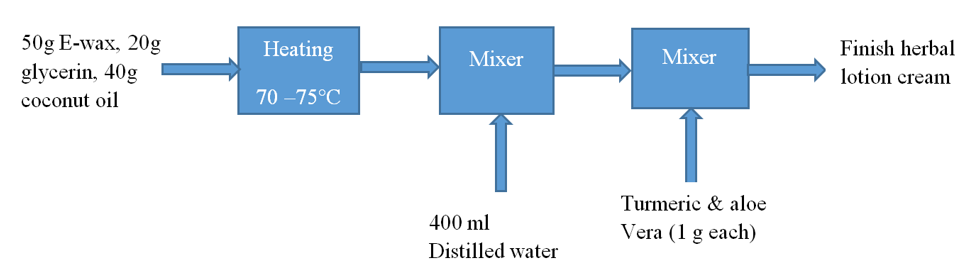
Figure 1 Flow diagram of the process.
Physical and sensory assessment
Physical evaluation: Physical parameters are thoroughly evaluated in the study, and the cream formulations are evaluated for color consistency, pleasant odor, and smooth texture. Maintaining a consistent visual and tactile profile is crucial for topical applications in order to guarantee both product efficacy and user acceptability, according to similar work from previous studies.8 Variations in color and texture have historically been linked to interactions between ingredients and manufacturing processes, as evidenced by studies.9
These earlier findings are supported by the formulation's observed stability over a 16-week period, which shows appropriate emulsification and ingredient compatibility as shown in the Table 1 below.10
|
S/N |
Parameters |
Formulation F1 |
Formulation F2 |
Formulation F3 |
|
1 |
Color |
White |
Yellow |
Faded yellow |
|
2 |
Odor |
Pleasant |
Pleasant |
Pleasant |
|
3 |
Texture |
Smooth |
Smooth |
Smooth |
Table 1 Physical evaluation of medicated cream
Safety and skin compatibility testing
Patch test and irritation assessment: The produced cream's patch test revealed no irritation, which is consistent with standard safety procedures discovered in previous cosmetic assessments. Patch tests, which apply the test substance to the dorsal skin and monitor for irritation or adverse reactions over a 24 to 48 hour period, have been used as a standard for dermatological safety in studies since the 1990s.11,12 The absence of irritation in formulations F1, F2, and F3 confirms that the ingredients, including active compounds from aloe vera and turmeric, are well tolerated as shown in the Table 2
|
S/No |
Formulation |
Irritancy effect |
|
1. |
F1 |
No irritation |
|
2. |
F2 |
No irritation |
|
3. |
F3 |
No irritation |
Table 2 Patch test
Wash ability and phase separation: The formulations' wash ability is crucial for the convenience and hygiene of the consumer. Furthermore, a crucial determinant of formulation stability that has also been emphasized in earlier studies on cosmetic emulsions is the lack of phase separation throughout the observation period.13,14 The stability shown in this work is especially significant because previous assessments have emphasized that phase separation may indicate the disintegration of an emulsion as shown in the Table 3 & 4
|
S/No |
Formulation |
Wash ability |
|
1 |
F1 |
Easily washable |
|
2 |
F2 |
Easily washable |
|
3 |
F3 |
Easily washable |
Table 3 Wash ability observation
|
S/No |
Formulation |
Phase separation |
|
1. |
F1 |
No phase separation was observed |
|
2. |
F2 |
No phase separation was observed |
|
3. |
F3 |
No phase separation was observed |
Table 4 Phase separation
pH evaluation: Preserving the skin's barrier function and avoiding irritation require keeping the pH within the skin's normal range of 5 to 7. In order to improve safety and efficacy, historical formulations containing natural ingredients have continuously strived for this pH range. In line with earlier research on comparable cosmetic products, the pH values of 5 to 5.5 validate the formulation's suitability for human skin (Table 5).15
|
S/No |
Formulation |
pH values |
|
1. |
F1 |
5.5 |
|
2. |
F2 |
5 |
|
3. |
F3 |
5 |
Table 5 pH table
Toxicology analysis: Albino mice are another well-established method for assessing dermal toxicity; prior studies have employed rodent models to evaluate systemic toxicity and acute dermal irritation, especially when testing formulations that contain herbal extracts. The absence of side effects in the formulation is consistent with these earlier findings, indicating that natural ingredients are safe when used within controlled dosage limits (Figure 2 & 3).16
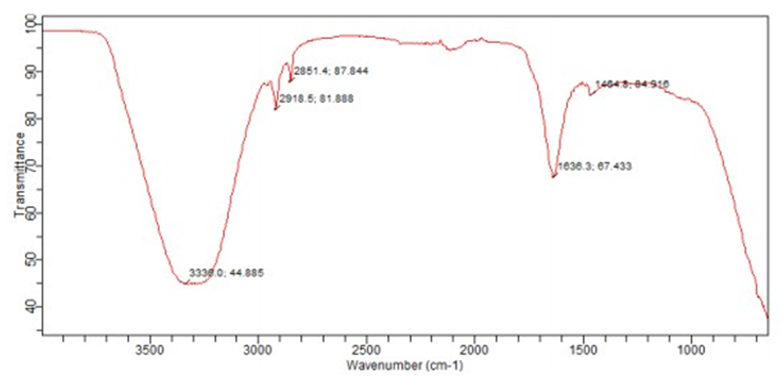
Figure 2 Fourier transform infrared analysis of pure lotion.
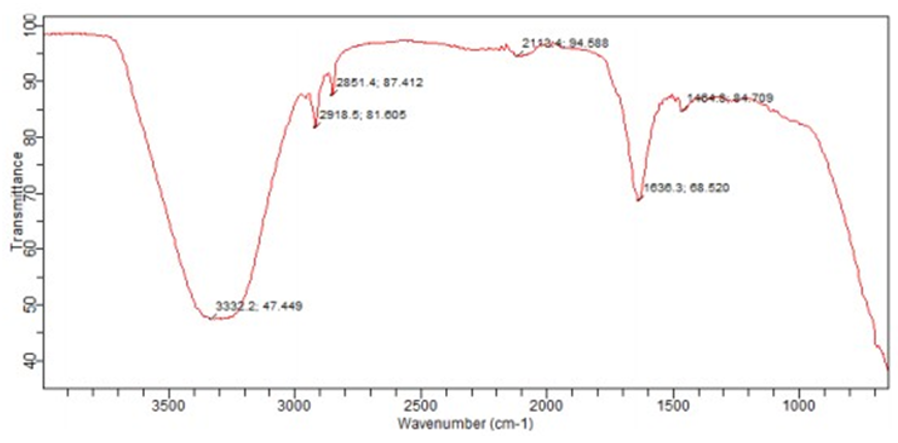
Figure 3 Fourier transform infrared analysis of medicated cream.
FTIR findings: Figure 2 and 3 above present the functional groups in the lotion cream are revealed by the study's FTIR analysis. Ether, phenolic, and aldehyde groups are commonly identified in cosmetic formulations. Crucially, the presence of an extra functional group in the medicated cream suggests that adding turmeric and aloe vera improves both bioactivity and aesthetic qualities.17 Similar investigations have confirmed the incorporation of botanical extracts into creams using FTIR spectroscopy; these extra peaks are indicators of enhanced antioxidant qualities and general product stability.10,18
Based on previous research in cosmetic formulations, the evaluation of the produced cream shows that it satisfies established quality and safety standards. According to the evaluation, the cream's long-term stable physical characteristics such as its steady color, pleasant scent, and smooth texture ensure user acceptance and appropriate ingredient compatibility. The formulation's safety for human skin is supported by safety evaluations such as patch tests and toxicology assessments, which show that it has no negative effects or dermal irritation. Additionally, the presence of functional groups common to cosmetic products and the advantageous incorporation of botanical extracts, as revealed by the FTIR analysis, which offered crucial insights into the cream's chemical profile. Among the formulations F3 produced the best. This strengthens the formulation's overall stability in addition to increasing the product's bioactivity.
None.
None.
Author declares that there are no conflicts of interest.

©2025 Olayinka, et al. This is an open access article distributed under the terms of the, which permits unrestricted use, distribution, and build upon your work non-commercially.