MOJ
eISSN: 2573-2919


Research Article Volume 11 Issue 4
 Ricardo Bemfica Steffen2
1Departamento de Diagnóstico e Pesquisa Agropecuária, Rio Grande do Sul, Brazil
2BioTecRS, Santa Maria, Rio Grande do Sul, Brazil
Correspondence: Gerusa Pauli Kist Steffen, Departamento de Diagnóstico e Pesquisa Agropecuária, Rio Grande do Sul, Brazil
Received: August 22, 2026 | Published: September 2, 2026
Citation: Steffen GPK, Steffen RB. Microbial priming in legumes: Methylobacterium accelerates early growth and biomass partitioning. MOJ Eco Environ Sci. 2026;11(4):140-144. DOI: 10.15406/mojes.2026.11.00394
The use of plant growth-promoting microorganisms has emerged as a sustainable strategy to enhance the early establishment of agricultural crops. In this study, the effect of Methylobacterium sp. (SEMIA 658) on the early growth and biomass partitioning of soybean (Glycine max L.) and common bean (Phaseolus vulgaris L.) plants was evaluated by comparing two inoculation methods: sowing furrow and seed treatment. The experiment was conducted under greenhouse conditions in a completely randomized design, with three treatments and eight replications. At 25 days after emergence, shoot dry mass, root dry mass, and total dry mass were determined, along with biomass allocation indices and the relative gain compared with the control. Inoculation with Methylobacterium sp. promoted significant increases in the early growth of both crops. In soybean, total dry mass nearly doubled in the inoculated treatments, regardless of the application method. In common bean, a progressive increase in total biomass was observed, with a greater response in the seed treatment, associated with an increase in the fraction of biomass allocated to roots. The results indicate that Methylobacterium sp. (SEMIA 658) acts as a promoter of early plant growth by modulating both biomass accumulation and allocation, with responses dependent on crop species and inoculation strategy. These findings reinforce the potential of this microorganism as a bio-input for efficient and sustainable agricultural systems, particularly during the crop establishment phase.
Keywords: methylotrophs microorganisms, biological inputs, Glycine max., Phaseolus vulgaris, plant growth promoter
The growing concern about reducing the damage and negative impacts of conventional agriculture on the environment has driven the search for more sustainable management strategies. Although the intensive use of fertilizers and chemical pesticides contributes to increased agricultural productivity, it also causes imbalances in biogeochemical processes within agroecosystems.1 In this context, bio-inputs formulated with multifunctional microorganisms associated with crop cultivation emerge as promising alternatives for promoting the sustainability of agricultural systems, reconciling productive efficiency with environmental conservation.
Microbial bioagents, such as plant growth–promoting rhizobacteria (PGPR), have been widely studied due to their ability to improve plant development through different mechanisms, including the production of phytohormones, nutrient solubilization, biological nitrogen fixation, and the induction of resistance to biotic and abiotic stresses. The careful evaluation of these microorganisms is essential to understand their efficiency, stability, and interaction with different crops and environments, ensuring consistent results in agricultural systems. In this regard, the proper selection and agronomic validation of bioagents are fundamental steps for their large-scale adoption.2,3
Recently, among plant growth–promoting microorganisms, bacteria of the genus Methylobacterium have attracted attention in agricultural research due to their broad association with cultivated plants and their metabolic versatility.4 These methylotrophic bacteria are capable of using single-carbon (C1) compounds released by plants and, in return, contribute to plant growth through the synthesis of auxins, cytokinins, and other bioactive metabolites. Recent studies demonstrate that Methylobacterium sp. has potential as an agricultural bioagent through its ability to solubilize nutrients and produce siderophores and indole-3-acetic acid, promoting increased early plant growth, greater root development, and improved crop establishment—characteristics that are fundamental for efficient and sustainable production systems.4–6 The evaluation of bioagents from the genus Methylobacterium therefore becomes strategic for advancing efficient and sustainable crop management. In addition to contributing to the reduction in the use of chemical inputs, these microorganisms can be integrated into biological management and biofertilization programs, increasing nutrient-use efficiency and plant resilience under adverse climatic conditions. Thus, studies that assess performance, application methods, and crop responses to inoculation with emerging bioagents are essential for consolidating their use in modern agriculture, aligning productivity, sustainability, and environmental safety.7–10
The evaluation of the initial development of cultivated plants of agronomic interest constitutes a fundamental step in the validation of bio-inputs, since early growth and establishment responses reflect the efficiency of plant–microorganism interactions and may indicate the potential for agronomic performance throughout the crop cycle. In legumes such as soybean (Glycine max L.) and common bean (Phaseolus vulgaris L.), microbial colonization in the early stages and its effects on root growth and plant biomass are considered good predictors of the effectiveness of plant growth–promoting microorganisms and other biological inputs, allowing inference of their impacts on overall plant development. In this way, the analysis of initial growth parameters represents a widely adopted approach for the selection and agronomic validation of bioagents, justifying the focus on early developmental stages in this study.2,9
In this context, the objective of this study was to determine the effect of two inoculation methods of Methylobacterium sp. SEMIA 658 on the initial growth and biomass partitioning of soybean and common bean plants.
The experiment was conducted in pots under greenhouse conditions with controlled temperature and humidity at the experimental area of the Department of Agricultural Diagnostics and Research (DDPA), in the municipality of Santa Maria, Rio Grande do Sul State, Brazil. Three treatments were evaluated: one corresponding to the non-inoculated control, and two inoculation methods of Methylobacterium sp. SEMIA 658—via the sowing furrow and via seed treatment—in soybean and common bean crops.
The Methylobacterium sp. strain used in the study was SEMIA 658, belonging to the SEMIA Rhizobia Collection of the Secretariat of Agriculture, Livestock, Sustainable Production and Irrigation (SEAPI/RS/Brazil). To date, no scientific publications have been found presenting agronomic data on the efficiency of the microorganism strain under study, which gives this work an innovative character. In the laboratory, the pure bacterial culture was multiplied in AMS + methanol liquid culture medium, specific for Methylobacterium sp., according to Whittenbury et al.11 For the treatment corresponding to bacterial inoculation via seed treatment, a spore suspension containing 2.5 × 10⁹ spores mL⁻¹ was used, with 4 mL applied per kg of seed shortly before sowing. For the treatment corresponding to inoculation via the furrow, 550 µL of a spore suspension containing 1.25 × 10⁹ spores mL⁻¹ were applied directly into the furrow made alongside the seed, simulating the mechanized sowing process under field conditions.
Untreated soybean seeds (NEO 581E) and black bean seeds of the cultivar Triunfo were used, without chemical pesticide treatment. Each experimental unit consisted of a black plastic pot with a capacity of 2.6 liters, filled with a mixture of sterilized agricultural soil and commercial plant substrate (Agrinobre brand) at a 2:1 ratio. The soil was sterilized in an autoclave for two cycles of 60 minutes at 121 °C and 1 atm pressure. The experimental design adopted was completely randomized, with three treatments and eight replications for each crop (soybean and bean). The pots, each containing a single plant, were kept in a greenhouse with controlled temperature and humidity for 25 days after plant emergence, when the initial growth and development parameters of the crops were determined: shoot dry mass (SDM) and root dry mass (RDM).
Based on the SDM and RDM results from each experimental unit, total dry mass (TDM) was calculated as the sum of the compartments: TDM = SDM + RDM. Subsequently, relative biomass allocation was expressed by the root mass fraction (RMF) and shoot mass fraction (SMF) indices, calculated as RMF = RDM/TDM and SMF = SDM/TDM. These metrics represent, respectively, the proportion of total biomass allocated to the root system and to the shoot, and are recommended for comparisons among treatments because they standardize the effect of plant size. Finally, to quantify the relative gain as a function of the treatments, the treatment response index was estimated based on total biomass, as the proportional change relative to the control:
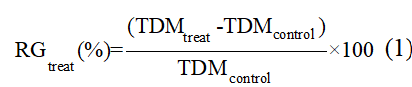
Where: RGTreat (%) refers to the relative gain as a function of the treatments; TDMtreat is the total dry mass of the evaluated treatment; TDMcontrol is the total dry mass in the control treatment.
The data obtained were subjected to analysis of variance, and the means were compared using Tukey’s test at a 5% probability of error with the aid of the SISVAR software.12
The inoculation of Methylobacterium sp. (SEMIA 658) significantly influenced biomass accumulation in soybean and common bean plants at 25 days after emergence. For the soybean crop, both furrow inoculation and seed treatment promoted a significant increase in shoot and root dry mass compared with the control treatment, demonstrating a positive effect of the bacterium on early plant growth. The values of shoot and root dry mass were higher in the inoculated treatments, with no statistical difference between the two application methods, indicating that both were effective in stimulating early vegetative development (Table 1) (Figure 1).
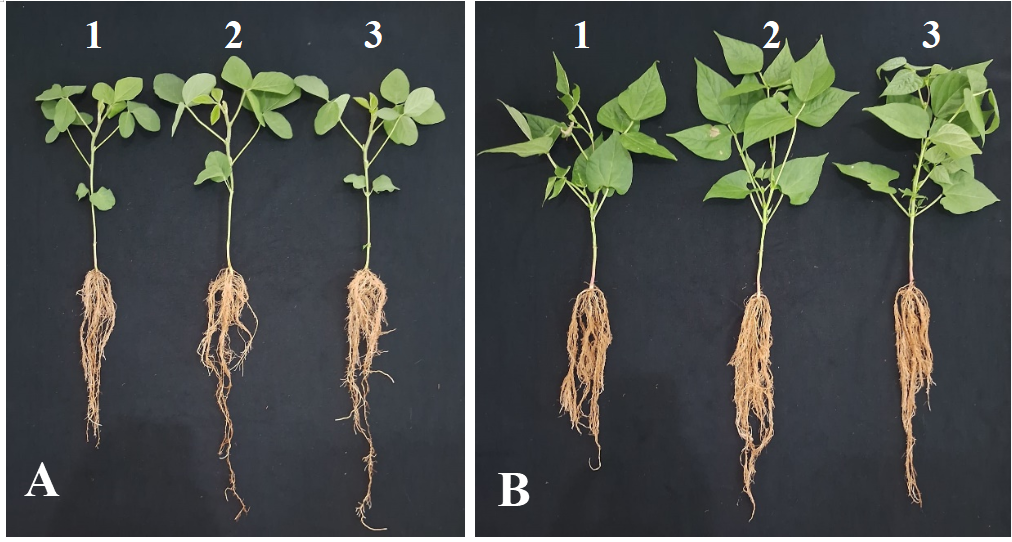
Figure 1 Soybean (A) and common bean (B) plants subjected to control treatments without inoculation (1) and with inoculation of Methylobacterium sp. (SEMIA 658) in the sowing furrow (2) and in seed treatment (3) at 25 days of development after emergence.
|
Treatments |
Soybean |
Common bean |
||
|
SDM (g) |
RDM (g) |
SDM (g) |
RDM (g) |
|
|
Control |
0.765b* |
0.295b |
3.814b |
0.996b |
|
Sowing furrow |
1.462a |
0.546a |
4.177a |
1.337ab |
|
Seed treatment |
1.403a |
0.611a |
4.289a |
1.682a |
|
CV (%) |
23.98 |
9.86 |
3.86 |
16.96 |
Table 1 Shoot dry mass (SDM) and root dry mass (RDM) of soybean and bean plants 25 days after emergence, with different inoculation methods of Methylobacterium sp. (SEMIA 658)
*Means followed by the same letter in the lines do not differ from each other by Tukey’s test at 5% probability. CV= coefficient of variation
Regarding the root dry mass of common bean, the seed treatment showed the highest values, differing significantly from the control, whereas inoculation in the furrow showed intermediate performance, not differing statistically from the other treatments. These results suggest that the direct contact of the bacterium with the seed favored root system development, possibly providing better initial colonization and greater stimulation of root growth (Table 1).
Inoculation with Methylobacterium sp. promoted consistent increases in the total dry mass (TDM) of common bean and soybean plants at 25 days after emergence, with magnitude depending on the method of application (Table 2). In common bean, a gradual increase in TDM was observed compared with the control, with relative gains of 14.6% in the furrow treatment and 24.1% in the seed treatment. These results indicate that inoculation—especially via seeds—favored total biomass accumulation already in the early stages of development, a critical period for defining the crop’s productive potential. In soybean, the effects of inoculation were even more pronounced. TDM nearly doubled in the inoculated treatments, with relative gains close to 90% for both application methods (Table 2).
|
Treatments |
TDM (g) |
RMF |
SMF |
RGtreat (%) |
|
Soybean |
||||
|
Control |
1.060 b* |
0.278 |
0.722 |
Reference |
|
Sowing furrow |
2.008 a |
0.272 |
0.728 |
89.4 |
|
Seed treatment |
2.014 a |
0.303 |
0.697 |
90 |
|
|
Common Bean |
|||
|
Control |
4.810 b |
0.207 |
0.793 |
Reference |
|
Sowing furrow |
5.514 a |
0.242 |
0.758 |
14.6 |
|
Seed treatment |
5.971 a |
0.282 |
0.718 |
24.1 |
|
CV (%) |
17,98 |
- |
- |
- |
Table 2 Total dry mass (TDM), root mass fraction (RMF) and shoot mass fraction (SMF) indices, and relative treatment gain (RGₜᵣₑₐₜ) of soybean and common bean plants at 25 days after emergence, under different inoculation methods of the bacterium Methylobacterium sp. (SEMIA 658
*Means followed by the same letter in the lines do not differ from each other by Tukey’s test at 5% probability. CV= coefficient of variation.
In addition to the increase in TDM, clear changes in biomass allocation patterns were observed with the inoculation of Methylobacterium sp. in both legumes. In common bean, the progressive increase in the root mass fraction (RMF)—from 0.207 in the control to 0.282 in the seed treatment—accompanied by the corresponding reduction in the shoot mass fraction (SMF), suggests that inoculation relatively stimulated root growth more strongly in bean. The analysis of the percentage of relative gain among treatments highlighted the superiority of the seed treatment, especially in common bean. In soybean, RMF values remained relatively stable between the control and the furrow application, with a more evident increase only in the seed treatment (Table 2). These data highlight the importance of early microbial colonization of soybean and common bean roots by Methylobacterium sp. to promote early plant growth, with likely positive effects on stress mitigation and productivity gains throughout the crop cycle.
Overall, the results indicate that inoculation with Methylobacterium sp. (SEMIA 658) favored the early growth of soybean and common bean plants, with particular emphasis on the seed treatment in stimulating root development in bean. This behavior confirms the potential of species of the genus Methylobacterium as plant growth–promoting bacteria, especially during the early stages of development—a critical phase for crop establishment and the definition of productive potential.5,13
The increase in shoot biomass observed in both crops may be related to the ability of Methylobacterium sp. to produce phytohormones, such as auxins and cytokinins, in addition to modulating carbon metabolism through the use of methylated compounds released by plants. These mechanisms favor cell expansion, increased leaf area, and, consequently, greater photosynthetic efficiency, resulting in higher biomass accumulation.4,6,14,15 The absence of differences between inoculation methods for shoot dry mass suggests that the bacterium was able to efficiently colonize the rhizosphere and/or plant tissues regardless of the application strategy.
The more pronounced effect of the seed treatment on root dry mass in common bean indicates that the direct contact between the bacterium and the seed favored early colonization of the root system, promoting stronger stimulation of root growth. Scientific literature points out that initial microbial colonization is decisive for the success of plant–microorganism interactions, especially in crops sensitive during early stages, such as bean, whose root system responds rapidly to hormonal and nutritional stimuli.16,17 A more robust root development increases the capacity for water and nutrient absorption, conferring greater plant vigor and resilience during periods of water and thermal stress.
In soybean, the absence of differences between inoculation methods suggests greater crop plasticity regarding the mode of bacterial application, whereas in bean the root system response was more sensitive to the inoculation strategy adopted. This behavior may be associated with soybean’s high capacity to establish beneficial interactions with microorganisms. Studies indicate that Methylobacterium sp. may act in a complementary manner to the microbiota associated with soybean, enhancing early growth without strongly depending on the inoculation method.18
Inoculation with Methylobacterium sp. produced marked effects on soybean plant development, with relative gains close to 90% for both furrow application and seed treatment. These results indicate a high responsiveness of soybean to inoculation with Methylobacterium sp. (SEMIA 658), possibly associated with the greater affinity of this crop for beneficial microbial interactions in the rhizosphere and the rapid colonization of roots during the initial growth phase. Recent studies demonstrate that early microbial colonization is decisive for the success of plant–microorganism interactions, as it provides lasting benefits to plant metabolism, increases nutrient-use efficiency, and enhances stress tolerance.17,19
Unlike what was observed in common bean, soybean showed relatively stable RMF values between the control and the furrow application, with a more evident increase only in the seed treatment (RMF = 0.303). This result suggests that, although total growth was strongly stimulated, relative biomass allocation was less altered, indicating more proportional growth between shoots and roots. According to plant allometry theory, responses of this type are typical of plants growing under favorable resource conditions, in which biomass increases without major deviations in relative allocation.20,21
Methylobacterium sp. (SEMIA 658) increased root growth in both legume species, with expressive gains in total dry mass (TDM) values. Clear changes in biomass allocation patterns were observed in the treatments with microbial inoculation in both soybean and common bean (Table 2). This pattern is consistent with the functional role attributed to plant growth–promoting rhizobacteria (PGPR), which often stimulate root system expansion, increasing the plant’s capacity to explore the soil and absorb water and nutrients.20,22 In particular, species of the genus Methylobacterium are recognized for their early colonization of the rhizosphere and endosphere and for producing phytohormones such as auxins, capable of modulating root architecture.13,23
Overall, the results of this study reinforce that Methylobacterium sp. (SEMIA 658) shows high potential as an emerging bio-input for soybean and common bean, promoting consistent gains in early plant growth. The greater response of the bean root system to seed treatment indicates that the choice of inoculation method may be decisive for maximizing the benefits of the bacterium, depending on the crop. Direct application to the seed increases the likelihood of immediate contact between the microorganism and the emerging root, favoring bacterial establishment before competition with the native soil microbiota. This factor has been identified as crucial for maximizing the beneficial effects of inoculated microorganisms, especially in intensive agricultural systems.19,24
The findings of this study contribute to advancing the use of plant growth–promoting microorganisms in sustainable agricultural systems aligned with reducing the use of chemical inputs and increasing productive efficiency, especially in soybean and common bean crops. Despite the scientific evidence of the positive effects of inoculation with Methylobacterium sp. (SEMIA 658) on the early growth of soybean and bean, it is important to consider some limitations of the present study. The experiment was conducted over a short period and under controlled greenhouse conditions, which reduces the complexity of plant–microorganism interactions and does not allow direct extrapolation to agronomic performance under field conditions or throughout the entire crop cycle.
Even so, it is noteworthy that the strain Methylobacterium sp. SEMIA 658 currently has no scientific reports of evaluation in legumes, which gives this work an innovative character by demonstrating, for the first time, its potential as a growth promoter in these crops. As future perspectives, field studies under different cultivars and under abiotic stresses (for example, water deficit and nutrient limitations) are necessary to verify the stability and magnitude of the observed effects, as well as to elucidate the interaction of the strain with native microbiota and its possible impacts on agronomic performance at more advanced phenological stages.
Inoculation with Methylobacterium sp. (SEMIA 658) markedly enhanced early biomass accumulation and biomass partitioning in both soybean and common bean, demonstrating strong potential as a multifunctional plant growth–promoting bacterium for crop establishment. In soybean, total dry mass increased from 1.06 g in the control to approximately 2.01 g in inoculated plants, corresponding to gains close to 90% regardless of the application method. These increases were driven by the simultaneous stimulation of shoot biomass (up to 1.462 g vs. 0.765 g in the control) and root biomass (up to 0.611 g vs. 0.295 g), indicating a robust and coordinated growth response.
In common bean, inoculation also promoted significant gains in early development, with total dry mass rising from 4.81 g in the control to 5.97 g under seed treatment (24.1% increase). Root dry mass increased from 0.996 g to 1.682 g, accompanied by a shift in biomass allocation toward roots (root mass fraction from 0.207 to 0.282), suggesting enhanced belowground investment and improved resource acquisition potential.
Responses were crop-dependent with respect to the inoculation strategy. Seed treatment maximized root stimulation in common bean, highlighting the importance of early root colonization for optimizing plant–microbe interactions, whereas soybean showed equivalent responses to both application methods, indicating greater physiological plasticity and operational flexibility.
Collectively, the magnitude and consistency of the responses—particularly the near doubling of soybean biomass and the pronounced increase in root allocation in common bean—underscore the relevance of Methylobacterium sp. (SEMIA 658) as a promising microbial input for agriculture. Field validation and long-term assessments across developmental stages are now required to determine the persistence of these effects and their translation into yield gains under production conditions.
The authors thank the Agricultural Microbiology Laboratory of the Secretariat of Agriculture, Livestock, Sustainable Production and Irrigation (SEAPI) of Rio Grande do Sul State, Brazil, for providing the Methylobacterium sp. SEMIA 658 strain for this study.
None.
The authors declare no conflict of interest

©2026 Steffen, et al. This is an open access article distributed under the terms of the, which permits unrestricted use, distribution, and build upon your work non-commercially.
