MOJ
eISSN: 2573-2919


Research Article Volume 11 Issue 1

Department of Radiation Oncology, Faculty of Medicine, and Department of Physics, Faculty of Science, Akdeniz University, Turkey
Correspondence: Nina Tunçel, Department of Radiation Oncology, Faculty of Medicine, and Department of Physics, Faculty of Science, Akdeniz University, Antalya, Turkey
Received: January 31, 2026 | Published: February 11, 2026
Citation: Tunçel N. Global Atlas of Natural background radiation: ecological and environmental perspectives. MOJ Eco Environ Sci. 2026;11(1):19-21. DOI: 10.15406/mojes.2026.11.00375
Natural background radiation (NBR) constitutes the dominant source of ionizing radiation exposure for humans and non-human biota worldwide. Its magnitude and composition vary significantly with geological structure, altitude, latitude, and environmental conditions. This review synthesizes global data on cosmic radiation, terrestrial gamma radiation, radon and thoron inhalation, and internal exposure pathways within an atlas-based framework, emphasizing ecological and environmental implications. Using internationally recognized datasets, global and regional exposure patterns are evaluated alongside high background radiation areas (HBRAs), which provide natural laboratories for studying chronic low-dose radiation effects. Although the global mean annual effective dose from natural sources is approximately 2.4 mSv, substantial spatial heterogeneity exists, driven primarily by radon and naturally occurring radionuclides in specific geological settings. From an ecological biology perspective, long-term exposure to natural radiation represents a persistent environmental stressor shaping evolutionary adaptation, ecosystem resilience, and baseline radiological conditions for environmental protection frameworks.
Keywords: natural background radiation; environmental radioactivity, ecological radiation, radon, terrestrial gamma radiation, high background radiation areas
Ionizing radiation is an intrinsic component of the natural environment and has been present since the formation of the Earth. Natural background radiation provides the baseline exposure level for all organisms and represents the reference against which anthropogenic radiation sources are evaluated. In ecological and environmental sciences, understanding this baseline is essential for interpreting biological responses to radiation, assessing ecosystem-level impacts, and establishing environmentally relevant protection criteria.
Natural background radiation arises from a combination of cosmic radiation, terrestrial radionuclides, airborne radioactive gases, and radionuclides incorporated into biological systems through food and water. Unlike artificial sources, these components exhibit strong spatial heterogeneity governed by geology, altitude, climate, and land use. Consequently, populations and ecosystems are exposed to markedly different radiation environments across the globe.
This review presents a global atlas–oriented synthesis of natural background radiation tailored to the scope of MedCrave Ecology & Environmental Sciences. Emphasis is placed on spatial variability, dominant exposure pathways, and ecological biology considerations, integrating human and non-human exposure perspectives. Figure 1 provides a visual framework for understanding global exposure heterogeneity and contextualizes subsequent discussions of uncertainty and interpretation.
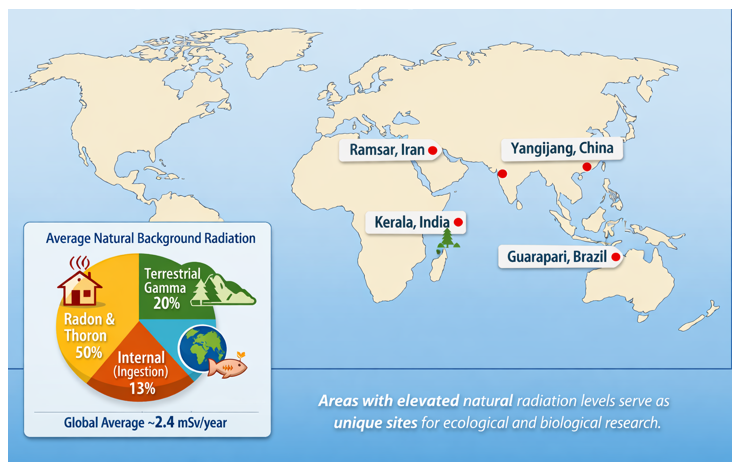
Figure 1 The global distribution of high background radiation areas (HBRAs) and the average contribution of natural background radiation to the annual effective dose.
Data sources
The atlas-based synthesis draws upon publicly available and peer-reviewed international datasets, including reports from the United Nations Scientific Committee on the Effects of Atomic Radiation (UNSCEAR), the International Atomic Energy Agency (IAEA), the World Health Organization (WHO), and national environmental radiation monitoring programs. Geological and soil radionuclide datasets were incorporated to contextualize terrestrial radiation patterns.
Dose assessment framework
Absorbed dose rates and effective doses were evaluated using internationally accepted methodologies. Conversion coefficients recommended by UNSCEAR and the International Commission on Radiological Protection (ICRP) were applied to relate environmental dose rates to effective dose for humans. Ecological dose considerations were discussed qualitatively with reference to established biota exposure models, recognizing current limitations in ecological dose–response characterization.
Cosmic radiation
Cosmic radiation originates from high-energy particles of galactic and solar origin interacting with the Earth’s atmosphere, producing secondary radiation fields. As reflected in the global patterns summarized in Figure 1, cosmic radiation intensity increases with altitude and geomagnetic latitude due to reduced atmospheric shielding and magnetic field effects.
At sea level, cosmic radiation contributes approximately 0.3–0.4 mSv y⁻¹ to the annual effective dose, while high-altitude regions may experience values exceeding 1 mSv y⁻¹. Ecologically, cosmic radiation represents a broad-scale, altitude-dependent exposure influencing alpine and highland ecosystems and contributing to baseline mutation rates in biota.
Terrestrial gamma radiation
Terrestrial gamma radiation arises from primordial radionuclides embedded in the Earth’s crust, primarily uranium-238, thorium-232 decay series radionuclides, and potassium-40. Their concentrations depend strongly on lithology, with granitic, volcanic, and phosphate-rich formations exhibiting elevated activity concentrations.
Global outdoor absorbed dose rates typically range from 20 to 200 nGy h⁻¹, with a world average of approximately 60 nGy h⁻¹. As illustrated schematically in Figure 1, regions characterized by such geological formations contribute disproportionately to elevated background dose levels. Continuous exposure of soil-dwelling organisms, plants, and microorganisms to terrestrial gamma radiation may influence long-term genetic diversity and adaptive responses in natural populations.
Radon and thoron exposure
Radon-222 and thoron-220 are gaseous decay products of uranium and thorium series radionuclides, respectively, and represent the largest contributors to natural radiation exposure. The dominance of radon in the global effective dose budget is reflected in the inset summary of Figure 1.
Indoor radon concentrations vary widely depending on soil permeability, radionuclide content, building materials, and ventilation practices. The global average annual effective dose from radon exposure is estimated at approximately 1.2 mSv, though values exceeding 10 mSv y⁻¹ have been documented in high-radon environments. Ecologically, radon contributes to radiation exposure in subterranean habitats, caves, and enclosed ecosystems, affecting both human and non-human organisms residing in these environments.
Internal exposure from ingestion
Internal exposure results from ingestion of naturally occurring radionuclides in food and drinking water. Potassium-40 constitutes the dominant contributor, while lead-210 and polonium-210 may contribute notably in specific dietary patterns, particularly those rich in marine products.
The average annual effective dose from ingestion is approximately 0.3 mSv and exhibits relatively limited geographical variability. In ecological systems, internal radionuclide uptake reflects biogeochemical cycling and provides insight into radionuclide transfer within food webs, as conceptually linked to the global exposure balance depicted in Figure 1.
Global distribution and high background radiation areas
Natural background radiation levels vary substantially on global and regional scales, as shown in Figure 1. Asia hosts several well-characterized high background radiation areas (HBRAs), including regions in India, Iran, and China, while additional HBRAs occur in South America and parts of Africa. These regions are associated with thorium-bearing monazite sands, granitic formations, or radium-rich geothermal waters.
Figure 1 illustrates both the spatial clustering of HBRAs and their embedding within broader regions of near-average background radiation. These areas provide natural laboratories for studying long-term, low-dose radiation exposure in human populations and ecosystems. Epidemiological and ecological studies conducted in such regions have generally not demonstrated consistent adverse effects at moderately elevated dose levels, although uncertainties persist at higher localized exposures.
Beyond visualizing exposure variability, Figure 1 provides a conceptual framework for interpreting the scientific debates and uncertainties associated with chronic low-dose natural radiation.
Scientific controversies in low-dose natural radiation research
As illustrated in Figure 1, the pronounced spatial heterogeneity of natural background radiation underpins ongoing scientific controversy regarding the biological significance of chronic low-dose exposure and the applicability of the linear no-threshold (LNT) model at environmental dose levels. While the LNT model remains foundational for radiological protection, observations from populations and ecosystems residing in the elevated-dose regions highlighted in Figure 1 have prompted debate over potential non-linear dose–response relationships, including adaptive or hormetic responses.
However, the lack of consistent adverse effects across the diverse HBRAs shown in Figure 1 does not constitute definitive evidence against the LNT framework. Rather, it reflects the complexity of interpreting low-dose radiation effects where exposure gradients overlap with geological, climatic, and ecological variability. From an ecological standpoint, these controversies extend beyond human health risk to questions of evolutionary adaptation and ecosystem resilience, which remain unresolved.
Epistemological uncertainties in interpreting natural radiation effects
The global exposure patterns shown in Figure 1 highlight key epistemological uncertainties inherent in natural radiation research. Exposure conditions in HBRAs are not experimentally controlled but arise from complex interactions between geology, altitude, soil composition, and land use. Consequently, the mapped regions represent composite radiation environments rather than isolated exposure variables, complicating causal inference.
Furthermore, translating the dose ranges illustrated in Figure 1 into biologically meaningful metrics introduces additional uncertainty. Dose estimates rely on conversion coefficients and exposure models that may not fully capture organism-specific behavior or internal radionuclide uptake, particularly for non-human biota. Thus, Figure 1 also illustrates the limits of knowledge when interpreting subtle biological effects at natural background dose levels.
Limitations of classical epidemiological approaches in HBRAs
The HBRA regions identified in Figure 1 have long served as focal points for epidemiological investigation; however, classical epidemiological approaches face intrinsic limitations in these settings. Many of the highlighted regions correspond to geographically restricted populations, limiting statistical power, particularly when expected effect sizes are small relative to biological variability.
Additionally, Figure 1 emphasizes that elevated radiation exposure often coexists with distinctive geological and environmental characteristics that may confound epidemiological analyses. Lifestyle, dietary patterns, and socioeconomic conditions vary across these regions, complicating efforts to isolate radiation as a single explanatory variable. Consequently, largely null or inconclusive findings should be interpreted in light of these methodological constraints rather than as definitive evidence of biological neutrality.
Ecological implications
Natural background radiation represents a chronic environmental stressor that has influenced biological evolution over geological timescales. Organisms inhabiting high-radiation environments may exhibit adaptive responses, including enhanced DNA repair capacity and altered life-history traits. Understanding these responses is essential for developing ecologically relevant radiation protection frameworks that extend beyond human-centric dose limits and reflect the spatial exposure patterns illustrated in Figure 1.
Limitations
The atlas-based approach is subject to uncertainties arising from spatial heterogeneity, temporal variability in radon concentrations, and differences in measurement methodologies across regions. Furthermore, the detection of subtle biological or ecological effects associated with natural background radiation is constrained by the inherent limitations of observational epidemiology at low dose rates, necessitating complementary ecological and mechanistic research approaches.1–8
This review provides a comprehensive, atlas-oriented synthesis of global natural background radiation with explicit consideration of spatial variability, scientific uncertainty, and ecological relevance. As illustrated in Figure 1, natural radiation remains the dominant contributor to radiation exposure worldwide and constitutes a fundamental reference baseline for environmental radiation protection, ecological risk assessment, and low-dose radiation research.
The author acknowledges international scientific organizations for maintaining open-access environmental radiation datasets that support global comparative analyses.
None.
The authors declare no competing interests.

©2026 Tunçel. This is an open access article distributed under the terms of the, which permits unrestricted use, distribution, and build upon your work non-commercially.
