MOJ
eISSN: 2573-2919


Research Article Volume 11 Issue 5
 Gerusa Pauli Kist Steffen2
1BioTecRS, Santa Maria, Rio Grande do Sul, Brazil
2Departamento de Diagnóstico e Pesquisa Agropecuária, Rio Grande do Sul, Brazil
Correspondence: Ricardo Bemfica Steffen, BioTecRS, Santa Maria, Rio Grande do Sul, Brazil
Received: September 11, 2026 | Published: September 25, 2026
Citation: Steffen RB, Steffen GPK. From soil redox state to electrical spectral signatures: Integrating bioelectrochemistry and enzyme activity to discriminate coffee management systems. MOJ Eco Environ Sci. 2026;11(5):154-159. DOI: 10.15406/mojes.2026.11.00397
Soil biological functioning emerges from tightly coupled biochemical, electrochemical and transport processes, yet these dimensions are commonly assessed separately. This study evaluated whether redox potential, soil enzyme activities and spontaneous electrical spectral signatures provide convergent information for distinguishing contrasting management systems in a coffee farm located in the southeastern region of Brazil. Conventional management was compared with management incorporating Penergetic Technology within a broader regenerative program. Soil oxidation–reduction potential was measured in situ and normalized to pH 7 (Eh₇), while arylsulfatase and β-glucosidase activities were quantified as indicators of sulfur and carbon cycling. In a complementary exploratory assay, spontaneous electrical signals from soil samples were acquired under electromagnetic shielding, transformed to the frequency domain and screened against instrumental background noise. Management incorporating Penergetic was associated with a lower Eh₇ (345.4 to 251.9 mV; −27.1%), higher arylsulfatase activity (45.2 to 83.8 µg pNP g⁻¹ soil h⁻¹; +85.4%) and higher β-glucosidase activity (46.6 to 68.7 µg pNP g⁻¹ soil h⁻¹; +47.4%). The electrical spectra also differed: 16 identifiable peaks spanning 1.8–942.5 Hz were detected under conventional management, compared with 20 peaks spanning 1.3–1778.3 Hz under Penergetic management. Taken together, the results reveal a consistent differentiation of the two soils across biochemical, redox and electrical domains. The findings support the hypothesis that management-induced changes in soil biological functioning and redox processes can coexist with measurable changes in electrical behavior. Because the spectral analysis was exploratory and individual frequencies were not assigned to specific biological or physicochemical processes, the spectral features should be regarded as candidate markers requiring independent replication and mechanistic validation. The integrated framework nevertheless provides a testable basis for developing soil bioelectrochemical and spectral measurements as complementary indicators of soil functional status.
Keywords: soil health, redox potential, Eh₇, β-glucosidase, arylsulfatase, extracellular electron transfer
Soil is a heterogeneous, biologically active electrochemical matrix in which roots, microorganisms, organic matter, minerals, water, gases and dissolved ions interact continuously. These interactions regulate nutrient cycling, organic matter turnover, aggregation, root development and plant performance.1 Accordingly, soil quality cannot be fully described by a single chemical, physical or biological variable; complementary indicators are needed to capture both biological function and the physicochemical environment in which that function occurs.2
Soil enzymes are among the most responsive biochemical indicators of management-induced change. β-glucosidase participates in the terminal steps of cellulose degradation and is closely associated with carbon cycling, whereas arylsulfatase catalyzes reactions involved in the mineralization of organically bound sulfur. Their activities therefore provide functional information on organic matter transformation and nutrient cycling. In parallel, oxidation–reduction potential (Eh) integrates the balance between oxidants, reductants and electron-transfer reactions. Because Eh is pH dependent, normalization to pH 7 (Eh₇) improves comparison among soils differing in acidity. Redox measurements have increasingly been proposed as complementary indicators of soil health because they respond to microbial activity, oxygen supply, organic substrates, water status and soil structure.3–9
Recent advances in soil bioelectrochemistry extend this framework from redox state to measurable electrical responses. Microbial metabolism and extracellular electron transfer can couple carbon, nitrogen, sulfur and iron transformations to charge transfer and ionic transport in soils.2,10 Electrochemical signals have recently been shown to distinguish soils differing in health status, providing direct evidence that biologically relevant differences can be captured electrically.11 Root-driven redox oscillations can also reorganize nutrient availability and rhizosphere chemistry, illustrating the dynamic coupling among biological activity, electron flow and biogeochemical cycling.12,13
Electrical measurements may therefore offer a complementary window into soil functional state. Water content, ionic concentration and mobility, organic matter, mineral surfaces, microbial activity and oxidation–reduction reactions can all influence conductivity, interfacial polarization and other electrical properties.14 However, while soil electrical conductivity and electrode-based electrochemical responses are increasingly studied, the use of spontaneous soil electrical signals in the frequency domain as candidate indicators of soil functional status remains comparatively unexplored. A critical distinction is therefore required: differences in spectral structure can be measured empirically, but individual frequency peaks should not be assigned a biological, chemical or physical origin without targeted validation.
The coffee farm in study located in São Paulo State, Brazil, has undergone a gradual transition since 2019 from conventional management toward an integrated regenerative production system incorporating composting, service crops, beneficial microorganisms, less intensive fertilization practices, biological crop protection and soil bioactivation technologies. Within this program, Penergetic technology is used as one component of the management system. Previous monitoring indicated differences in soil biological indicators between management zones, motivating a combined assessment of biochemical, redox and electrical responses.
We hypothesized that soils under contrasting management would show convergent differences in
The objective was therefore to integrate Eh₇, arylsulfatase, β-glucosidase and exploratory electrical spectral analysis to determine whether these independent measurement domains consistently discriminate conventional management from management incorporating Penergetic Technology in a coffee production system
Study site and management systems
The study was conducted in a Coffea arabica production area subjected to skeleton pruning at a coffee farm located in São Paulo State, Brazil. Two management conditions were compared: conventional management used by the farm (Conventional management) and management incorporating Penergetic technology within the farm's broader regenerative program (Management with Penergetic). The conventional management system included regenerative agricultural practices, such as the use of cover crops, organomineral fertilization, and the application of microbial-based bioproducts. The Penergetic management system followed the same regenerative practices, with the additional application of Penergetic Soil at 2.0 kg ha⁻¹ before the onset of the coffee production cycle and Penergetic Plant at a total rate of 1.0 kg ha⁻¹, split between the pre-flowering and early fruit-set stages.
Soil redox potential and pH normalization
Soil pH and oxidation–reduction potential (ORP) were measured in situ in the soil near coffee plants. ORP measurements were obtained with a Mettler Toledo instrument equipped with an Ag/AgCl electrode. Ten measurements per treatment were reported in the source protocol. ORP values were normalized to pH 7 at a reference temperature of 25 °C to obtain Eh₇, thereby reducing the confounding effect of differences in soil pH. Eh₇ data were subjected to analysis of variance (ANOVA), and treatment means were compared by Tukey's test at the 5% significance level (Figure 1).
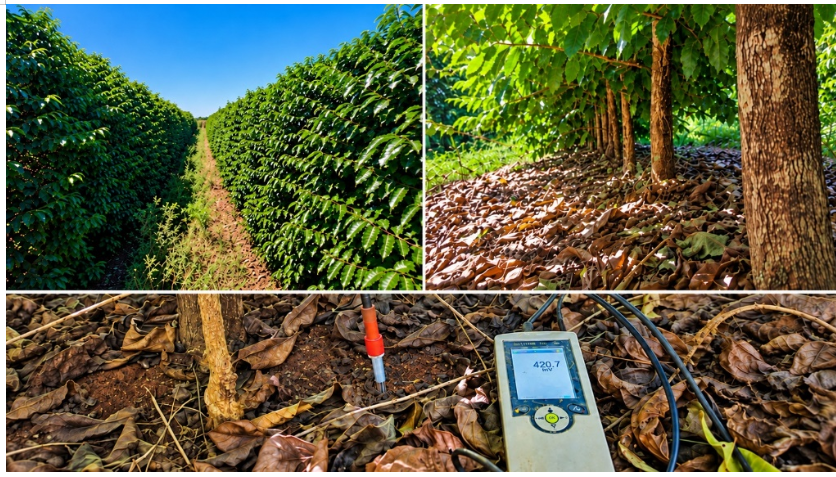
Figure 1 In situ assessment of soil redox potential in a skeleton-pruned coffee plantation under contrasting management systems in São Paulo State, Brazil.
Soil enzyme activities
Arylsulfatase and β-glucosidase activities were determined as indicators of soil biochemical functioning. Enzyme activities were measured according to Tabatabai,16 using p-nitrophenol (pNP) release as the analytical endpoint. Results were expressed as µg pNP g⁻¹ soil h⁻¹. Treatment effects were statistically compared using ANOVA followed by Tukey's test at the 5% significance level, as reported in the original dataset.
Acquisition and spectral analysis of spontaneous soil electrical signals
Soil samples from the same contrasting management conditions were used for exploratory electrical spectral characterization. Each sample was placed in contact with aluminum conductive material and positioned inside a Faraday enclosure to reduce external electromagnetic interference. The conductive material was connected to an amplification system and subsequently to a computer for signal acquisition. Recorded signals were analyzed in the frequency domain using spectral-analysis software to identify frequency components and their corresponding amplitude peaks (Figure 2).
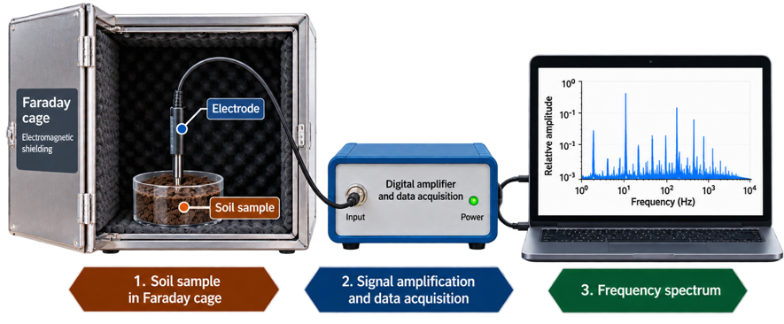
Figure 2 Graphical representation of the experimental setup for acquisition and frequency-domain analysis of spontaneous soil electrical signal.
A background measurement was acquired using the aluminum system without soil in order to characterize instrumental noise. During processing, peaks coincident with or attributable to this background were excluded. The remaining peaks were treated as candidate components of the soil electrical spectral signature. The treatments were compared descriptively for the total number of identifiable peaks, their frequency distribution and the maximum detected frequency. Because this component of the study was exploratory, no specific biological, chemical or physical origin was assigned to individual frequencies.
Integrated analytical framework
The four measurement domains were interpreted jointly but conservatively. Eh₇ was considered an indicator of the soil electrochemical environment; arylsulfatase and β-glucosidase represented biochemical functions related to sulfur and carbon cycling; and the frequency-domain measurements represented exploratory electrical descriptors. Convergence among these independent responses was evaluated as evidence of management-associated differentiation of soil functional state. No causal relationship between enzyme activity, Eh₇ and individual spectral peaks was assumed.
Soil redox potential
The management system had a significant effect on redox potential normalized to pH 7 (Eh₇). Conventional management exhibited a mean Eh₇ of 345.4 mV, whereas the Penergetic-managed system exhibited a mean Eh₇ of 251.9 mV, resulting in a difference of ΔEh₇ = −93.5 mV (Figure 3). This change corresponds to an approximately 27.1% reduction in Eh₇ compared with conventional management. The soil under Penergetic management therefore exhibited a significantly less oxidizing environment than that observed under conventional management.
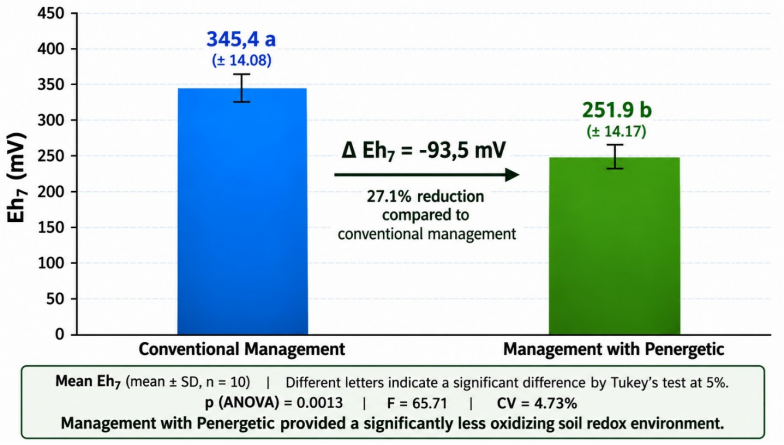
Figure 3 Soil redox potential normalized to pH 7 (Eh₇) in a skeleton-pruned coffee plantation under conventional management and management with Penergetic technology.
From an agronomic perspective, the lower Eh₇ observed under management with Penergetic indicates a shift toward a less oxidizing soil environment relative to conventional management. Within the range recorded in this study, this change represents a modification of the soil electrochemical conditions under which microbial metabolism, organic matter transformations and nutrient cycling occur. Importantly, the observed decrease should not be interpreted as evidence of strongly reducing or anaerobic conditions, but rather as a relative shift in redox status between the management systems. Thus, the Eh₇ response indicates that the incorporation of Penergetic into the regenerative management program was associated with a distinct soil electrochemical environment potentially more conducive to biologically mediated transformations and dynamic nutrient cycling.
Arylsulfatase activity
Arylsulfatase activity showed a marked response to the management system. Under conventional management, enzyme activity was 45.2 µg pNP g⁻¹ soil h⁻¹, whereas under Penergetic management it reached 83.8 µg pNP g⁻¹ soil h⁻¹ (Figure 4). The difference between treatments was Δ = +38.6 µg pNP g⁻¹ soil h⁻¹, corresponding to an 85.4% increase under Penergetic management. The treatments differed significantly according to Tukey's test at the 5% significance level.
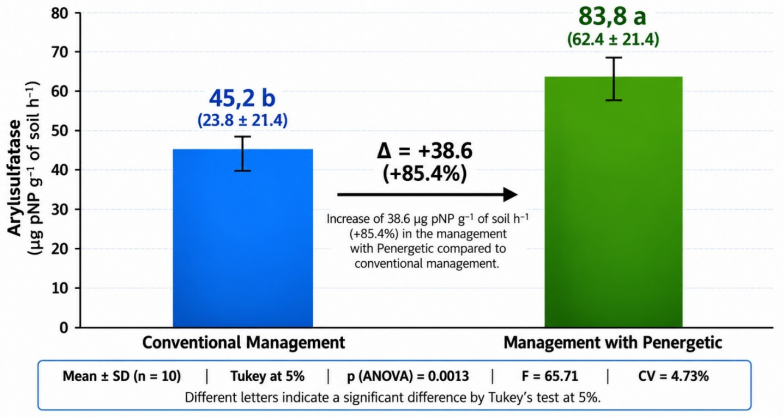
Figure 4 Arylsulfatase activity in soil from a skeleton-pruned coffee plantation under conventional management and management with Penergetic technology.
The marked increase in arylsulfatase activity under management with Penergetic indicates a greater biochemical potential for the transformation of organically bound sulfur in the soil. Because arylsulfatase participates in the hydrolysis of sulfate esters present in soil organic matter, higher activity reflects enhanced functioning of an enzymatic pathway directly involved in sulfur cycling. Agronomically, this response suggests a more active biological component of the soil S cycle and a greater potential for converting organic S pools into forms that can subsequently contribute to plant-available sulfur.
The magnitude of the response therefore indicates that the management-associated effect extended beyond the soil electrochemical environment and was also expressed in a specific biochemical function relevant to nutrient cycling.
β-glucosidase activity
A similar response was observed for β-glucosidase activity. Under conventional management, enzyme activity was 46.6 µg pNP g⁻¹ soil h⁻¹, whereas under Penergetic management it reached 68.7 µg pNP g⁻¹ soil h⁻¹ (Figure 5). The absolute increase was Δ = +22.1 µg pNP g⁻¹ soil h⁻¹, corresponding to a 47.4% increase compared with conventional management. The difference between treatments was statistically significant according to Tukey's test at the 5% significance level.
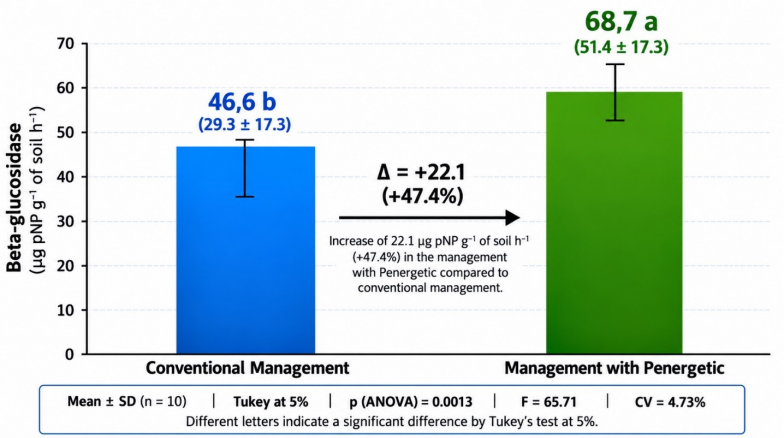
Figure 5 β-glucosidase activity in soil from a skeleton-pruned coffee plantation under conventional management and management with Penergetic technology.
The higher β-glucosidase activity under management with Penergetic indicates enhanced biochemical potential for the decomposition and transformation of cellulose-derived organic carbon. As β-glucosidase catalyzes a key terminal step in cellulose degradation, its activity is closely associated with the biological processing of plant-derived organic residues and soil carbon cycling. From an agronomic perspective, the observed increase suggests a more functionally active soil environment for organic matter turnover and microbial utilization of carbon substrates, processes that underpin nutrient recycling and the maintenance of soil biological functioning. Together with the arylsulfatase response, this result demonstrates that the management-associated changes encompassed enzymatic processes linked to two distinct biogeochemical cycles, providing complementary evidence of differences in soil biochemical functioning between the management systems.
Electrical spectral signatures
The electrical spectra differed between the two management systems after exclusion of components attributable to experimental background noise. Sixteen identifiable peaks were detected in the Conventional soil, distributed from 1.8 to 942.5 Hz, whereas 20 peaks were detected in the Penergetic soil, spanning 1.3 to 1778.3 Hz (Figure 6). Thus, the Penergetic sample contained 25% more identifiable spectral components and extended to a substantially higher maximum detected frequency. In particular, the upper portion of the Penergetic series included components at 631.0, 890.1, 1258.9 and 1778.3 Hz.
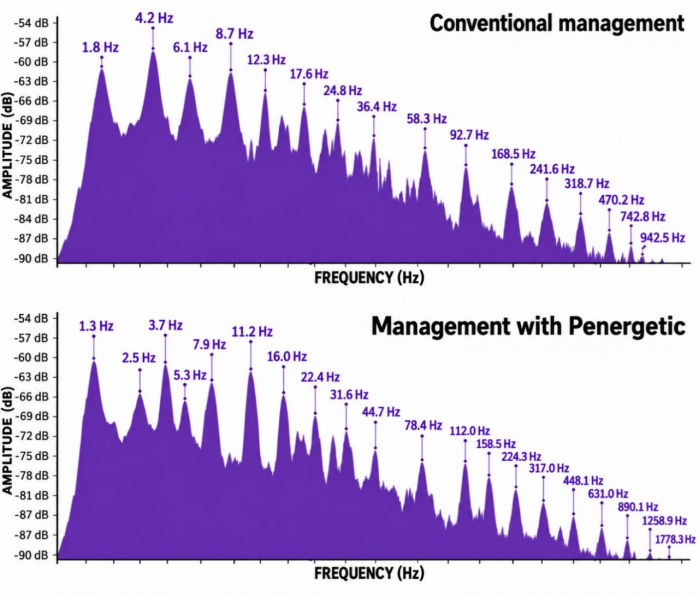
Figure 6 Frequency-domain representation of spontaneous soil electrical signals under conventional management (upper panel) and management with Penergetic technology (lower panel), after screening against instrumental background noise.
The broader spectral distribution observed under management with Penergetic, characterized by 20 identifiable peaks compared with 16 under conventional management and by the extension of detectable components from 942.5 to 1778.3 Hz, suggests a more complex electrical response of the soil matrix under the experimental conditions (Table 1).
|
No. |
Conventional management (Hz) |
Management with Penergetic (Hz) |
|
1 |
1.8 |
1.3 |
|
2 |
4.2 |
2.5 |
|
3 |
6.1 |
3.7 |
|
4 |
8.7 |
5.3 |
|
5 |
12.3 |
7.9 |
|
6 |
17.6 |
11.2 |
|
7 |
24.8 |
16 |
|
8 |
36.4 |
22.4 |
|
9 |
58.3 |
31.6 |
|
10 |
92.7 |
44.7 |
|
11 |
168.5 |
78.4 |
|
12 |
241.6 |
112 |
|
13 |
318.7 |
158.5 |
|
14 |
470.2 |
224.3 |
|
15 |
742.8 |
317 |
|
16 |
942.5 |
448.1 |
|
17 |
— |
631 |
|
18 |
— |
890.1 |
|
19 |
— |
1258.9 |
|
20 |
— |
1778.3 |
|
Total peaks |
16 |
20 |
Table 1 Frequency components identified in spontaneous soil electrical spectral signatures under conventional management and management with Penergetic technolog
From a soil-function perspective, this spectral differentiation is potentially relevant because electrical behavior in soils emerges from interacting processes involving ionic transport, water-phase connectivity, mineral–solution interfaces, redox reactions and microbial metabolism. Recent evidence indicates that soil electrical properties can reflect constraints on microbial respiration associated with pore-water connectivity, while electrode-derived electrochemical signals can discriminate soils differing in biological activity and soil-health attributes.11,14,15 Accordingly, when considered together with the lower Eh₇ and higher arylsulfatase and β-glucosidase activities observed in the same management system, the greater number and broader frequency range of detectable spectral components may represent an electrical expression of a more functionally differentiated soil environment, potentially associated with processes underpinning ecosystem services such as organic matter turnover, nutrient cycling and biologically mediated transformations. However, individual frequency peaks cannot presently be assigned to specific microbial, enzymatic or biogeochemical processes; therefore, the spectral pattern should be interpreted as a candidate integrative electrical signature of soil functional state rather than as direct evidence that particular frequencies confer specific ecosystem benefits.
Convergence of biochemical and redox indicators
The central finding is not the response of any single variable but the convergence of independent indicators. Management incorporating Penergetic technology was associated simultaneously with a 93.5 mV decrease in Eh₇ and substantial increases in arylsulfatase and β-glucosidase activities. This pattern indicates that the two management zones differed both in their electrochemical environment and in biochemical functions linked to organic matter transformation. Mattila9 showed that soil redox status can covary with microbial activity and other soil-health attributes, supporting the use of redox as a complementary rather than stand-alone indicator. Earlier work likewise established that Eh and pH respond to soil management and integrate oxygen supply, water regime, biological activity and electron-acceptor availability.3–6,8
The enzyme responses provide a biologically interpretable counterpart to the Eh₇ shift. β-glucosidase participates in cellulose-derived carbon turnover, whereas arylsulfatase reflects the mineralization of organically bound sulfur.16 Higher activities do not by themselves identify the mechanism responsible for the lower Eh₇; nevertheless, their simultaneous response is consistent with a soil environment in which organic matter transformation and microbial metabolism differ between management systems. The interpretation should therefore remain one of association and functional convergence, rather than direct causality.
Redox dynamics as a link between biological activity and nutrient cycling
Redox potential is mechanistically relevant because many soil transformations depend on electron donors and acceptors. Microbial respiration, oxygen diffusion, water-filled pore space, organic substrates and mineral redox couples jointly determine the local electron balance. Marschner7 and Zhang and Furman8 emphasized the coupling between hydrology, organic matter turnover and nutrient cycling through redox processes.
More recent studies further demonstrate that rhizosphere redox oscillations can mobilize nutrients through mineral transformation. Li et al.,12 for example, showed that rhythmic root oxygen loss can activate iron phases and increase phosphorus bioavailability, while Sheng et al.13 demonstrated that circadian rhizosphere redox oscillations can drive measurable biogeochemical transformations. These studies reinforce the view that Eh is not merely a static chemical descriptor but a dynamic expression of coupled biological and geochemical processes.
Electrical spectral differentiation and soil bioelectrochemistry
The spectral component adds a distinct measurement dimension. The Penergetic soil exhibited more identifiable peaks and a broader detected frequency range than the Conventional soil. These differences demonstrate that the soils were electrically distinguishable under the experimental acquisition conditions. They do not, however, establish that a greater number of peaks or a higher maximum frequency is intrinsically equivalent to better soil health. The scientifically defensible interpretation is that spectral structure is a candidate electrical phenotype of the soil matrix whose relationship with biological and electrochemical processes now requires validation.
A mechanistic basis for such a relationship is plausible. Soil microorganisms can participate in extracellular electron transfer, directly or through redox mediators and conductive mineral phases, while ionic conductance provides additional routes for charge transport. Han et al.10 demonstrated electron transfer through ion conductance in a soil bioelectric field, and Zhao et al.2 synthesized evidence that microbial extracellular electron transfer is coupled to carbon, nitrogen, sulfur and iron transformations in agricultural soils. These processes can alter ionic composition, redox gradients and interfacial electrical behavior, all of which may contribute to measurable electrical responses of the soil matrix.
Most importantly, Webster et al.11 provided direct experimental evidence that electrode-derived electrochemical signals can distinguish soils differing in health status across electrode sizes. Their measurements were based on chronoamperometry, cyclic voltammetry and open-circuit potential rather than passive frequency-domain spectra, so the present spectral method should not be considered equivalent. Nevertheless, the study establishes a contemporary precedent for using soil electrical/electrochemical information as a proxy for biologically relevant differences. The present results extend this conceptual space by suggesting that the frequency composition of spontaneous signals may contain complementary information worthy of systematic investigation.
An integrated soil bioelectrochemical signature
Taken together, the results support an integrated conceptual sequence: management modifies the biological and physicochemical environment; changes in organic matter transformation, microbial metabolism and nutrient cycling alter the balance of electron donors and acceptors and the composition and mobility of ions; these changes influence redox state and charge-transfer processes; and the resulting soil matrix may exhibit altered electrical behavior. The simultaneous occurrence of lower Eh₇, higher enzyme activities and a distinct electrical spectrum under Penergetic management is consistent with this framework.
The spectral results should be considered hypothesis-generating candidate markers rather than direct indicators of specific biological processes. Given the innovative integrative analysis approach presented in this article, future studies should test whether the presented spectral descriptors showed correlate quantitatively with Eh₇, enzyme activities, microbial biomass, respiration, soil moisture, electrical conductivity, ion composition and microbial community structure across independent sites and sampling dates. Such scientific validation could confirm the possibility of developing a reproducible multivariate bioelectrochemical fingerprint for agricultural soils.
Contrasting coffee management systems were consistently differentiated across biochemical, redox and electrical measurement domains. Management incorporating Penergetic technology was associated with a 27.1% lower Eh₇, 85.4% higher arylsulfatase activity and 47.4% higher β-glucosidase activity, together with an electrical spectrum containing 20 rather than 16 identifiable peaks and extending to 1778.3 rather than 942.5 Hz. The convergence of these responses supports the use of soil bioelectrochemistry as an integrative framework linking biological functioning, redox processes and measurable electrical behavior.
None.
None.
The authors declare no conflict of interest.

©2026 Steffen, et al. This is an open access article distributed under the terms of the, which permits unrestricted use, distribution, and build upon your work non-commercially.
