MOJ
eISSN: 2574-9722


Research Article Volume 10 Issue 2

Correspondence: Chee Kong Yap, Department of Biology, Faculty of Science, Universiti Putra Malaysia, 43400 UPM Serdang, Malaysia, Tel 60397691000
Received: June 21, 2025 | Published: July 17, 2025
Citation: Yap CK. Where the flame endures: passion, mentorship, and writing rooted in basic ecological research. MOJ Biol Med. 2025;10(2):76‒78. DOI: 10.15406/mojbm.2025.10.00245
This reflection article explores the interwoven significance of passion, mentorship, and writing in the context of basic research activities within an ecology laboratory. Drawing from personal academic experiences and supported by literature, the article highlights how passion sustains long-term research engagement, how intentional and compassionate mentorship fosters scientific growth, and how writing becomes both a medium for communication and a means of meaning-making in science. With more than two decades of laboratory mentoring and over 400 peer-reviewed publications, I reflect on how these elements coalesce in nurturing future ecologists, with reference to lab and field teaching practices involving local and international students. The article aims to inspire educators and researchers to embrace mentorship and writing not only as academic requirements but as deeply human and transformative acts in scientific inquiry.
Keywords: passion, mentorship, scientific writing; ecology, basic research, laboratory teaching
As an ecotoxicologist and academic, I have often found that beyond methodologies and statistics, it is passion, mentorship, and writing that serve as the foundational pillars of research success. Since publishing my 2009 article in the Pertanika Journal of Tropical Agricultural Science on publication acceptance and rejection,1 I have transitioned from an early-career lecturer with 50 publications to a senior academic with more than 400 peer-reviewed papers and decades of laboratory mentoring experience. Despite the time passed, the passion that fuelled my early work has not diminished. In fact, it has grown stronger-deepened by the joy of mentoring students and by the act of continually writing to share knowledge and reflections.
The ecology laboratory at the department of biology in Universiti Putra Malaysia has become more than a workplace-it is a site of transformation for both myself and my students (Figure 1). The lab and its fieldwork (Figure 2) are where knowledge is constructed, tested, and passed on. It is also where mentorship, compassion, and scientific imagination come to life. This article reflects on these core elements-passion, mentorship, and writing—integrating them with scholarly literature to illuminate their importance in ecology and ecotoxicological education and practice.

Figure 1 Explaining to the students during the lab-based activities in the ecology laboratory in UPM.
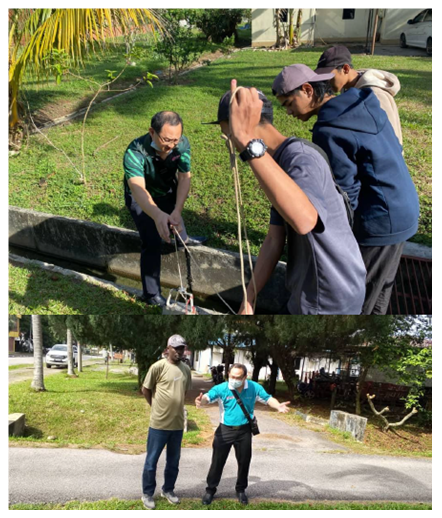
Figure 2 Guiding the students during the field-based samplings near the fifty drainages.
Effective mentorship is central to the success and sustainability of ecology as a scientific discipline. In mentoring undergraduate and postgraduate students-local and international-I have come to understand that mentorship is not only about teaching techniques (Figure 1). It is about building relationships that provide emotional support, intellectual guidance, and professional development.6 Intentional mentoring practices, especially in the sciences, have been shown to increase inclusivity, retention, and a sense of belonging among emerging scholars.7
In my lab, mentoring goes beyond supervisory meetings. It involves daily field instructions, sample analysis walkthroughs, and spontaneous discussions that ignite curiosity. Such engagement reflects the principles of scaffolding, whereby mentors help mentees navigate uncertainties by modelling, reflecting, and refining.8 Programs in Kenya and elsewhere confirm that mentorship is not just about research execution-it’s also about career building, confidence nurturing, and capacity development.9
High-quality mentorship integrates reflection, accountability, and shared experiences.10 My students are not just assistants; they are future scientists, and guiding them is a responsibility I embrace with care and pride. In 2024-2025, working with Nigerian students and a visiting scholar has further enriched this dynamic, fostering a multicultural learning environment grounded in mutual respect and collaboration.
Writing is not simply a reporting mechanism-it is the lifeblood of science. Scientific writing transforms raw data into meaningful knowledge, bridges gaps between research and application, and connects scientists across cultures and disciplines. Writing in ecology, particularly, plays a dual role: it documents empirical findings and tells the story of nature in ways that engage a broader public.11
Writing also supports the development of teaching resources and reflective practice. Programs that combine writing with teaching and research experiences for undergraduates and pre-service educators underscore the importance of integrating writing across academic roles.12 Good scientific writing, as emphasized by Hailman & Strier,13 requires precision, clarity, and logical structure—skills that are cultivated over time and through feedback, often beginning in the lab notebook and culminating in published papers.
In my own experience, every research manuscript originates from basic lab practices—sampling, measuring, analyzing—and each paper becomes a reflection of not only findings but also the mentoring that shaped them. Writing is how I guide, how I model scientific rigor, and how I share the joys and struggles of inquiry.
The synergy of passion, mentorship, and writing is what creates a thriving research environment. Passion fuels curiosity, mentorship channels it into skill-building, and writing gives it voice. Educational programs that successfully combine these three elements—especially those grounded in fieldwork and real-time collaboration—show improved student engagement and preparedness.14
In our lab, these elements are tightly interwoven. My students learn to collect field data with purpose, analyze samples critically, and write manuscripts that contribute to the field. Through this, they don’t just become graduates—they become knowledge producers. This cycle of learning and sharing is what gives academic life its depth and renewal.
In conclusion, passion, mentorship, and writing are not separate tasks in ecological research—they are integrated, reinforcing dimensions of a meaningful academic life. Reflecting on over two decades in the lab, I have come to see that these elements sustain not only scientific productivity but also personal growth, student development, and lasting contribution to the field.
What drives me today is not merely the metric of publication count or citation index. It is the joy of seeing students grow in confidence and capability, and the privilege of being present in their journey of becoming. I may not always know why this passion never fades- but I see the answer in their faces, in their questions, and in the shared silences of our work together.
In a world increasingly driven by performance and quantification, I return to the fundamental truth: science begins with curiosity, thrives on mentorship, and flourishes through writing. My reflections now echo louder than ever before- writing and mentoring are not parallel paths, but one and the same. And in this realization, I find renewed purpose.a
To other educators and researchers, I offer this message: continue to nurture your passion, invest compassionately in your mentees, and write with purpose. These practices will not only elevate your science but also inspire the next generation of ecologists. The flame never dies- it simply finds new light in others.
None.
The author declares that there are no conflicts of interest.

©2025 Yap. This is an open access article distributed under the terms of the, which permits unrestricted use, distribution, and build upon your work non-commercially.