Journal of
eISSN: 2574-8114


Literature Review Volume 12 Issue 3
 Md Tajbir Husain,2 Md Shoriful Islam,2 Shahed Khan,2 Nayan Chandra Shil,2 Kamrul Hassan Bhuiyan2
1Department of Fashion Design & Technology (FDT), Sonargaon University (SU), Bangladesh
2Department of Apparel Manufacture & Technology (AMT), Sonargaon University (SU), Bangladesh
Correspondence: Md Ahshan Habib, Department of Fashion Design & Technology (FDT), Sonargaon University (SU), Dhaka, Bangladesh
Received: May 02, 2026 | Published: May 21, 2026
Citation: Habib A, Husain T, Islam S, et al. The future of Bangladesh’s RMG industry: trends, innovation & challenges. J Textile Eng Fashion Technol. 2026;12(3):191-198. DOI: 10.15406/jteft.2026.12.00465
The Ready-Made Garment (RMG) industry of Bangladesh stands as the backbone of the national economy, contributing more than 80% of export earnings and employing over 4 million workers, the majority of whom are women. As the second-largest apparel exporter globally, Bangladesh has achieved remarkable growth over the past three decades. However, the industry now faces a critical transition period shaped by global competition, technological advancement, sustainability demands, and shifting trade policies. This study explores the future trajectory of Bangladesh’s RMG sector by analyzing emerging trends, technological innovations, and structural challenges. It highlights key developments such as digital transformation, automation, green manufacturing, and diversification of export markets. At the same time, the research identifies persistent challenges, including over-dependence on low-value products, inadequate backward linkage industries, labor rights concerns, and vulnerability to global economic shocks. The study adopts a qualitative and analytical approach based on secondary data from industry reports, academic literature, and policy documents. The findings suggest that while Bangladesh retains strong competitive advantages in cost efficiency and large-scale production, long-term sustainability will depend on innovation-driven growth, product diversification, and compliance with international environmental and labor standards. Strategic policy interventions and industry-level reforms are essential to ensure resilience and global competitiveness in the evolving apparel market.
Keywords: ready-made garment (RMG) industry, Bangladesh, global apparel trade, industrial innovation, automation, sustainability, supply chain management, export diversification, labor compliance, economic development
The Ready-Made Garment (RMG) industry has emerged as the most significant driver of Bangladesh’s economic development, transforming the country into one of the leading apparel exporters in the global market.1,2 Since its inception in the late twentieth century, the sector has experienced rapid growth, supported by competitive labor costs, favorable trade policies, and strong integration into global value chains. Bangladesh is currently the second-largest exporter of ready-made garments worldwide, following China, and the sector contributes over 81.49% to the country's total exports of 2024-25 and 84.21% in the year of 2018-19, making it a cornerstone of national economic stability.3 Moreover, the RMG sector plays a pivotal role in job creation across Bangladesh, particularly providing entry-level positions for young men and women. Directly employing 4.2 million people, of whom 60% are women, the RMG industry significantly contributes to economic development and employment generation.4,5
The contribution of the RMG sector extends beyond macroeconomic indicators to broader socio-economic development. The industry employs over four million workers, the majority of whom are women, thereby playing a transformative role in poverty reduction, gender empowerment, and rural-to-urban migration.6 This structural shift has significantly influenced household income distribution and social mobility, positioning the RMG sector as a catalyst for inclusive development.7 Additionally, the growth of the apparel sector has stimulated the expansion of backward- and forward-linkage industries, including textiles, accessories, transportation, and financial services, contributing to industrial diversification. Despite these achievements, the industry faces increasing structural and competitive challenges in the evolving global apparel market. One of the most critical limitations is its heavy dependence on low-value-added products, such as basic knitwear and woven garments, which restricts its ability to move up the global value chain.8,9 Competing countries such as Vietnam and India have already diversified into higher-value segments, thereby intensifying competitive pressure on Bangladesh’s traditional cost-based advantage.10 Furthermore, the sector’s reliance on imported raw materials, particularly in the woven segment, highlights persistent weaknesses in backward linkage industries, limiting domestic value addition and increasing production lead times.11,12
Global trade dynamics are also undergoing significant transformations, creating both opportunities and vulnerabilities for Bangladesh’s RMG sector. The increasing emphasis on sustainability, ethical sourcing, and environmental compliance has reshaped buyer expectations and regulatory frameworks in major export markets.13 While Bangladesh has made notable progress in establishing green factories and improving workplace safety following industrial disasters such as the Rana Plaza collapse, maintaining consistent compliance remains a major challenge. Moreover, fluctuations in global demand, geopolitical tensions, and trade policy changes continue to affect export stability and market access.14–16
Technological transformation represents another critical factor shaping the future of the RMG industry. The emergence of Industry 4.0 technologies, including automation, artificial intelligence, and digital supply chain systems, has redefined production efficiency and competitiveness in the global apparel sector.17,18 Bangladesh faces challenges in adopting these technologies due to high investment costs, limited technical expertise, and inadequate infrastructure. At the same time, the risk of labor displacement due to automation poses socio-economic concerns in a labor-intensive industry.19,20
Furthermore, the heavy concentration of export earnings in a single sector exposes Bangladesh to significant external risks. Global shocks such as economic recessions, pandemics, and supply chain disruptions have demonstrated the vulnerability of overdependence on the RMG sector. These challenges highlight the urgent need for diversification, resilience, and innovation-driven growth strategies to ensure long-term sustainability.21,22
Although a substantial body of literature has examined the economic contribution, labor conditions, export performance, and sustainability practices of Bangladesh’s RMG industry, most studies focus on isolated dimensions of the sector rather than providing an integrated future-oriented perspective. Existing research has largely emphasized historical growth patterns, compliance issues, or trade performance, with limited attention given to how technological transformation, sustainability transition, global market restructuring, and institutional competitiveness interact simultaneously to shape the future trajectory of the industry.
Furthermore, previous literature reviews rarely combine Industry 4.0 adoption, environmental governance, global value chain transformation, labor dynamics, and export diversification within a unified analytical framework. As a result, there remains a lack of comprehensive understanding regarding how Bangladesh’s RMG industry can transition from a low-cost manufacturing model toward a more innovation-driven and value-added industrial structure.
Therefore, this study seeks to bridge this gap by critically synthesizing emerging trends, technological innovations, sustainability imperatives, and structural challenges affecting the future competitiveness of Bangladesh’s RMG sector. The study contributes by offering an integrated analytical perspective that supports both academic understanding and policy formulation for long-term industrial resilience and sustainable growth.
Rationale of the study
The Ready-Made Garment (RMG) industry of Bangladesh has long been recognized as the cornerstone of the country’s economic growth and global trade integration. Despite its remarkable success in achieving large-scale export expansion and employment generation, the industry is currently undergoing a critical transformation driven by globalization, technological advancement, and increasing demands for sustainability and ethical compliance. Existing studies have predominantly focused on the historical growth, economic contribution, and labor dynamics of the sector. However, there remains a lack of comprehensive analysis that integrates emerging global trends, technological innovation, and structural challenges into a forward-looking perspective on the industry’s future.
The rationale for this study lies in addressing this gap by providing a holistic understanding of how the RMG sector can sustain its competitive position in an increasingly complex global apparel market. With rising competition from countries such as Vietnam, India, and China, Bangladesh must move beyond its traditional low-cost advantage and adopt innovation-driven strategies. Furthermore, the growing emphasis on environmental sustainability, digital transformation, and responsible supply chains necessitates a re-evaluation of existing business models and policy frameworks.
Additionally, the industry’s heavy dependence on a limited range of products and markets increases its vulnerability to external shocks, including global economic fluctuations, trade policy changes, and supply chain disruptions. Therefore, this study is essential to explore the strategic pathways that can enhance resilience, promote diversification, and ensure long-term sustainability. By examining trends, innovations, and challenges in a unified framework, the research aims to contribute both to academic discourse and policy formulation, offering practical insights for stakeholders across the RMG value chain.
Research objectives
General objective: To analyze the prospects of Bangladesh’s RMG industry by examining emerging trends, technological innovations, and key challenges affecting its sustainability and global competitiveness.
Specific objectives
Bangladesh’s Ready-Made Garment (RMG) industry spans multiple dimensions, including global value chain integration, labor governance, technological upgrading, and sustainability transition. Rather than reiterating the sector’s historical growth, this section critically synthesizes prior research to identify dominant themes, analytical gaps, and evolving scholarly debates relevant to the industry’s future trajectory.
Global value chain integration and upgrading
Bangladesh is deeply integrated into global value chains (GVCs) mainly through the ready-made garment (RMG) sector. Research consistently shows that its role is concentrated in low-value-added, labor-intensive manufacturing and assembly, with limited control over higher-value functions.3,8
Previous scholars conceptualize apparel production as a buyer-driven chain, where lead firms retain control over design, branding, and distribution, while production is outsourced to developing economies. Subsequent studies highlight that while Bangladesh has achieved scale efficiency, functional upgrading into higher-value segments such as design, product development, and branding remains limited.9 Recent empirical work suggests that upgrading is not merely a function of firm capability but is constrained by governance structures within GVCs, where global buyers dictate standards, pricing, and compliance requirements. This has led to a middle-income trap dynamic in the apparel sector, where productivity gains do not necessarily translate into higher value capture for producers.
Labor governance and social compliance
Another dominant research stream focuses on labor conditions, compliance, and governance mechanisms. Following industrial disasters, particularly the Rana Plaza collapse, scholars have critically examined the effectiveness of private and transnational regulatory frameworks such as the Accord and Alliance initiatives. These studies argue that while compliance mechanisms have improved workplace safety standards, they often operate within a narrow audit-based model that does not fully address structural labor issues such as wage inequality, worker representation, and job security.23,24
Moreover, the literature highlights the gendered nature of labor in the RMG sector, where women constitute the majority of the workforce but remain concentrated in low-skilled, low-paid positions. This raises questions about the long-term sustainability of ‘social upgrading’ alongside economic growth. Scholars argue that without institutional reforms and stronger labor rights frameworks, compliance improvements may remain superficial.25
Technological change and industrial transformation
The growing relevance of Industry 4.0 technologies has introduced a new dimension to the literature on the RMG sector. Studies on industrial automation suggest that digital technologies, including robotics, artificial intelligence, and data-driven supply chain systems, have the potential to significantly enhance productivity and reduce lead times. However, the implications for labor-intensive industries like Bangladesh’s RMG sector are complex.20,26
Recent research indicates that while automation may improve efficiency, it also poses risks of labor displacement, particularly for low-skilled workers. In developing economies, the adoption of advanced technologies is often uneven, constrained by capital intensity, infrastructure limitations, and skill gaps. Consequently, scholars emphasize the need for a balanced approach that integrates technological upgrading with workforce reskilling and institutional support.27–29
However, the literature presents contrasting perspectives regarding the implications of automation in labor-intensive economies such as Bangladesh. While several studies emphasize the positive effects of Industry 4.0 technologies on productivity enhancement, operational efficiency, and lead-time reduction, other scholars argue that rapid automation may increase unemployment risks for low-skilled workers and widen socio-economic inequality. This contradiction reflects the broader challenge of balancing technological modernization with employment sustainability in developing-country apparel industries. Therefore, future industrial transformation in Bangladesh’s RMG sector requires not only technological investment but also workforce reskilling, institutional support, and inclusive transition strategies.
Sustainability and environmental transition
Sustainability has emerged as a critical area of scholarly attention, driven by increasing global pressure for environmentally responsible production.30 The literature identifies the apparel industry as one of the most resource-intensive sectors, with substantial environmental impacts water usage, chemical pollution, and carbon emissions. In response, Bangladesh has made notable progress in adopting green manufacturing practices, including the establishment of LEED-certified factories.31–33
However, researchers argue that sustainability transitions in the RMG sector are uneven and often driven by external buyer requirements rather than internal innovation. Furthermore, the cost of compliance with environmental standards may disproportionately affect smaller firms, potentially leading to market consolidation and reduced inclusivity. This raises important questions about the balance between environmental responsibility and economic viability.34,35
In addition, the literature reveals a distinction between compliance-driven sustainability and innovation-driven sustainability within the RMG sector. Many firms adopt green manufacturing practices primarily to satisfy international buyer requirements rather than as part of a long-term strategic transformation toward sustainable industrial development. As a result, sustainability implementation remains uneven across the industry, particularly between large export-oriented firms and small or medium-sized enterprises. This indicates that future sustainability transitions will require stronger domestic policy support, technological capability, and institutional coordination.
Market diversification and trade dynamics
The literature also explores the implications of changing global trade patterns and market diversification strategies. While traditional export markets such as the European Union and the United States remain dominant, there is growing interest in expanding into emerging markets in Asia, Africa, and Latin America. Scholars argue that diversification can reduce dependency risks and enhance resilience against external shocks.21,36
At the same time, evolving trade agreements, tariff structures, and geopolitical dynamics continue to shape competitive positioning in the global apparel market.37 The phasing out of preferential trade benefits and increasing competition from countries with similar cost structures present ongoing challenges for Bangladesh’s export strategy.
Synthesis of the literature
Overall, the literature provides valuable insights into the structural characteristics and evolving dynamics of Bangladesh’s RMG industry. However, most studies remain fragmented, focusing on isolated dimensions such as labor, sustainability, or trade competitiveness. There is limited integrative research that connects these dimensions within a forward-looking framework addressing future industry transformation.
This study builds upon existing scholarship by synthesizing these perspectives and examining how technological innovation, sustainability imperatives, and global market shifts interact to shape the future competitiveness of Bangladesh’s RMG sector (Table 1).
|
Theme |
Key findings |
Research gap |
|
Sustainability |
Growth of green manufacturing |
Limited SME adoption analysis |
|
Automation |
Productivity improvement |
Labor displacement concerns |
|
Export diversification |
Reduces dependency risk |
Weak policy integration |
|
Labor governance |
Safety compliance improved |
Long-term worker welfare underexplored |
|
Technological upgrading |
Enhances efficiency |
Uneven adoption across firms |
Table 1 Summary of major themes and research gaps in existing literature
Research design
This study adopts a qualitative and analytical research design to explore the future trajectory of Bangladesh’s Ready-Made Garment (RMG) industry. Given the study’s focus on trends, innovation, and structural challenges, a qualitative approach is considered appropriate for capturing complex industry dynamics, policy implications, and emerging global developments. The research emphasizes interpretive analysis rather than statistical modeling, allowing for an in-depth understanding of interconnected economic, technological, and institutional factors shaping the sector.
Research approach
The study follows a descriptive and exploratory approach, combining thematic analysis with comparative insights. The descriptive component outlines the current state and structural characteristics of the RMG industry, while the exploratory dimension investigates future-oriented issues such as digital transformation, sustainability transitions, and market diversification. This dual approach ensures both contextual depth and forward-looking analysis.
Data sources
The research is based entirely on secondary data, collected from a wide range of credible and authoritative sources. These include:
The use of diverse secondary sources enhances the reliability and validity of the findings by enabling cross-verification of information.
Data collection technique
A systematic document review method was employed for data collection. Relevant literature and reports were identified through keyword-based searches using terms such as ‘Bangladesh RMG industry,’ ‘global value chain,’ ‘garment sustainability,’ and ‘Industry 4.0 in textiles.’ Only sources published in peer-reviewed journals or by recognized institutions were selected to ensure academic rigor.
Literature search and screening process: The literature review followed a systematic search and screening procedure to ensure the credibility, relevance, and academic rigor of the selected sources. Several academic databases and research platforms were used to identify relevant studies, including Scopus, Web of Science, Google Scholar, ScienceDirect, SpringerLink, Wiley Online Library, and Taylor & Francis Online.
The search process utilized combinations of keywords and Boolean operators such as:
The review primarily focused on publications published between 2015 and 2025 to ensure recency and relevance, although several earlier foundational studies were also included where necessary for theoretical support.
The inclusion criteria were:
Sources lacking academic credibility, duplicate publications, or studies unrelated to the research objectives were excluded from the review process. After screening and evaluation, approximately 37 relevant sources were selected for thematic analysis.
Data analysis technique
The collected data were analyzed using a thematic analysis approach, where key patterns and themes were identified, categorized, and interpreted. The analysis focused on three core dimensions aligned with the study objectives:
A comparative analytical framework was also applied to assess Bangladesh’s position relative to competing countries such as China and Vietnam. This helped identify competitive advantages, gaps, and strategic opportunities. The study is guided by a conceptual framework that illustrates the relationships between key determinants influencing the future competitiveness of Bangladesh’s Ready-Made Garment (RMG) industry.
As shown in Figure 1, the framework is structured around three primary independent variables: global market trends, technological innovation, and structural challenges. Global market trends influence demand patterns, trade opportunities, and competitive pressures in the international apparel market. Technological innovation, including automation, digitalization, and advanced supply chain systems, plays a crucial role in enhancing productivity, efficiency, and value addition. In contrast, structural challenges such as labor skill gaps, infrastructure limitations, compliance requirements, and dependence on imported raw materials can either constrain or facilitate industry transformation.
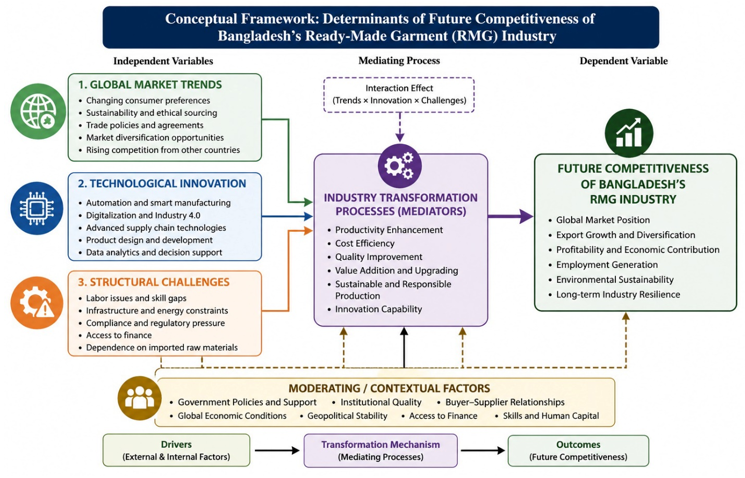
Figure 1 Conceptual framework illustrating determinants of the future competitiveness of Bangladesh’s RMG industry.
These variables are interdependent and interact through a set of transformation processes, including productivity enhancement, cost efficiency, quality improvement, and sustainable production practices. The outcome of these interactions determines the dependent variable, namely the future competitiveness of the RMG industry, which is reflected in export performance, global market positioning, profitability, and long-term sustainability.
Furthermore, the framework acknowledges the role of moderating or contextual factors, such as government policies, global economic conditions, institutional quality, access to finance, and human capital development. These factors influence the strength and direction of the relationships among the variables. Therefore, the framework provides a comprehensive analytical basis for examining how multiple dimensions collectively shape the growth and resilience of Bangladesh’s RMG sector.
The proposed conceptual framework is grounded in existing theories and empirical studies related to global value chains, industrial upgrading, sustainability transition, and technological innovation. Previous studies have demonstrated that global market trends significantly influence buyer requirements, trade competitiveness, and export restructuring, while technological innovation contributes to productivity enhancement and operational efficiency. Simultaneously, structural limitations such as labor skill shortages, infrastructural weaknesses, and compliance pressures may constrain industrial upgrading. Therefore, the framework assumes that these variables interact dynamically through transformation processes that collectively shape the long-term competitiveness and sustainability of Bangladesh’s RMG industry.
Reliability and validity
To ensure the credibility of the research, data triangulation was employed by cross-checking information from multiple sources. Only peer-reviewed and institutionally recognized publications were included to maintain academic reliability. Additionally, consistent analytical criteria were applied across all sources to enhance internal validity.
Limitations of the study
Despite its comprehensive approach, the study has several limitations:
However, these limitations do not significantly undermine the study, as the use of diverse and credible sources ensures a robust analytical foundation.
Thematic analysis and discussion
This section presents and interprets the findings based on the conceptual framework, which links global market trends, technological innovation, and structural challenges to the future competitiveness of Bangladesh’s Ready-Made Garment (RMG) industry through a set of mediating transformation processes.
Influence of global market trends
The analysis reveals that global market trends are a dominant force shaping the trajectory of Bangladesh’s RMG sector. Increasing consumer awareness regarding sustainability and ethical sourcing has significantly altered demand patterns, compelling manufacturers to adopt environmentally responsible production practices. Buyers from major markets, particularly the European Union and North America, are placing greater emphasis on transparency, traceability, and compliance with environmental and social standards.
At the same time, diversification of export markets is gradually emerging as a strategic response to overdependence on traditional destinations. According to BGMEA export statistics, more than 80% of Bangladesh’s apparel exports remain concentrated in the European Union and North American markets, highlighting the industry’s continued dependency on a limited number of export destinations. This concentration increases vulnerability to external economic shocks, trade policy changes, and fluctuations in consumer demand. Expansion into non-traditional markets in Asia, the Middle East, and Latin America indicates a shift toward broader market integration. However, rising competition from countries such as Vietnam, India, and Turkey continues to challenge Bangladesh’s cost-based competitive advantage.
These trends collectively create both opportunities and pressures, requiring firms to adapt their production strategies, upgrade capabilities, and improve responsiveness to changing global demand.
Role of technological innovation
Technological innovation plays a critical role in driving transformation within the RMG industry. The findings indicate a gradual but uneven adoption of automation, digital production systems, and data-driven supply chain management. Large and export-oriented firms are increasingly investing in modern machinery, enterprise resource planning (ERP) systems, and digital quality control processes to enhance operational efficiency.
Automation has contributed to improvements in productivity, reduced production lead times, and minimized human error. Additionally, digitalization has improved coordination across supply chain actors, enabling better forecasting, inventory management, and buyer communication. These advancements support higher value addition and facilitate integration into more sophisticated segments of the global apparel market.
Recent industry evidence suggests that factories adopting automated cutting technologies, enterprise resource planning (ERP) systems, and digital quality management processes have experienced improvements in production efficiency, inventory control, and supply chain coordination. These technological advancements also contribute to reduced material wastage and shorter lead times, which are increasingly important in fast-changing global apparel markets.
However, the adoption of advanced technologies remains limited among small and medium-sized enterprises due to financial constraints, lack of technical expertise, and inadequate infrastructure. This uneven technological diffusion creates disparities within the industry and highlights the need for policy support and capacity development.
Impact of structural challenges
Despite progress in several areas, structural challenges continue to constrain the industry’s transformation. Labor-related issues, including skill gaps and limited access to technical training, restrict the effective implementation of advanced production technologies. While Bangladesh benefits from a large labor force, the transition toward higher-value production requires a more skilled and adaptable workforce.
Infrastructure limitations, particularly in energy supply, transportation, and port efficiency, contribute to increased production costs and longer lead times. Additionally, compliance with international labor and environmental standards imposes financial and operational pressures on manufacturers, especially smaller firms.
Another significant constraint is the industry’s dependence on imported raw materials, particularly in the woven segment. Compared with competing countries such as China and Vietnam, Bangladesh still demonstrates relatively lower domestic value addition in the woven apparel segment due to dependence on imported fabrics, chemicals, and accessories. This dependency not only increases production lead times but also weakens supply chain resilience during global disruptions.
This reliance reduces domestic value addition and exposes the sector to external supply chain disruptions. These structural limitations hinder the industry’s ability to capitalize on emerging opportunities in the global market fully.
Mediating role of industry transformation processes
The findings demonstrate that the interaction between global trends, technological innovation, and structural challenges is mediated through a set of transformation processes. These include productivity enhancement, cost efficiency, quality improvement, value addition, and sustainable production practices.
Firms that successfully adopt modern technologies and respond to global market demands are able to achieve higher productivity and improved product quality. This, in turn, enhances their competitiveness and ability to attract higher-value orders. Sustainable production practices, such as energy-efficient operations and waste reduction, further strengthen market positioning, particularly in environmentally conscious markets.
However, the effectiveness of these mediating processes is highly dependent on the extent to which structural challenges are addressed. For instance, technological investments yield optimal results only when supported by skilled labor and efficient infrastructure. Therefore, the transformation process is not linear but conditional upon multiple interrelated factors.
Moderating effects of contextual factors
The analysis highlights the significant role of moderating factors in shaping the overall outcomes of the RMG industry. Government policies, including export incentives, infrastructure development, and regulatory frameworks, play a crucial role in facilitating industry growth. Institutional quality and governance also influence the effectiveness of compliance mechanisms and business operations.
Global economic conditions, such as fluctuations in demand and exchange rates, directly affect export performance and profitability. Similarly, access to finance determines the capacity of firms to invest in technology, sustainability, and skill development. Human capital development, particularly through education and vocational training, is essential for supporting technological upgrading and innovation.
These contextual factors can either strengthen or weaken the relationships among the key variables, thereby influencing the overall competitiveness of the industry.
Implications for future competitiveness
The integrated analysis suggests that the future competitiveness of Bangladesh’s RMG industry depends on its ability to balance cost efficiency with innovation and sustainability. While the sector continues to benefit from its established position in global apparel markets, reliance on low-cost production alone is no longer sufficient to maintain competitiveness.
To achieve long-term growth, the industry must focus on product diversification, technological upgrading, and strengthening backward linkages. Enhancing workforce skills, improving infrastructure, and ensuring consistent compliance with international standards are critical for sustaining competitive advantage.
Furthermore, proactive policy support and strategic collaboration among stakeholders, including government, industry associations, and international buyers, are essential to facilitate a smooth transition toward a more resilient and value-added RMG sector.
Conclusion
This study examined the future competitiveness of Bangladesh’s Ready-Made Garment (RMG) industry through an integrated framework linking global market trends, technological innovation, and structural challenges. The findings demonstrate that while the industry has achieved remarkable success as a leading global apparel exporter, its long-term sustainability is increasingly shaped by its ability to adapt to a rapidly evolving global environment.
Global market trends, particularly the growing demand for sustainable and ethically produced garments, as well as the diversification of export destinations, are redefining competitive dynamics. At the same time, technological innovation is emerging as a critical driver of productivity, efficiency, and value addition, enabling firms to move beyond traditional low-cost production models. However, the pace and extent of technological adoption remain uneven across the sector.
Structural challenges continue to pose significant constraints. Issues related to labor skills, infrastructure limitations, compliance costs, and dependence on imported raw materials hinder the industry’s transformation toward higher-value production. The study further highlights that the impact of these factors is mediated through transformation processes such as productivity enhancement, quality improvement, and sustainable production, and moderated by broader contextual factors including policy support, institutional quality, and global economic conditions.
Overall, the analysis suggests that the future competitiveness of Bangladesh’s RMG industry will depend not only on maintaining cost advantages but also on its capacity to innovate, diversify, and strengthen resilience. A strategic shift toward value-added production, supported by coordinated policy and industry efforts, is essential for sustaining growth in the global apparel market.
Policy recommendations
Based on the thematic analysis, technological upgrading, workforce skill development, and strengthening backward linkage industries emerged as the most critical priorities for sustaining the long-term competitiveness of Bangladesh’s RMG sector.
Priority 1: Promote technological upgrading and industry 4.0 adoption
The government should introduce targeted incentives, such as tax benefits, subsidized loans, and innovation grants, to encourage the adoption of automation, digital manufacturing systems, and advanced supply chain technologies. Special support programs should be designed for small and medium-sized enterprises (SMEs) to reduce the technological gap within the industry.
Priority 2: Strengthen human capital development
Investment in skill development is essential to support technological transformation. Public–private partnerships should be established to expand vocational training, technical education, and reskilling programs, particularly in areas such as digital production, machine operation, and quality management.
Priority 3: Enhance infrastructure and logistics efficiency
Improving transportation networks, port capacity, and energy supply systems is critical to reducing lead times and production costs. Strategic infrastructure investments will enhance supply chain efficiency and strengthen Bangladesh’s competitiveness in global markets.
Priority 4: Develop backward linkage industries
Policies should focus on strengthening domestic textile and raw material production to reduce dependency on imports. Encouraging investment in spinning, weaving, and dyeing industries will increase value addition and improve supply chain resilience.
Priority 5: Support sustainable and green manufacturing
The government and industry stakeholders should promote environmentally sustainable practices by providing financial incentives for green factory certification, energy-efficient technologies, and waste management systems. Strengthening environmental regulations and compliance monitoring will further enhance global market acceptance.
Priority 6: Diversify export markets and product portfolio
Strategic efforts should be made to expand into emerging markets and develop higher-value products such as technical textiles, sportswear, and fashion-oriented garments. Trade diplomacy and bilateral agreements can play a key role in securing new market access.
Priority 7: Improve access to finance
Facilitating easier access to affordable financing, particularly for SMEs, will enable firms to invest in technology, sustainability, and capacity expansion. Financial institutions should be encouraged to develop sector-specific funding schemes.
Priority 8: Strengthen institutional and regulatory frameworks
Enhancing governance, transparency, and regulatory efficiency will improve business confidence and compliance standards. Collaboration among government agencies, industry associations, and international partners is essential to ensure effective policy implementation.
Final insight
In conclusion, Bangladesh’s RMG industry stands at a critical juncture where future success will depend on its ability to transition from a cost-driven model to an innovation- and sustainability-driven growth paradigm. A coordinated approach involving technological advancement, policy support, and structural reform is necessary to secure its position in the increasingly competitive global apparel industry.
None.
None.
The authors declare no conflict of interest.

©2026 Habib, et al. This is an open access article distributed under the terms of the, which permits unrestricted use, distribution, and build upon your work non-commercially.