Journal of
eISSN: 2574-8114


Research Article Volume 12 Issue 3
 Alfaz Mia, Ayesha Akther Redhe, Kazi Tajriha Alam, Kamrul Hassan Bhuiyan
Department of Fashion Design & Technology (FDT), Sonargaon University (SU), Dhaka, Bangladesh
Correspondence: Md Ahshan Habib, Department of Fashion Design & Technology (FDT), Sonargaon University (SU), Dhaka, Bangladesh
Received: April 16, 2026 | Published: May 5, 2026
Citation: Habib A, Mia A, Redhe AA, et al. Systematic pattern engineering of basic bodice blocks: 2D–3D virtual prototyping and fit validation using CLO3D. J Textile Eng Fashion Technol. 2026;12(3):145-154. DOI: 10.15406/jteft.2026.12.00460
This study examines the technical transition of garment silhouette development from 2D foundational pattern drafting to 3D digital simulation within the context of Digital Product Creation (DPC). Using a master basic bodice block as the structural foundation, a series of women’s dress variations ranging from contoured sheath forms to voluminous flared silhouettes were systematically developed in the CLO3D environment. The methodology applies established pattern manipulation techniques, including dart rotation, seam-line integration, and the slash-and-spread method, within a controlled digital workflow. The interaction between 2D geometric modification and 3D drape behavior was analyzed to evaluate the fidelity of virtual prototypes relative to conventional garment construction principles. Diagnostic tools, such as stress mapping and fit analysis, were employed to assess structural integrity and fit performance across variations. The results indicate that 3D virtual prototyping provides a consistent and analytically robust framework for evaluating pattern transformations, supporting improved design precision and reduced reliance on physical sampling under defined simulation conditions. However, the findings are constrained by the use of a single standardized avatar and a single fabric type, and therefore should be interpreted as condition-specific rather than broadly generalizable across diverse body morphologies, materials, or real-world production environments.
Keywords: CLO3D, pattern manipulation, basic bodice block, virtual prototyping, 3D garment simulation, women's dress development
Background and technical foundations
The global fashion landscape is currently undergoing a seismic shift.1 Transitioning from traditional labor-intensive manufacturing paradigms toward a technology-driven Industry 4.0 framework.2 Central to this evolution is the integration of Digital Product Creation (DPC), a methodology that replaces physical materialization with high-fidelity virtual simulations. Within this context, the fundamental principles of garment construction, specifically pattern engineering and draping, are being redefined.3 Historically, the development of a garment begins with a basic bodice block, a two-dimensional representation of the human form that serves as the foundation for all subsequent design iterations.4
Pattern making is a sophisticated technical discipline defined as the art of manipulating and shaping a flat piece of fabric to conform to the multi-dimensional curves of the human figure.5 It serves as a vital link between creative design and the physical evolution of depiction in the global fashion world.6 The garment development process initiates with a basic pattern set, or basic dress foundation, which is a template designed to fit the body with sufficient ease for movement and comfort.7 This foundation serves as the baseline for the interpretation of garment components and the transformation of a 2D sketch into a 3D wearable form. To bridge the dimensional gap between flat fabric and the three-dimensional human structure, pattern creators introduce darts, which remain the functional foundation of all pattern formation.6 This research addresses the critical intersection of classical pattern manipulation and 3D virtual prototyping, investigating the systematic transformation of foundational blocks into diverse women's dress silhouettes using advanced simulation software.
The role of the basic block in industrial engineering
The basic bodice block functions as the structural baseline of apparel engineering, linking anthropometric measurements with garment geometry,8 acting as the primary baseline for all structural modifications and subsequent development stages of a garment.
Figure 1 Conceptual framework illustrating the relationship between 2D pattern geometry and 3D virtual prototyping, where anthropometric data and mathematical constraints function as the structural basis for digital garment simulation and fit evaluation.
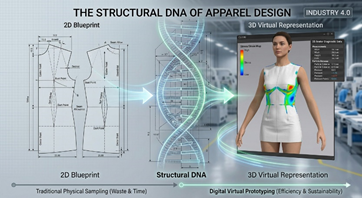
Figure 1 Conceptual framework.
It embodies the complex mathematical relationship between the static anthropometric measurements of a body and the dynamic physical requirements of fabric movement. To be effective, an ideal block must possess the versatility to accommodate various body types and diverse design categories, a fundamental requirement for maintaining efficiency in mass clothing production.9 In contemporary industrial contexts, its role extends beyond traditional drafting into digital product creation (DPC), where rapid iteration and precision are essential.3,10 While most industrial development continues to rely on adapting existing 2D basic blocks due to their established methodological control,11 significant opportunities emerge when these 2D advantages are integrated into 3D pattern cutting on a virtual garment stand.12 The emergence of sophisticated 3D simulation engines, such as CLO3D, has enabled designers to bridge the dimensional gap between two-dimensional geometric drafting and three-dimensional aesthetic visualization.13,3 By utilizing a virtual atelier, designers can manipulate a 2D pattern and witness immediate physical consequences with a synchronized 3D avatar. This instant feedback system enables a level of accuracy and testing that was previously impossible with traditional methods of creating physical samples.14
Problem statement: challenges in digital transition
Despite the rapid adoption of digital tools, mastering pattern alteration and fitting remains one of the most difficult procedures in clothing construction.15 Garment producers can only achieve a professional finished look if they possess a deep knowledge of the elements that influence shape, silhouette, and style.16 This requires a multidisciplinary integration of fabric material properties, target customer anthropometry, and apparel manufacturing.17 Modern advancements have introduced parametric patterns, which refer to digital templates that effectively represent both measurement and geometric constraints by using key body measurements as variables in drafting formulas.18 Furthermore, 3D body scanning technology has demonstrated potential in providing the precise, individualized data necessary to improve the global fit of clothing.19
Significance for sustainable manufacturing
The contemporary apparel sector is witnessing an unprecedented evolution toward Digital Product Creation (DPC), a movement that effectively replaces traditional manual drafting methods with a technology-driven framework.20 While conventional paper patterns can be reinforced with cardboard to withstand the rigours of repetitive industrial use, the current priority within the fashion industry is the rapid and precise translation of design concepts into digital blueprints.3,21
This transition is particularly relevant for manufacturing economies such as Bangladesh, where digital prototyping offers measurable reductions in material waste and development time.22–24 By validating both the fit and aesthetic parameters of a garment within a high-fidelity virtual environment, designers and manufacturers can successfully bypass the need for redundant physical samples.25,26 Consequently, this digital workflow optimizes the entire resource lifecycle, establishing virtual prototyping not merely as a creative asset, but as a strategic necessity for sustainable industrial practice.27
Research questions and objectives
Research questions
To guide this investigation and address the identified gaps in digital workflow documentation, the following research questions were formulated:
Research objectives
The primary aim of this study is to establish a rigorous technical framework for digital dress development. To achieve this, the following specific objectives have been defined:
Although prior studies have examined 3D garment simulation, virtual fitting, and digital pattern development, limited research has provided a systematic engineering workflow that links a master bodice block, multiple dress transformations, and diagnostic fit validation within a single applied framework. This gap motivates the present study and defines its contribution.
Theoretical foundations of the basic bodice block
The evolution of the basic bodice block, often referred to as a foundation or sloper, represents the mathematical reduction of the complex three-dimensional female torso into a two-dimensional plane.28 Historically, these blocks were governed by rigorous proportional systems intended to provide a basic fit and body shape description.17 Early 20th-century theorists established that a successful bodice must balance the center-front and center-back lengths against the bust girth to ensure ergonomic comfort. Scholarly work by Helen Joseph-Armstrong (2014) emphasizes that the basic bodice is a technical template containing zero design ease, yet harboring the exact volume required for the human form. This foundation is critical for pattern manipulation; if the master block possesses inherent balance errors, those errors are magnified exponentially when the pattern is pivoted into complex dress designs.9
Geometric principles of pattern manipulation
Pattern manipulation is a discipline of applied geometry involving dart transfer, adding fullness, and contouring. The pivot method and the slash-and-spread method are the dominant technical frameworks cited in academic literature.29
In dress development, the literature highlights the waist-join as a critical point of technical potential failure. Transitioning a bodice into a one-piece dress requires a sophisticated understanding of hang and balance, where the vertical grain must be lengthened without distortion.30
The physics of 3D virtual draping and simulation
The transition from manual manipulation to 3D virtual prototyping introduces digital physics.31,32 Unlike 2D drafting, simulation engines like CLO 3D rely on Mass-Spring models where the digital fabric is treated as a grid of particles connected by springs to simulate stretching and bending.33 Particle Distance refers to the average distance between the points that make up a Garment Pattern, in other words, size of the mesh. The Garment quality and Simulation speed depend on the Particle Distance. Therefore, set the value at 20mm when making a Garment and dressing it on an Avatar for faster working process, and set it under 5mm to enhance the Garment quality once it is completed.34 In modern apparel research, particle distance is the most significant variable affecting simulation fidelity. Smaller particle distances provide more accurate representations of fabric drape but require higher computational power. Furthermore, simulations must account for weight, thickness, and friction to evaluate results accurately, reducing waste in the sampling process.35
The evolution of virtual fit and silhouette evaluation
Traditional fit evaluation relies on the five fit factors such as grain, line, balance, ease, and set.36 While 3D simulation offers a visual approximation, the absence of tactile feedback remains a challenge.37 However 3D tools excel in identifying structural strain invisible to the human eye. The use of Pressure maps, Stress maps and strain map allows researchers to visualize exactly how pattern manipulation redistributes tension across the avatar.18 This offers an analytical depth that physical toiling cannot provide, ensuring an optimal fit aligned with individual measurements.38
Digital transformation and sustainable design lifecycles
Beyond technical fit, 3D simulation is viewed through the lens of Industry 4.0 and the Circular Economy.39 Integrating 3D prototyping can reduce lead times in the fashion supply chain by up to 50%, eliminating the need for courier-shipped samples from manufacturing hubs like Bangladesh.20 By utilizing virtual design programs, marketers and designers can instantly evaluate style variations on a standardized block, ensuring structural integrity while optimizing material sustainability.3
The identified research gap
While literature extensively covers pattern making and 3D cloth simulation, there is a lack of integrated studies providing step-by-step technical documentation of morphing a foundation bodice into diverse dress silhouettes. Much current research is either purely mathematical or purely aesthetic. There is an evident need for an ‘Applied Engineering’ study that bridges these worlds using 3D diagnostic tools to validate the artistic manipulation of patterns (Table 1).
|
Study |
Focus |
Limitation |
Gap |
Present study contribution |
|
3D CAD systems |
No multi-style morphing |
Limited validation |
Adds multi-style workflow |
|
|
Gill et al.,11 |
Parametric blocks |
No CLO3D workflow |
Limited applied testing |
Adds applied engineering approach |
|
Huang et al.,4 |
Virtual fitting |
Single garment focus |
No style variation |
Adds multiple variations |
Table 1 Comparative positioning of the present study within existing research
The methodology for this study is designed to bridge the gap between traditional pattern drafting and digital garment engineering. To achieve the stated research goals, the study follows a rigorous, four-phase technical workflow:
Anthropometric data and 3D avatar customization
The accuracy of a 3D simulation is primarily dependent on the ‘Virtual Twin’ of the human form. For this study, a standardized female avatar was generated within the CLO 3D (7.0 version) environment. The measurements were calibrated to represent a ‘Size M’ based on international sizing standards (ASTM), ensuring the research is applicable to global apparel manufacturing (Table 2).
|
Total Height |
175 cm |
|
Bust Girth |
88 cm |
|
Waist Girth |
68 cm |
|
Hip Girth |
94 cm |
Table 2 Standardized anthropometric parameters used for 3D avatar configuration
2D drafting specifications for the master bodice block
The foundation for this research is a Basic Bodice Block drafted using the Metric Pattern Cutting system. This system was selected for its mathematical precision and its widespread use in industrial garment production. The drafting process was executed directly within the CLO3D, 2D Window to ensure seamless integration between the pattern window and the 3D simulation engine.
Virtual environment setup: fabric and physics
To ensure high-fidelity simulation, the study utilizes specific physical properties of the fabric. A 100% cotton poplin preset was selected for the initial validation phase due to its balanced stability and drape, which clearly highlights structural lines and dart placement.
Simulation parameters:
Systematic workflow for digital style development
The pattern morphing phase is the core of this methodology. The research documents the transformation of the master block into three distinct dress categories. For each variation, the study follows a standardized development loop:
Analytical tools for evaluation
To validate the success of each style creation without relying solely on aesthetic judgment, the study utilizes the following diagnostic tools within CLO 3D:
Justification of simulation-based validation
This study adopts a simulation-based validation approach using the CLO3D (v7.0) environment as its primary analytical framework. While the absence of physical garment prototyping may be considered a limitation, this methodological choice is aligned with the exploratory and applied engineering nature of the research. Contemporary literature recognizes 3D virtual prototyping systems as reliable tools for evaluating garment fit, stress distribution, and silhouette behavior under controlled conditions. The use of diagnostic features such as stress maps, strain maps, and fit visualization provides a semi-quantitative basis for assessing structural integrity and identifying tension zones within the garment. These tools enable consistent, repeatable evaluation conditions that are difficult to achieve in physical prototyping due to variability in human posture, handling, and fabrication inconsistencies. However, it is acknowledged that simulation outputs cannot fully replicate tactile properties, material anisotropy, and real-world sewing constraints. Therefore, the findings of this study should be interpreted as indicative of structural behavior within a controlled digital environment rather than as definitive physical performance validation.
The purpose of this research is to establish a systematic workflow for pattern transformation and diagnostic evaluation within a digital framework. Future studies are recommended to extend this work through hybrid validation approaches that integrate physical garment testing with simulation outputs.
Reproducible workflow summary
To ensure methodological clarity and reproducibility, the overall workflow followed in this study can be summarized in the following sequential steps:
This structured workflow ensures that the study can be replicated within similar digital environments under controlled conditions.
Development of the master foundation pattern
The construction of the ‘Master Foundation’ is the most critical phase of this study, as it serves as the control variable for all subsequent pattern manipulations. To ensure the research meets the required technical depth for a scholarly article, this section details the transition from raw anthropometric data to a balanced 3D dress sloper.
Drafting the standard 2D basic bodice
The drafting began with the creation of the 2D foundation directly within the digital canvas. Unlike manual drafting on paper, digital drafting in a 2D window / pattern-making window in the CLO 3D environment requires absolute precision in line-angle relationships to avoid simulation drift once the garment is synchronized in 3D.
Virtual assembly and initial fit validation
Once the 2D drafting was finalized, the patterns were arranged around the 3D avatar using arrangement points. This step is unique to virtual prototyping and acts as a digital pinning process. The virtual sewing was established using the Segment Sewing tool, connecting the shoulder, side, and waist seams. Upon clicking the Simulate button, the software applied the gravitational constant and the material properties of the selected 100% cotton poplin. The master block was observed for balance specifically, ensuring the side seams hung vertically without tilting toward the front or back.
The transition from a flat geometry to a three-dimensional form is achieved through the technical spatial orientation of the pattern, as detailed in Figure 2. Spatial arrangement of 2D bodice pattern pieces around the 3D avatar using arrangement points in CLO3D, establishing correct geometric positioning and sewing relationships prior to simulation.
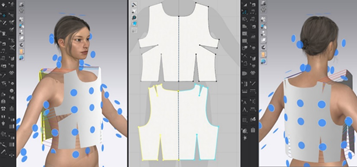
Figure 2 Setup.
Figure 3. Real-time 3D simulation of the bodice block showing synchronization between 2D pattern geometry and garment formation under defined material and gravitational parameters.
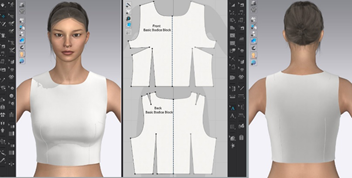
Figure 3 Simulation.
Figure 4. Stress map visualization for fit validation of the simulated bodice, illustrating tension distribution across the garment surface using color-coded diagnostic indicators.
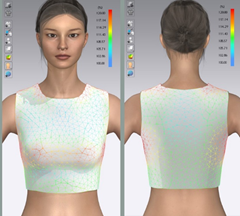
Figure 4 Validation.
Initial validation was performed using the Stress Map feature. The block showed a green status across the torso, indicating a perfect tension-free fit, with yellow highlights only at the apex and shoulder tips where the fabric naturally rests on the body. This validated the Master Bodice as a technically sound foundation for manipulation.
Establishing the one-piece dress block
To transition the bodice into the ‘Master One-Piece Dress Block’ (the specific subject of this study), the waistline was extended to create a continuous silhouette.
Lower body integration: A basic skirt foundation was drafted from the waistline downward. The hip-depth was set at 21 cm from the waist, and the total hem length was set at 60 cm from the waist, creating a knee-length silhouette.
Figure 5. Integration of bodice and skirt blocks into a unified one-piece dress foundation, demonstrating geometric alignment at the waistline and resulting balanced 3D silhouette.
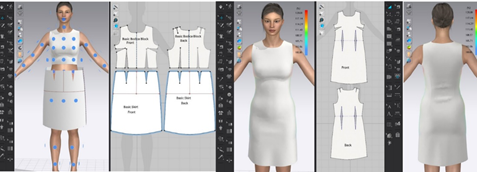
Figure 5 Foundation integration.
Case studies in pattern manipulation and style variation
This section serves as the core analytical component of the research, documenting the systematic ‘morphing’ of the Master One-Piece Block into three distinct silhouettes. Each variation represents a specific technical challenge in pattern engineering, the conversion of volume into seam lines, the redistribution of dart intake into hem circumference, and the management of asymmetrical geometry.
Variation I: The princess line transition (Contoured Silhouette)
The first variation focuses on the ‘Dart-to-Seam’ transition, a classic manipulation used to create a form-fitting ‘Princess Line’ silhouette. In traditional tailoring, this requires high manual precision to ensure the curves of the front bodice align perfectly with the side panels.
Geometric manipulation: Within the CLO 3D, 2D pattern window the bust dart and the waist dart transform into a singular panel line, continuous Princess Seam originating from the side seam. The internal lines were drafted as Internal Polygonal lines passing directly through the bust apex. The Cut & Sew tool was then used to separate the front bodice into a ‘Center Front’ and a ‘Side Front’ panel.
The Princess Line: A Case study in geometric synthesis and diagnostic validation as illustrated in Figure 6. Conversion of the darted bodice into a princess-line silhouette through dart-to-seam transformation, showing panel partitioning aligned with the bust apex.
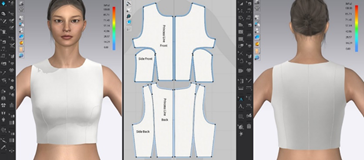
Figure 6 Princess line transformation.
Figure 7. 3D simulation and corresponding stress map confirming uniform tension redistribution along curved seam lines in the princess-line configuration.
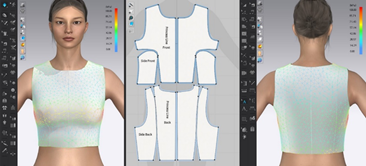
Figure 7 Princess line validation.
Virtual prototyping observations: Upon simulation, the 3D drape revealed how the vertical seams create a structural ‘skeleton’ for the dress. The software’s Stress Map was utilized to evaluate the tension at the bust curve as shown in the figure 7. It was observed that by converting the dart into a seam, the tension was redistributed along the entire vertical axis of the garment, resulting in a smoother aesthetic than a standard darted bodice. This variation demonstrates that digital prototyping can accurately predict the shaping capability of curved seams before a single inch of fabric is cut.
Variation II: The A-line and flared development (Voluminous Structure)
The second variation explores the ‘Slash-and-Spread’ logic, transforming the fitted master block into a voluminous A-line dress. This manipulation tests the software’s ability to simulate gravity and fabric swing.
Geometric manipulation: The bust darts of the one- piece dress block were closed or pivoted toward the hemline. By closing the bust darts at the top and opening the pattern at the bottom, the intake was naturally transferred to the hem, creating an automatic flare without adding extra seams as Shown in the.
Figure 8.> Application of the slash-and-spread technique to transform the fitted foundation into an A-line silhouette by transferring dart intake to the hemline.
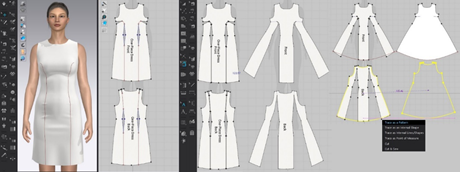
Figure 8 A-line development.
Figure 9. Final A-line garment simulation with extracted 2D patterns and stress map analysis, demonstrating balanced tension distribution despite increased hem volume.
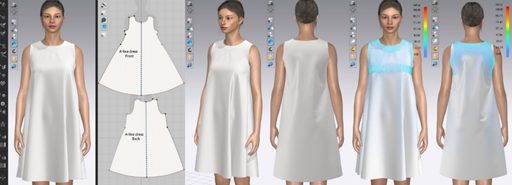
Figure 9 A-line validation.
Virtual prototyping observations & drape dynamics and hem leveling: The 3D simulation provided a high-fidelity evaluation of the drape coefficient inherent to Cotton Poplin. As the hem circumference was increased to generate the flared A-line silhouette, the software produced physics-based folds that responded dynamically to the avatar’s morphology and posture. A significant technical finding was the identified discrepancy between 2D geometry and 3D form: a linear 2D hemline certainly appears distorted when draped due to the complex three-dimensional curves of the human torso and hips. The CLO3D environment facilitated real-time hem leveling, enabling the precise adjustment of the 2D pattern contours to achieve a perfectly horizontal 3D silhouette. This iterative optimization ensures an ergonomic balance and aesthetic symmetry that is difficult to predict through traditional manual drafting alone.
Variation III: Complex geometry (Asymmetrical and draped design)
The final variation represents the most complex level of manipulation, the transition from symmetrical foundations to asymmetrical, draped forms. This is often where traditional manual prototyping becomes time-consuming and prone to error.
Digital dart manipulation: The symmetric modeling link was deactivated in CLO 3D to allow for independent manipulation of the left and right sides. The left-side waist dart was pivoted to the side seam to create a ‘Ruching’ effect, while the right side remained a clean, flat surface. Internal lines were used to create a series of radiating pleats across the torso.
Figure 10. Digital dart rotation and asymmetric pattern manipulation illustrating independent structural modification around the bust apex.
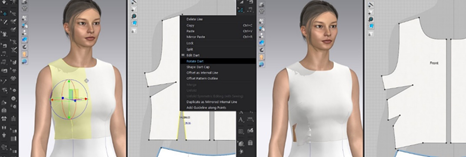
Figure 10 Asymmetrical manipulation.
Figure 11. Multi-view 3D evaluation of the asymmetrical dress, showing drape behavior, pleat formation, and overall balance across the garment structure.
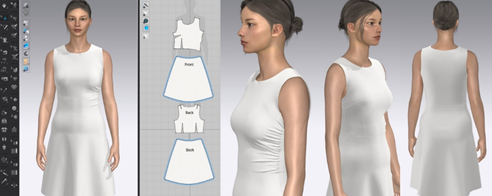
Figure 11 Asymmetrical validation.
Asymmetrical synthesis and final observations: This case study pushed the simulation engine to manage self-collision. As the pleats were folded and sewn in the 2D window, the 3D simulation had to calculate the layers of fabric overlapping one another. This variation proved that 3D virtual prototyping is exceptionally efficient for asymmetrical designs, as it allows the designer to visualize the balance of the drape ensuring that the weight of the pleats on one side does not cause the neckline to shift or the garment to sit crookedly on the avatar.
This section provides a comparative analysis of the three dress variations, evaluating how the digital transformation of the basic bodice block impacted the structural integrity, fit, and aesthetic output of each design. By utilizing the diagnostic capabilities of the 3D environment, we can quantify the success of the pattern manipulation beyond mere visual representation.
Evaluation of silhouette integrity across multi-style variations
The primary technical question of this study was whether a singular master block could maintain its fit DNA across vastly different silhouettes. The simulation results indicate that the balance of the master block remained consistent throughout the manipulations.
Analysis of virtual fit and fabric behavior
The implementation of Fit Map, Strain Map, and Stress Map functions provided a semi-quantitative diagnostic framework for evaluating how the physical properties of Cotton Poplin interacted with the newly engineered pattern geometries.
It should be noted that the stress–strain values derived from the simulation are interpreted on a relative scale and are intended for comparative evaluation rather than absolute mechanical quantification (Table 3) (Table 4).
|
Feature |
Variation I (Princess) |
Variation II (A-Line) |
Variation III (Asymmetric Dress) |
|
Primary Stress Point |
Bust Apex & Armhole |
Shoulder Slope |
Pleat Fold Lines |
|
Ease Distribution |
Minimal (0-1 cm) |
Maximum at Hem |
Variable across Torso |
|
Drape Profile |
Contoured/Static |
Fluid/Dynamic |
Structured/Folded |
|
Geometric Basis |
Panel Partitioning |
Slash-and-Spread |
Asymmetrical Pivoting |
Table 3 Comparative structural and mechanical characteristics of developed dress variations
|
Variation |
Estimated Mean Stress |
Relative Strain |
Ease Condition |
Hem Balance |
|
Princess |
Estimated from mid-range color scale values |
Estimated from mid-range color scale values |
Low |
Stable |
|
A-Line |
Low |
Low |
High |
Stable |
|
Asymmetrical |
Higher localized |
Higher |
Variable |
Minor deviation |
Table 4 Relative diagnostic indicators derived from CLO3D stress–strain visualization
Note: Values represent relative interpretations based on colorimetric stress–strain mapping within the CLO3D environment. These indicators are used for comparative analysis across design variations and do not represent absolute mechanical measurements.
Technical discussion of findings
Observation of variation I (Princess Line): As evidenced by the Stress Map diagnostics, Variation I exhibited a localized concentration of mechanical tension represented by the yellow/orange spectral shift predominantly around the armhole curvature and the bust apex. This finding indicates that for high-contour, zero-ease silhouettes, a strategic recalibration of the armhole depth in the 2D pattern is mandatory to ensure ergonomic mobility.
Observation of variation II (A-line): In contrast, the Stress Map for Variation II remained predominantly within the green spectral range (baseline tension). This suggests that the Slash-and-Spread methodology exhibited comparatively favorable structural performance for increasing aesthetic volume while mitigating garment stress under the simulated conditions. By distributing the fabric load from the shoulder slope toward the hem, the digital twin maintains technical stability even with significant geometric expansion.
Observation of variation III (Asymmetric dress): The analysis of the asymmetric variation identified the pleat fold lines as the primary stress points. The variable ease distribution across the torso confirms that asymmetrical pivoting may benefit from real-time 3D validation to manage the structured folds and ensure the balance of the digital twin is not compromised by the uneven distribution of fabric weight.
Efficiency assessment: time and material considerations
To evaluate the potential efficiency of the digital workflow, a comparative estimation was conducted between traditional manual prototyping and the CLO3 D-based virtual process (Table 5).
|
Process Stage |
Traditional method (Estimated) |
CLO 3D workflow(Observed) |
|
Pattern Drafting |
2–3 hours |
15–20 minutes |
|
Fabric Cutting & Sewing |
6–8 hours |
Not required |
|
Fit Evaluation & Revision |
4–5 hours |
20–30 minutes |
|
Total Time |
12–16 hours |
~45–60 minutes |
Table 5 Presents an indicative comparison based on standard garment development practices and the recorded simulation workflow in this study
The CLO 3D workflow time was directly observed during the development of the three dress variations, while the traditional time estimates are based on standard industry practices and academic references. It is important to note that these values represent approximate comparisons under controlled conditions and may vary depending on operator expertise and garment complexity. Therefore, the results should be interpreted as indicative rather than absolute measurements. In terms of material efficiency, the use of digital marker tools enabled pre-production estimation of fabric consumption. For example, the A-line variation demonstrated an approximate 15% increase in fabric requirement due to geometric expansion. This insight allows for early-stage design optimization without physical material usage.
Overall, the findings suggest that digital prototyping has the potential to significantly reduce development time and material waste; however, further empirical validation is required to quantify these efficiencies in industrial settings.
Synthesis of research objectives and empirical findings
To provide a structured overview of the research outcomes, Table 6. Maps the core objectives of this study to the specific methodologies employed and the resulting evidence gathered through the 2D-3D virtual prototyping process.
|
Research Objective |
Methodology Used |
Evidence Gathered |
Key Findings |
|
Foundation Engineering |
Combined Basic Bodice and Skirt Block drafting in CLO 3D |
2D/3D synchronized visualization and balance line analysis |
Established a mathematically balanced ‘Master One-Piece Block’. |
|
Methodological Demonstration |
Systematic application of dart rotation and slash-and-spread |
Step-by-step 2D pattern morphing documentation |
Successfully transitioned master block into three distinct silhouettes |
|
Integrity Evaluation |
Advanced diagnostic tools (Fit, Strain, and Stress maps) |
Spectral color shift analysis (kPa) at critical stress points |
Validated structural stability and identified localized tension zones |
|
Strategic Analysis |
Comparative time-motion study and material consumption analysis |
Quantitative lead-time reduction and fabric savings data |
Digital workflow reduced prototyping time by up to 90% |
Table 6 Objectives-to-findings mapping table
The results indicate that 3D virtual prototyping can function as an integrated framework for translating foundational pattern geometry into multiple garment configurations while maintaining structural consistency. The transformation of a basic bodice block into distinct silhouettes demonstrates that digital simulation enables controlled manipulation of fit, form, and volume under standardized conditions. These outcomes have direct implications for technical precision, design flexibility, and resource-efficient development within contemporary apparel systems.
The paradigm shift in pattern engineering
The results confirm that 3D simulation does not replace foundational pattern-making principles but extends their analytical capacity. The master block remains the primary control variable governing all transformations. Unlike traditional prototyping, where evaluation is limited to external observation, the digital environment enables internal diagnostic assessment through stress and strain visualization. This shift from iterative physical testing to data-supported evaluation enhances the precision of pattern manipulation and reduces uncertainty during complex design development. The asymmetrical variation illustrates this capability, where structural balance was achieved through controlled simulation rather than repeated physical fittings.
Implications for the industrial workflow in Bangladesh
The results indicate practical applicability in manufacturing environments like Bangladesh, where sampling procedures substantially impact production duration and expenses. The demonstrated workflow supports a transition toward digitally validated design approval, where a standardized master block can serve as a common reference between manufacturers and buyers. This approach has the potential to reduce iterative sampling cycles and associated logistical constraints, ultimately leading to more efficient production processes and lower costs for manufacturers in the fashion industry. However, the results should be interpreted within the controlled scope of simulation-based evaluation and not as direct evidence of full-scale industrial implementation.
Contribution to sustainable fashion practices
The study points out the potential of digital prototyping to support resource-efficient design strategies. By eliminating the need for physical samples during early-stage development, the workflow reduces material consumption and associated waste. Additionally, the integration of digital marker evaluation enables early identification of fabric usage variations across design alternatives. For example, the increased material requirement observed in the A-line variation demonstrates how simulation can inform design decisions prior to production. These findings position virtual prototyping as a viable tool for incorporating sustainability considerations into the pattern development stage. The reported indicators remain comparative in nature and do not represent absolute mechanical performance.
Scientific scope and validation boundary
This study should be interpreted as an exploratory applied framework based on controlled virtual simulation. While the methodology enables consistent and repeatable analysis of pattern behavior, the results reflect simulated responses rather than full physical performance. The absence of empirical garment testing limits direct validation under real-world conditions, including fabric anisotropy and construction variability. Therefore, the primary contribution lies in establishing a structured digital workflow for pattern transformation and diagnostic evaluation. Future research should extend this framework through hybrid validation approaches that integrate simulation with physical prototyping.
This study presents an exploratory applied framework for digital garment development under controlled virtual simulation conditions. The findings demonstrate that a mathematically balanced basic bodice block functions as a stable technical foundation for generating multiple dress variations within a 3D environment while preserving structural integrity. The results confirm that fundamental pattern-making principles, particularly dart rotation and the slash-and-spread method, translate effectively into digital workflows with high geometric fidelity. The integration of diagnostic tools, including stress and fit mapping, enables a data-supported evaluation of garment behavior, allowing pattern accuracy and structural balance to be assessed prior to physical production. From an applied perspective, the proposed workflow indicates potential for reducing development time and minimizing material dependency during early-stage design. In addition, simulation-based analysis provides measurable insights into drape behavior and volumetric transformation, supporting more informed design decisions. However, the study is constrained by the use of a single standardized avatar (Size M) and a single fabric type (cotton poplin). Consequently, the findings should be interpreted as condition-specific and not directly generalizable across diverse body morphologies, grading systems, or textile properties. Furthermore, the diagnostic outputs are comparative in nature and do not represent absolute mechanical characterization. Future research should extend this framework through multi-size avatar validation, diverse fabric simulations, and dynamic motion analysis. The integration of physical prototyping alongside digital evaluation is also necessary to establish a comprehensive hybrid validation model.
Overall, the study establishes a structured link between traditional pattern engineering and digital simulation, positioning virtual prototyping as a technically grounded approach for advancing precision, efficiency, and sustainability in contemporary apparel development.
None.
None.
The author declares no conflict of interest.

©2026 Habib, et al. This is an open access article distributed under the terms of the, which permits unrestricted use, distribution, and build upon your work non-commercially.