Journal of
eISSN: 2574-8114


Research Article Volume 12 Issue 3
 Md Imam Howlader, Srity Roy, Saqlain Rahman Chowdhury, Mohammed Shamsul Alam
Department of Fashion Design & Technology (FDT), Sonargaon University (SU), Dhaka, Bangladesh
Correspondence: Md Ahshan Habib, Department of Fashion Design & Technology (FDT), Sonargaon University (SU), Dhaka, Bangladesh
Received: April 27, 2026 | Published: May 13, 2026
Citation: Habib A, Howlader I, Roy S, et al. Methodological analysis of 3d virtual simulation and physical draping from illustrative origins of a gown. J Textile Eng Fashion Technol. 2026;12(3):172-179. DOI: 10.15406/jteft.2026.12.00463
This study investigates the transition from two-dimensional creative concepts to three-dimensional physical forms in gown construction, with particular focus on the translation gap between digital simulation and material realization. Adopting a practice-based research methodology, the development of a single gown is systematically examined across five interconnected stages: mood board creation, hand-drawn sketching, refined illustration, 3D virtual simulation using CLO3D, and physical draping in monochromatic grey muslin. The research evaluates how key structural elements, specifically grainline orientation, seam placement, and volumetric balance, are interpreted and transformed across visual, digital, and physical environments. The use of grey muslin as an analytical medium enables precise observation of fabric behavior under tension by minimizing the influence of surface aesthetics.
Findings indicate that 3D virtual simulation functions effectively as a predictive tool for silhouette, fit, and volume distribution. However, it remains limited in representing tactile properties such as cumulative fabric weight, localized tension, and grainline distortion. These limitations are resolved during the physical draping stage, where direct material interaction enables structural correction and stabilization. The study concludes that digital simulation cannot fully substitute material intelligence and that physical draping remains essential for final structural resolution. This research proposes a replicable methodological framework that integrates illustration, simulation, and draping to bridge the gap between conceptual design and technically resolved garment construction.
Keywords: 3D virtual prototyping, draping methodology, material intelligence, garment engineering, translation gap, clo3d
A significant methodological shift is occurring in the contemporary fashion landscape, transforming the conception, translation, and realization of creative ideas into material forms.. Traditionally, garment development followed a linear progression from hand sketch to flat pattern drafting and, finally, to fabric construction. However, recent fashion scholarship emphasizes that this reductive sequence no longer sufficiently accounts for the complexity of contemporary garment engineering, particularly in couture, experimental design, and research-led practice.1 The convergence of digital technologies and a renewed interest in material intelligence has transformed garment development into a multidimensional and iterative process. This research article examines this evolution by systematically tracing the transformation of a single gown through four interrelated stages: curatorial inspiration via a mood board, hand-drawn illustration, 3D virtual simulation, and physical draping using monochromatic grey muslin. Rather than positioning these stages as isolated or sequential, the study treats them as a recursive workflow in which visual intent, digital prediction, and material feedback continually inform one another.
This approach aligns with practice-based fashion research methodologies. In this study, practice-based research refers to a mode of inquiry in which knowledge is generated through the act of designing, making, testing, and reflecting on the garment development process, which recognizes design practice itself as a legitimate mode of knowledge generation.2 The creative genesis of garment development often begins with sketches and illustrations, where designers translate abstract inspiration into visual form. Fashion illustration functions as a semiotic and expressive tool, capturing gesture, mood, and silhouette with deliberate exaggeration. However, illustration also occupies a speculative space that frequently ignores the physical laws governing cloth behavior, gravity, and structural support. Scholars describe this disjunction as a translation gap between two-dimensional idealization and three-dimensional realization, where the illustrated figure operates without material consequence.2 In this study, the ‘translation gap’ refers to the difference between the idealized visual form represented in sketches or digital simulations and the actual behavior of fabric when subjected to gravity, tension, weight, grainline direction, and seam construction.
In the fashion industry, illustrations play an important role in communicating and promoting design concepts, serving as the initial stage in product development. Graphic elements such as dots, lines, surfaces, and tonal variations form the visual language through which fashion figures are represented.3 As a result, illustrated silhouettes often require reinterpretation when confronted with the mechanical behavior of fabric. Garments that rely on fluid draping, asymmetry, and bias manipulation intensify the challenge of bridging this translation gap. Textile research confirms that bias-cut fabrics introduce directional stretch, shear deformation, and dimensional instability, requiring precise structural compensation during construction.4 Thus, the hand sketch functions not as a technical instruction but as a conceptual hypothesis, an ideal form that must undergo empirical testing through subsequent stages of development.5,6 In contemporary fashion workflows, 3D virtual garment simulation has emerged as a critical intermediary between conceptual illustration and physical fabrication.7 Software platforms such as CLO3D employ physics-based engines to simulate drape, gravity, and tension, enabling designers to visualize garments in a digitally embodied environment before cutting fabric.8 Comparative studies demonstrate that, when material parameters are accurately calibrated, virtual simulations can approximate real-world drape behavior with notable reliability.9,10
Despite these advances, scholarly evaluations consistently indicate that digital simulations remain limited in their capacity to replicate tactile intuition, grainline negotiation, and cumulative fabric weight factors that are immediately perceptible through physical manipulation.11 While 3D software excels at predicting stress zones, estimating fabric consumption, and visualizing volume, it cannot fully substitute the embodied knowledge gained through pinning, stretching, and anchoring fabric on a dress form. This limitation reinforces the necessity of physical draping as a final stage of structural resolution. In this study, physical draping is conducted using monochromatic grey muslin, selected for its analytical neutrality and its ability to reveal structural shadows and grainline distortion.12 Fashion historians and pattern scholars have long identified the toile as a diagnostic object, a material site where imbalance, tension, and misalignment become visible before aesthetic considerations are introduced.13 The absence of color or surface decoration allows the garment’s architecture to be assessed independently of stylistic bias.
By integrating illustrative intent, digital simulation, and tactile draping, this research proposes a rigorous methodological framework for translating static visual concepts into structurally sound, fluid forms. In doing so, it contributes to contemporary fashion discourse that advocates hybrid workflows uniting technological precision with embodied craftsmanship.14 Ultimately, the study argues that the successful realization of a gown is not the product of a single technique but of an orchestrated dialogue between imagination, computation, and material logic. While there is research into fashion illustration, 3D garment simulation, and physical draping as individual design practices, there is a lack of research that systematically examines the translation of a single gown's design across all three stages in an integrated methodological workflow. The novelty of this research is the ability to trace the transformation from the mood board and illustration to the CLO3D simulation and grey muslin draping, using one gown as a controlled practice-based case. This allows the research to identify where digital prediction is effective and where physical material validation is still needed in relation to the behavior of grainlines, the anchoring of seams, the weight of fabric, and balance in layered hems.
Research questions
Research objectives
This research is significant as it demonstrates how a digitally developed gown with a structured bodice and layered hem can be refined through physical draping to achieve structural integrity and visual balance. By examining the interaction between 3D simulation and hands-on fabric manipulation, the study highlights the complementary roles of digital precision and tactile decision-making in contemporary gown construction. The findings contribute practical insights to fashion education and industry practice, emphasizing that complex silhouettes require both virtual planning and physical validation to achieve technically sound results.
The Historical and structural evolution of draping
The practice of draping, often referred to as le moulage, represents one of the most historically grounded and structurally sophisticated methods of garment construction.12,15 Unlike flat pattern drafting, which operates through two-dimensional geometric abstractions, draping is inherently three-dimensional, unfolding directly on the body or dress form.16 This embodied approach allows designers to observe gravity, fabric tension, and spatial volume in real time, making draping both a construction technique and a mode of material inquiry. Scholarly discourse consistently positions Madeleine Vionnet as the pivotal figure who transformed draping into an architectural methodology. Through her systematic exploration of the bias cut, Vionnet reconceptualized fabric as an elastic structure rather than a rigid surface, allowing garments to respond dynamically to the contours and movement of the body.17 Her work established a foundational principle within couture practice: fabric possesses an intrinsic logic governed by grainline orientation, and successful draping requires collaboration with, rather than domination over, this material behavior. Contemporary fashion pedagogy continues to emphasize draping as a tactile learning process.18 Research in apparel education identifies draping as a critical tool for developing “material intelligence,” enabling designers to understand how cloth behaves under stress, shear, and gravity qualities that cannot be fully apprehended through flat pattern drafting alone.1 The literature further suggests that monochromatic toiles function as analytical instruments, allowing designers to evaluate balance, silhouette, and structural distortion without interference from surface aesthetics.
The cognitive gap between illustration and construction
Fashion illustration has traditionally served as the primary communicative device through which designer’s articulate conceptual vision.19 Illustrations capture gesture, rhythm, and proportion, operating within a symbolic register that prioritizes expression over construction. However, scholars increasingly critique the assumption that illustrations can function as direct technical guides. Instead, illustrations are understood as speculative artifacts that intentionally suspend the physical constraints governing real materials.20 A recurring theme in design theory literature is the presence of a translation gap between illustration and realized garment form. This gap emerges because fashion figures are often exaggerated, frequently extending beyond human anatomical proportions, while illustrated drapes ignore gravitational load and fabric weight. As a result, lines that appear fluid and effortless on paper often require significant structural intervention in physical reality. Recent computational research into sketch-based garment visualization further reinforces this limitation. Studies on sketch-to-image translation using AI reveal that even advanced algorithms struggle to preserve designer intent while simultaneously embedding accurate structural logic, often producing visually convincing yet materially implausible outputs. These findings confirm that illustration alone cannot encode the tacit knowledge required for garment engineering.
Digital transformation: 3D virtual garment simulation
The introduction of 3D virtual garment simulation has significantly altered contemporary fashion workflows, positioning digital environments as intermediary spaces between conceptual vision and physical execution.21 Software platforms such as CLO3D employ physics-based simulation engines to model gravity, fabric collision, and body interaction, offering designers the ability to visualize garments in motion prior to fabrication. Empirical studies comparing virtual and physical garments suggest that digital simulations can achieve high levels of morphological similarity when fabric parameters are accurately calibrated.22 Research measuring drape coefficients demonstrates a statistically significant correlation between CLO3D simulations and real-world drape tests, particularly for woven fabrics such as cotton and polyester blends. These findings support the role of 3D simulation as a predictive tool within sustainable and waste-reducing design practices.However, the literature also identifies critical limitations. Recent assessments of CLO3D’s material sensitivity reveal that the software struggles to differentiate subtle variations in fabric elasticity and mechanical response, particularly under dynamic movement conditions.23 While digital tools can identify zones of tension and estimate material consumption, they remain limited in their ability to model tactile intuition, grainline negotiation, and cumulative fabric weight.
Grainline integrity and material physics
At the core of structural garment design lies the concept of grainline integrity. Textile science literature defines the grain as the foundational grid of woven fabric, comprising the warp (lengthwise) and weft (crosswise) threads. The orientation of this grid directly determines a garment’s stability, elasticity, and draping behavior. Bias orientation, established at a 45-degree angle to the warp and weft, introduces controlled elasticity.24 Allowing fabric to contour the body with fluidity. However, this elasticity also introduces dimensional instability, necessitating precise structural compensation through seam placement and anchoring techniques.25 Pattern engineering research confirms that untreated bias-cut garments are prone to distortion and imbalance, particularly in gowns with asymmetrical weight distribution. Couture literature frequently describes seams as structural elements that absorb and redirect gravitational force. Aligning key seams, such as center back or side seams, with the straight grain provides the necessary stability for supporting complex drapes. Misalignment of grainline, even by small degrees, can compromise both fit and silhouette, reinforcing the necessity of tactile verification through physical draping.
Practice‑based research and tactile knowledge
Practice-based research (PBR) provides the methodological foundation for integrating illustration, digital simulation, and physical draping within a single analytical framework. PBR recognizes making as a form of inquiry, wherein knowledge is generated through iterative engagement with materials, tools, and processes. In fashion research, this approach legitimizes the garment itself as a site of data production. Hybrid methodologies merge digital precision with embodied craftsmanship, rather than positioning technology as a replacement for traditional skills.26 Studies in digital craftsmanship emphasize that the translation between physical and digital realms requires iterative correction, with each domain informing and refining the other.27 This integrative perspective is further supported by interdisciplinary design research, which frames garment development as a recursive loop rather than a linear process. Within this loop, physical draping plays a decisive role, resolving discrepancies introduced by idealized illustrations and algorithmic simulations alike.28,29 The act of pinning, adjusting, and realigning fabric becomes not merely corrective, but epistemological, revealing structural truths inaccessible through other means.
Synthesis: bridging illustration, simulation, and draping
The existing literature collectively suggests that no single representational system, illustration, digital simulation, or physical draping, can independently resolve the complexities of gown construction.30 Illustration communicates intent but lacks material logic; simulation predicts behavior but lacks tactile sensitivity; draping resolves structure but requires prior conceptual framing. Contemporary fashion research increasingly calls for integrated methodologies that acknowledge the strengths and limitations of each medium.1 By situating monochromatic muslin draping as the final site of empirical validation, this study aligns with a growing body of research that treats the toile as both an experimental model and an analytical instrument. Through this synthesis, the journey of a gown emerges as a multidimensional negotiation between vision, computation, and material reality an approach essential for advancing both fashion pedagogy and professional practice. Based on this literature, the following methodology was designed to test the gown development process as a connected sequence of visual interpretation, digital prediction, and physical validation.
Research approach
This study adopts a practice-based research (PBR) methodology, in which design practice functions as the primary mode of inquiry. Rather than treating garment development merely as an outcome, the research positions the processes of sketching, illustration, digital simulation, and physical draping as epistemological tools through which knowledge is generated. The evolving gown itself serves as the central research artefact, enabling systematic observation of how design intent, structural decisions, and material behavior emerge and transform across different stages of development. Within this framework, making is understood as a form of critical investigation. Insights are derived through iterative engagement with visual representation, digital modeling, and tactile fabric manipulation, allowing the researcher to identify and document the technical translation gap between two-dimensional concepts, virtual simulations, and three-dimensional physical forms.
Design case selection
The selected case study is a fitted evening gown featuring a crossover halter neckline, a sculpted bodice, and a layered flared hem. This design was chosen due to its structural complexity, which combines close-fitting upper sections with dynamic lower skirt volume. The gown’s reliance on curved seam lines, controlled flare, and the balance between fitted and fluid zones makes it an appropriate subject for examining the translation of design intent across illustration, 3D virtual simulation, and physical draping. The silhouette demands precise control of grainline orientation, seam placement, and weight distribution, thereby providing a rigorous context for evaluating the respective capabilities and limitations of digital and physical design methods.
Conceptualization, sketch and illustration
The methodological process began with the development of a conceptual mood board to establish the overall aesthetic direction, silhouette intent, and proportional relationships of the gown.
Figure 1 demonantrates the white gowns, featuring halter necklines, fitted torsos, floral motifs, and flared skirts, influenced the final gown's crossover neckline, elongated fitted bodice, soft white texture, and layered hemline. The floral and fluid dress inspirations directed the implementation of curved seam lines and a gentle, flared silhouette, whereas the fitted eveningwear visuals influenced the close body contour and vertical proportions. This conceptualization phase informed critical decisions regarding form, kinetic movement, and visual equilibrium. Building upon this foundation, hand-drawn sketches and fashion illustrations were developed to articulate the crossover neckline, contoured torso, and articulated hemline. These renderings served as stylized explorations of fluidity and proportion, functioning as conceptual blueprints rather than technical schematics. This stage prioritized the investigation of silhouette and visual rhythm, intentionally bypassing the immediate constraints of fabric mechanics and structural feasibility.
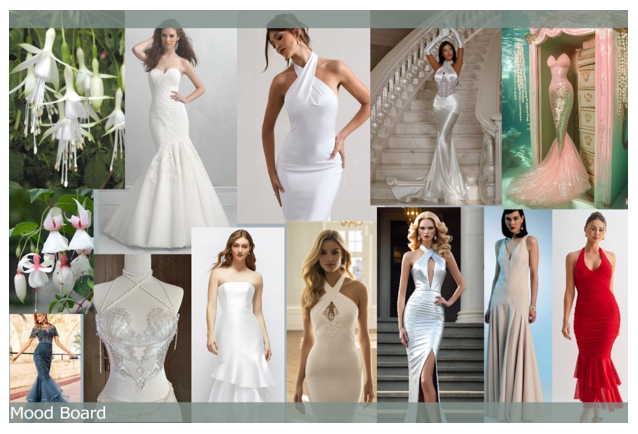
Figure 1 Mood Board.
Figure 2 Pencil sketch showing the initial two-dimensional exploration of silhouette, proportion, neckline placement, and hem structure. At this stage, the drawing functions as an early design draft rather than a technical construction plan.
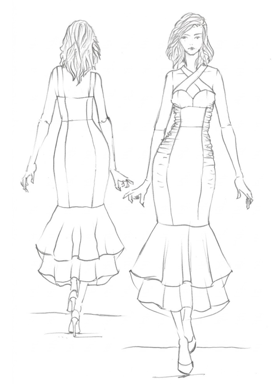
Figure 2 Pencil sketch.
Figure 3 Final fashion illustration showing a more refined visual interpretation of the gown, including surface flow, garment proportion, colors, and visual rhythm. Unlike the pencil sketch, this illustration communicates the intended aesthetic appearance before digital pattern development.
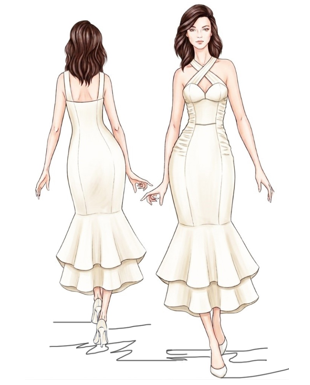
Figure 3 Illustrations.
3d Virtual pattern development and simulation
The illustrated design was translated into digital patterns using CLO3D software. Pattern pieces were developed to support the structured bodice and sectional flared skirt, with careful attention to seam placement, symmetry, and balance within the digital environment. Virtual fabric properties were assigned to approximate the behavior of a medium-weight woven textile. The gown was simulated on a digital avatar to evaluate fit, volume distribution, seam interaction, and hem behavior under gravity. Visual stress indicators and garment balance were analyzed to identify potential structural issues, such as excessive tension or distortion, before any physical material use. This phase functioned as a predictive and exploratory stage, allowing pattern refinements and seam adjustments to be made digitally before proceeding to physical construction. For reproducibility, the CLO3D (version 7.0) simulation was conducted using a standard female avatar in a standing pose. Pattern pieces were arranged around the avatar and simulated under default gravity conditions. A medium-weight woven fabric preset was selected and adjusted to approximate cotton muslin behavior. Key simulation observations included garment pressure, tension distribution, seam alignment, hem balance, and collision behavior between garment layers. Pattern refinements were made digitally by adjusting seam lengths, panel distribution, and flare proportions before physical draping.
Figure 4 Demonstrates Digital pattern layout and seam segmentation of the gown generated in CLO3D, demonstrating pattern logic, structural seam placement, and panel distribution used to support the simulated gown form.
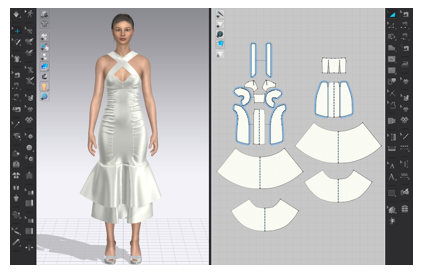
Figure 4 Digital pattern layout.
Figure 5 Illustrates the three-dimensional digital garment simulation created in CLO3D, visualizing the illustrated design on a virtual body avatar and predicting garment volume, drape behavior, and gravitational response.
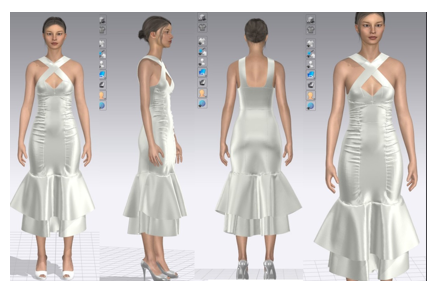
Figure 5 3D Virtual Gown Visualization.
Physical draping and structural validation
Following digital simulation, the gown was physically draped and assembled on a professional dress form using monochromatic grey muslin. The dress form was prepared with clearly marked center front, center back, and horizontal balance references to ensure accurate alignment during draping. Physical draping focused on refining the crossover bodice, stabilizing the fitted torso, and resolving the layered flared hem. Grainline orientation was carefully controlled, and seams were used as structural anchors to manage fabric weight and maintain silhouette balance. Pins were employed as temporary structural points to test tension, drape behavior, and stability. Adjustments were introduced where the physical behavior of the muslin diverged from the predictions of the 3D simulation. The physical prototype was developed using grey cotton muslin as an analytical toile fabric. The dress form was marked at center front, center back, bust, waist, hip, and horizontal balance lines. During draping, seam alignment was checked against these reference lines, and deviations in hem level, torso fit, and strap tension were recorded visually and by measurement. The most visible displacement occurred at the torso-to-hem transition, where the layered hem dropped approximately 1–2 cm under fabric weight.
Figure 6 Demonstrates the physical muslin prototype of the gown draped on a professional dress form (front, side, and back views), executed in monochromatic grey cotton muslin to evaluate silhouette, grainline behavior, seam anchoring, and structural balance. This illustrates the translation of the illustrated drape into a resolved three-dimensional garment form.
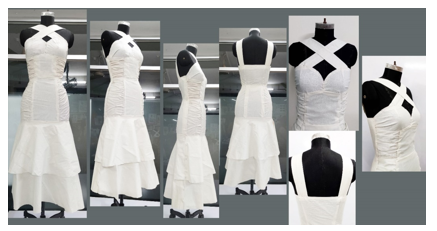
Figure 6 Physical Prototype of the Gown.
Comparative analysis
A comparative analysis was conducted between the hand sketches, illustrations, 3D virtual garment, and the physical muslin prototype. This analysis focused on differences in silhouette volume, fit accuracy, seam performance, grain alignment, and hem flare. Particular attention was given to areas where physical draping required intervention to resolve structural issues that were not fully anticipated in the digital model. These differences were systematically documented as evidence of the translation gap between digital and physical processes.
Documentation and evaluation
Each methodological stage was systematically documented through digital screenshots, pattern layouts, and photographic records of the physical muslin prototype. Qualitative evaluation was based on silhouette accuracy, structural stability, and grainline integrity. The final analysis synthesized observations across all stages to assess the effectiveness of the integrated workflow and to evaluate the role of physical draping in resolving structural and material challenges. The evaluation criteria were applied consistently across all stages to ensure analytical comparability between digital simulation and physical realization.
The outcomes of the integrated workflow applied to the construction of the fitted evening gown are presented, focusing on the comparative behavior of the design across sketch, illustration, 3D virtual simulation, and physical muslin draping. The results are organized around structural resolution, digital accuracy, and material response, with emphasis on areas where physical processes refined the digital model.
Silhouette fidelity across design stages
The overall silhouette remained highly consistent across illustration, simulation, and physical realization. The crossover halter neckline, fitted torso, and flared hem were successfully maintained, indicating continuity between visual intent and structural execution. Minor deviations appeared during physical draping, where a slight downward displacement (approximately 1–2 cm) was observed at the transition between the torso and layered hem. This required localized seam redistribution and grainline adjustment. These variations did not alter the silhouette but reflected the influence of cumulative fabric weight not fully represented in the simulation.
Performance of the crossover halter bodice
The crossover halter neckline was identified as a structurally sensitive zone. In the simulation, strap intersections appeared balanced with stable load distribution. In the physical prototype, directional tension emerged along neckline edges, particularly where grain orientation shifted. Minor misalignment intensified the strain at the intersection points. Adjustments through seam repositioning and reinforced anchoring redistributed tension and stabilized the structure.
Digital and physical comparison of bodice fit
The fitted bodice demonstrated strong agreement between digital and physical stages. CLO3D accurately predicted fit across the bust and waist, requiring minimal structural modification. However, physical draping revealed micro-adjustments not captured digitally, including slight refinements along curved seams to improve smoothness and reduce fabric drag.
Behavior of the layered flared hem
The layered hem showed the most notable divergence between simulation and physical form. While the virtual model maintained uniform flare and symmetry, the muslin prototype exhibited vertical pull due to fabric weight, particularly along straight-grain seams. This resulted in minor irregularities, which were corrected by redistributing volume toward bias-cut sections and adjusting seam orientation.
Grainline orientation and structural stability
Grainline orientation played a critical role in structural performance. Straight grain alignment provided stability within the bodice, while bias sections introduced fluidity in the hem. Physical draping revealed deviations under cumulative weight, requiring strategic seam anchoring to maintain balance and prevent distortion.
Documentation of the translation gap
Differences between simulation and physical realization were observed in fabric resistance, localized stretching, and weight distribution, particularly at structural transition points. These discrepancies required corrective adjustments during draping, demonstrating the limitations of digital prediction in fully representing material behavior.
Table 1 Summarizes the comparative evaluation of structural and material behavior observed in CLO3D simulation and physical muslin draping. It identifies key areas of divergence, including tension, fabric weight effects, and grainline distortion, and documents the corrective interventions applied during the physical development stage.
|
Evaluation area |
CLO3D simulation observation |
Physical muslin observation |
Adjustment required |
|
Torso-to-hem transition |
Balanced transition |
1–2 cm downward displacement |
Seam redistribution and grainline correction |
|
Crossover neckline |
Visually stable |
Localized tension at strap intersection |
Reinforced anchoring and seam adjustment |
|
Bodice fit |
Smooth bust and waist fit |
Minor drag along curved seams |
Curved seam refinement |
|
Layered hem |
Uniform flare |
Slight vertical pull from fabric weight |
Volume redistributed toward bias sections |
|
Grainline |
Digitally aligned |
Small distortion under weight |
Re-pinning and seam anchoring |
Table 1 Comparative evaluation of CLO3D simulation and physical draping outcomes
Summary of Key Findings
The findings demonstrate that garment development operates as an iterative process in which each stage contributes distinct knowledge rather than functioning as a direct translation sequence. While visual and digital stages provide strong predictive insight, their outputs require material validation. The consistency of silhouette across stages indicates that digital simulation effectively supports the preservation of design intent. However, structural discrepancies observed in the physical prototype, particularly at transition zones, highlight the limitations of simulation in representing cumulative fabric weight and localized tension. These limitations become more pronounced in complex constructions involving intersecting forms and layered volumes. The behavior of the crossover halter neckline and layered hem underscores the importance of grainline orientation and seam placement as structural determinants. While simulation can approximate these interactions, it lacks the sensitivity to capture subtle variations arising from fabric response under gravity. Physical draping enables these conditions to be observed and corrected through direct manipulation. These observations support the view that digital tools function most effectively as predictive systems rather than definitive solutions. Their value lies in early-stage evaluation and efficiency, while physical processes remain necessary for achieving structural precision. These findings support previous scholarship that positions digital simulation as a predictive tool rather than a complete substitute for embodied material knowledge. The observed differences in hem weight, grainline distortion, and localized neckline tension confirm the literature’s argument that tactile draping remains necessary for identifying fabric behavior that cannot be fully captured through digital visualization alone. Overall, the study reinforces the importance of integrating digital simulation with material-based practices. The interaction between these approaches allows for both conceptual clarity and technical resolution, particularly in garments where structural complexity and fluidity must coexist.
This study examined the transition from two-dimensional design representation to three-dimensional garment realization through an integrated workflow involving illustration, digital simulation, and physical draping. The findings demonstrate that garment construction is a recursive process in which each stage contributes to progressive refinement. The research confirms that digital simulation provides reliable predictions of silhouette and fit, while physical draping is essential for resolving structural conditions related to material behavior. The combined use of these approaches enables a more accurate alignment between design intent and constructed form. The methodological framework presented in this study offers a structured approach for bridging conceptual design and technical execution. It provides practical value for designers and educators by illustrating how digital and physical processes can be coordinated to improve both efficiency and accuracy. Ultimately, the successful realization of complex garments depends on the integration of visual design, computational modeling, and material engagement, ensuring that aesthetic intent is supported by structural coherence. Future research may expand this framework by comparing multiple gown silhouettes, different fabric types, and varied fabric weights to evaluate how simulation accuracy changes across materials. Further studies may also incorporate quantitative fabric testing, wearer movement analysis, and side-by-side measurement of digital and physical garment deformation to strengthen technical validation.
The authors gratefully acknowledge the Department of Fashion Design & Technology at Sonargaon University (SU) for providing the facilities and materials required for this research. The authors also thank Arfa Ibnat, Soborna Akter, Israt Jahan, Rukaeya Yesmin Mim, Israth Jahan Rim, and Khadija Khanom Masu for their contributions to the development of fashion illustrations and muslin prototypes.
None.
The author declares no conflict of interest.

©2026 Habib, et al. This is an open access article distributed under the terms of the, which permits unrestricted use, distribution, and build upon your work non-commercially.