Journal of
eISSN: 2574-8114


Research Article Volume 11 Issue 6
 Tufayel Ahmed,1 Tanzila Akter Shima,1 MD Mehedi Hasan,1 MD Zobayer Alam2
1Department of Fashion Design & Technology (FDT), Sonargaon University (SU), Dhaka, Bangladesh
2Dhaka Institute of Fashion and Technology (DIFT), Dhaka, Bangladesh
Correspondence: Md Ahshan Habib, Department of Fashion Design & Technology (FDT), Sonargaon University (SU), Dhaka, Bangladesh
Received: November 21, 2025 | Published: December 2, 2025
Citation: Habib A, Ahmed T, Shima TA, et al. Innovating sustainable denim aesthetics through ozone, laser, and enzyme finishing technologies. J Textile Eng Fashion Technol. 2025;11(6):317-324. DOI: 10.15406/jteft.2025.11.00439
This study investigates the evolution of denim aesthetics through ozone, laser, and enzyme finishing technologies, analyzing their effects on sustainability, visual appeal, mechanical properties, and fabric integrity. Traditional denim finishing processes, which rely heavily on water, chemicals, and energy, pose significant environmental challenges. Modern finishing technologies offer eco-friendly alternatives while achieving diverse and desirable fabric aesthetics. Ozone washing employs a gas-based process to bleach denim, reducing water consumption by up to 80% and eliminating harsh chemicals such as hypochlorite, producing a soft, vintage appearance with minimal environmental impact. Laser technology enables precise creation of localized fading, whiskers, and distressing effects without water or chemicals, reducing labor, processing time, and energy use. Enzyme washing utilizes naturally occurring cellulose enzymes to partially degrade cotton fibers, achieving a soft hand feel and faded look similar to stonewashing but with far less water and without pumice stones, preventing damage to machinery and fabrics. The study systematically reviews existing literature to compare aesthetic outcomes including color depth, contrast, texture, and wear patterns .Environmental impacts reported in previous studies are also analyzed. Findings indicate that while each technology offers unique aesthetic and performance advantages, their combined application provides exceptional creative flexibility and enhanced sustainability. Integrating ozone, laser, and enzyme finishing allows the denim industry to meet consumer demand for fashionable, high-quality garments while substantially reducing environmental impact.
Keywords: denim, aesthetics, ozone wash, laser wash, enzyme wash, sustainability, fashion technology, eco-friendly finishing
The global significance and environmental crisis of denim
Denim, a world-renowned textile characterized by its durable twill weave, indigo-dyed warp, and white weft yarns,1 has evolved from 19th-century workwear into a global fashion staple, symbolizing durability, cultural movements, and high-end style.2,3 It’s intrinsic aesthetic appeal driven by its signature diagonal ribbing and capacity for attractive fading and aging patterns ensures its constant demand across all consumer demographics.4,5 This enduring popularity makes denim production a massive global enterprise, with major manufacturing powerhouses including China (30%), India (20%), and Turkey (8%), as well as key exporters like Pakistan (12%), Bangladesh (10%) Figure 1, which leverages its integrated textile ecosystem.3
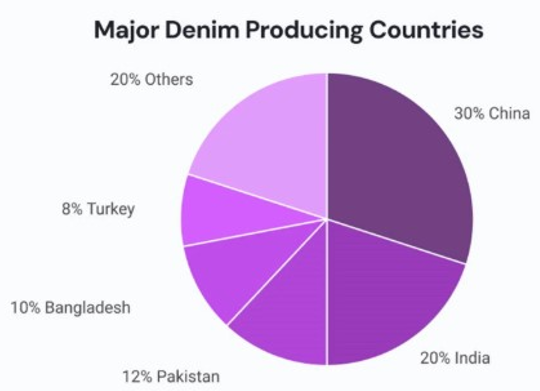
Figure 1 Major Denim-producing countries based on global market distribution.3
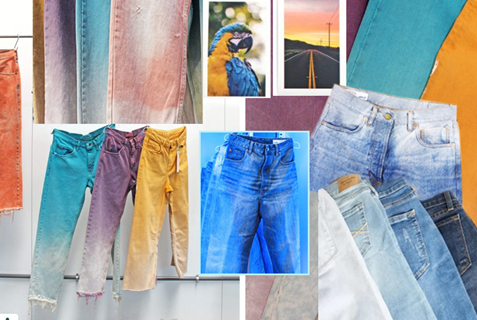
The sheer volume of global denim production, coupled with the consumer demand for diverse aesthetic effects such as the hand-painted and graphic designs seen in contemporary customization in Figure 2 has created a monumental environmental challenge.6,7

Figure 2 Examples of contemporary artistic denim customization showcasing hand-painted illustrations (picture collected from etsy.com and composed by author)
Quantifying the sustainability problem
The core of denim’s environmental crisis lies in its finishing and washing processes, which are essential to achieve the desired softness, suppleness, and the highly-valued distressed, aged appearance.8 These traditional finishing methods which rely on mechanical, chemical, and wet processes are devastatingly resource-intensive.9
Integrating Environmental Data: Estimates show that the production of just one pair of finished jeans requires, on average, 3,000 to 4,000 liters of water, with some least-efficient processes exceeding 10,000 liters.10 Beyond water consumption, these conventional garment washing techniques necessitate vast quantities of energy, time, and hazardous chemicals, directly contradicting global sustainability goals.9
The shift to sustainable finishing technologies
Recognizing the urgent need to decouple aesthetic appeal from environmental damage, the denim industry is rapidly shifting toward three primary sustainable finishing technologies: Ozone washing, Laser finishing, and Enzyme application. These processes offer viable, resource-efficient alternatives to traditional methods like stone washing, which are the main culprits behind the industry's massive ecological footprint.
Ozone washing: This process uses ozone gas in an enclosed chamber to achieve bleaching and fading effects on denim, drastically reducing water and chemical consumption compared to conventional wet processes.
Laser finishing: This technology employs high-precision lasers to burn off indigo dye and create intricate patterns, whiskering, and localized abrasion, eliminating the need for large quantities of water and toxic chemicals used in mechanical methods.
Enzyme application: Utilizing biodegradable biological catalysts (cellulases) to soften and selectively remove surface indigo, enzyme washing provides aesthetic effects with significantly lower energy and chemical input than pumice stone washing.
The viability of these sustainable techniques for industrial adoption hinges not just on environmental metrics, but also on their ability to consistently meet consumer demands regarding aesthetic quality and maintain the crucial mechanical integrity (e.g., strength and durability) of the final garment.4,11
Research gap and study objective
While previous studies have addressed the sustainability of individual finishing technologies, a gap remains in providing a structured, objective, and synthesized comparison that simultaneously evaluates the aesthetic, mechanical, and environmental attributes of ozone, laser, and enzyme technologies against the backdrop of industrial applicability.
Objective: Therefore, this study presents a structured, comparative analysis of Ozone washing, Laser finishing, and Enzyme application in sustainable denim finishing. Utilizing a robust methodology, the work aims to synthesize the advantages and limitations of each technology, providing a clear reference for industry stakeholders on the optimal integration of these techniques to achieve aesthetic excellence while maximizing sustainability and maintaining crucial garment performance.
Structured comparative analysis
This study employed a Structured Literature Review approach using secondary data to conduct an objective, comparative analysis of three sustainable denim finishing technologies: Ozone washing, Laser finishing, and Enzyme application. The focus is strictly on aesthetic outcomes and environmental sustainability.
Literature search strategy
Studies were systematically sourced from major academic databases (e.g., Scopus, Web of Science, ScienceDirect). The search used targeted keywords, including "sustainable denim finishing," "ozone washing textile," "laser denim fading," "enzyme finishing," and their combination with terms like "aesthetic evaluation" and "environmental impact." The search scope was limited to publications between 2015 and 2024.
Inclusion and Exclusion criteria
To focus the analysis on relevant findings, the following criteria were applied:
|
Criterion Type |
Inclusion Criteria (Selected) |
Exclusion Criteria (Rejected) |
|
Scope |
Must evaluate the finishing effect of Ozone, Laser, or Enzymes on denim fabric/garments. |
Studies focused on raw fiber, dyeing, or non-denim materials. |
|
Data Type |
Must report quantifiable metrics in both the aesthetic and environmental domains. |
Descriptive articles or those focused solely on the mechanical performance of the fabric. |
|
Format |
Peer-reviewed journal articles and scholarly reviews published in English. |
Patents, technical reports, or conference abstracts. |
Selection process and total works analyzed
After the initial search, screening, and full-text review, a final set was determined:
Total Number of Selected Works: 42 original research and synthesis articles were selected for systematic content analysis.
Content analysis protocol
A rigorous content analysis protocol was used for objective data extraction and synthesis into the comparative framework:
Aesthetic Attributes: Extracted metrics included Color Difference (L*, a*, b*), Fading Index (K/S), and the nature of the achieved visual effect (e.g., contrast, uniformity).
Environmental Attributes: Data quantifying sustainability benefits included Water Consumption Reduction (%), Energy Consumption (kWh or % reduction), and the Elimination of Hazardous Chemicals.
Theoretical framework and detailed review of sustainable finishing technologies
The textile industry utilizes extensive finishing processes to meet consumer demand for comfortable, aesthetically appealing denim. While traditional methods like stone washing and chemical bleaching achieve desired distressed effects, they are highly resource-intensive, consuming excessive water, energy, and chemicals, and generating hazardous waste, along with posing occupational risks. To address these environmental and health challenges, manufacturers are adopting sustainable, precise alternatives specifically enzyme treatments, ozone washing, and laser finishing. These emerging technologies provide eco-friendly, dry solutions that drastically reduce resource consumption and occupational hazards while ensuring consistent aesthetic outcomes and garment performance.12
Industrial washing era (1970s–1980s)
The shift of denim from work-wear to fashion in the 1970s and 1980s created demand for softer, pre-aged garments with a worn appearance, leading to the rise of industrial washing processes.13 Early methods, such as rinse washing with softeners, removed residual dyes and sizing to enhance softness. Stone washing, popularized in the late 1970s, used pumice stones in tumblers to abrade the fabric, creating faded, worn effects. Acid washing emerged in the 1980s, employing pumice stones soaked in oxidizing agents like sodium hypochlorite or potassium permanganate to produce high-contrast patterns.14
While effective in achieving desired aesthetics, these techniques consumed large amounts of water and energy, compromised fabric integrity, and generated chemical and pumice stone waste, highlighting the environmental challenges of early mechanized denim finishing.
Denim washing is a cosmetic procedure that improves a fabric's suppleness and comfort. Denim cloth can be washed with a variety of enzymes. Denim finishers currently employ cellulose enzyme to speed up the abrasion process. Several kilograms of stones can be replaced with a tiny amount of enzyme, which affects the characteristics of the denim fabric. Cellulose operates on the surface, smoothing it, preventing pill formation, reducing water consumption, and eliminating the need for pumice stones that can damage machinery and fabrics.15,16
Ozone finishing technologies: advancing sustainable and aesthetic denim
Ozone washing is an innovative waterless technology, and ozone imposes crucial effects on clothing and the environment. For instance, the production of denim alone consumes approximately 350 million m³ of water annually.17 Finishing denim jeans with ozone offers ecological and economic advantages by decreasing rinsing times and reducing water and energy consumption. Figure 3 Ozone system configuration for textile processing, showing the oxygen concentrator, filtration unit, ozone generator, ozone-resistant flow meter, injection line, washing chamber, and ozone destructor.
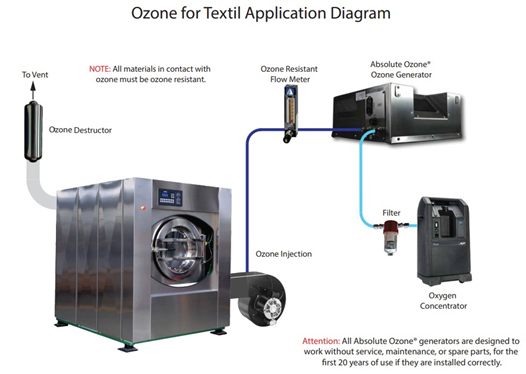
Figure 3 Ozone for Textile Application Diagram.17
Ozone, a selective oxidant with high reduction potential, decolorizes textile effluents and reacts effectively with indigo. This study examines the effect of ozone on denim color change and its application in fashion aesthetics.18 Figure 4 Jeans treated with ozone, illustrating a range of color effects including lightening, gradient fading, and uniform tonal changes achieved through ozone-based finishing processes.
Ozone washing is a sustainable chemical process that provides significant advantages over conventional denim finishing.21 As a powerful oxidant, ozone delivers desirable faded and vintage looks while reducing environmental impact, offering an eco-friendly alternative to water- and chemical-intensive methods.
Sustainable advantages: Ozone finishing reduces water and chemical consumption by 85–95%, saves 62–80% energy, and halves production times. It generates minimal wastewater and eliminates harmful byproducts, making it cost-effective and environmentally friendly. The process can be applied in both dry and wet systems, enhancing flexibility and sustainability
Aesthetic and functional outcomes: Ozone finishing achieves controlled fading, bleaching, and vintage effects comparable to or better than traditional stone or chemical washes. Denim can be bleached and back stains reduced in just 15 minutes, versus 30–45 minutes with conventional methods, without significantly affecting fabric strength. This accelerates production and ensures consistent, fashionable denim effects.22 Overall, ozone finishing combines fashionable aesthetics, fabric preservation, and superior environmental performance, making it a sustainable and efficient solution for modern denim production.
Laser finishing technologies: driving sustainable innovation in denim aesthetics
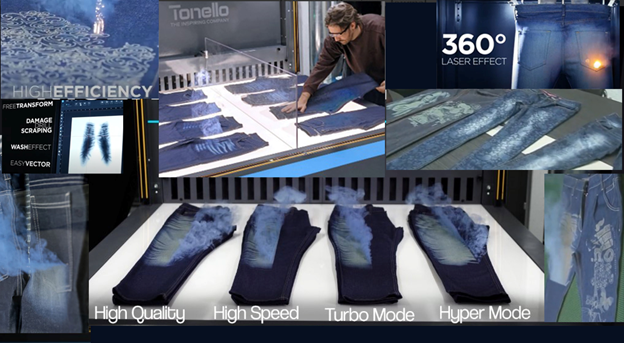
Laser is the fastest growing and most accepted new technique in the denim finishing market.23 The technology has been able to replicate most of the wash effects with the various shade like the stone wash, mill wash, moon wash, bleach, PP spray, monkey wash, cat whiskers, snow wash, holing, tinting and so on.24 Figure 5 this figure illustrates a modern, high-efficiency, and high-speed process for finishing denim garments, typically to create vintage, faded, or distressed effects. Showcasing multiple jeans undergoing laser treatment in various modes (Turbo Mode, Hyper Mode) to achieve effects like scrapes, wash effects, and damage. The process emphasizes high quality and high speed, demonstrating advanced, automated, and environmentally friendlier alternatives to traditional denim finishing techniques (e.g., manual scraping or chemical treatments).
Laser treatment is a clean, low-cost, low-impact, water-free process. In textiles, the CO₂ laser is the most commonly used for color fading. As a major advancement in sustainable finishing, CO₂ lasers provide precise, localized fading, whiskers, and patterning without water or chemicals, reducing energy use and production time. Laser irradiation also enhances dye absorption in synthetic blends and reduces shrinkage and felting, showing its versatility and precision in modern textile applications.12
Laser treatment of denim fabrics has been demonstrated as an effective method for producing distressed effects, attracting textile and fashion designers to develop bespoke designs appealing to all age groups.25 Laser finishing technologies are revolutionizing denim manufacturing by enabling precise, creative, and sustainable aesthetic effects.26 As environmental concerns grow, lasers offer a dry, chemical-free alternative to traditional denim finishing, reducing resource use while expanding design possibilities. Figure 6 Garment featuring laser-printed denim patterns, demonstrating precision surface texturing and controlled tonal variation achievable through laser-based denim finishing techniques.

Figure 6 Example of Laser Printed finishing techniques Denim.26
Sustainability and environmental impact: Laser fading preserves fabric qualities with minimal color change and can even improve properties such as rip strength and shrinkage. The CO2 laser is the most viable option due to its unique interaction properties, energy efficiency, and cost-effectiveness compared to other lasers.27
Laser finishing is a waterless, eco-friendly technique that drastically reduces water and chemical use, eliminating hazardous substances involved in stone washing, bleaching, or sandblasting. Studies report up to 97% water savings, 70–90% energy reduction, and 60–70% lower chemical costs, with minimal waste and pollution. The process also enhances worker safety by avoiding harmful dust and chemical exposure.28
In addition to its sustainability, laser finishing efficiently fades denim and enables precise, creative effects in minutes, providing reproducible results at lower production costs.
Aesthetic versatility and design innovation: Lasers can partially remove indigo dye from denim surfaces to produce controlled fading and distressed effects.29 CO2 lasers allow adjustment of color hue, brightness, and saturation in both lightweight and heavyweight denim.25 This enables a wide range of fashionable effects, including whiskering, intricate patterns, and three-dimensional textures. Computer-controlled systems provide high precision, repeatability, and rapid prototyping, surpassing traditional hand-crafted techniques. Figure 7 depicts Laser-cut denim demonstrating fine decorative detailing and aesthetic versatility across footwear, garments, and accessories.

Figure 7 Examples of laser-cut denim designs, illustrating precision-cut patterns applied to shoes, jeans, dresses, and bags.30
Laser finishing is also compatible with circular fashion and upcycling, supporting creative reuse of denim waste. Figure 8 Schematic representation of sustainable denim manufacturing using ozone (O3) and laser technologies, highlighting their role in reducing chemical, water, and energy usage to produce eco-friendly denim garments.
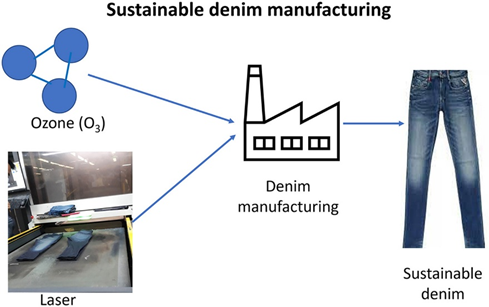
Figure 8 Sustainable Denim Manufacturing Process.28
Overall, laser finishing technologies provide sustainable, efficient, and highly creative denim aesthetics, establishing them as a leading solution for eco-friendly and innovative denim manufacturing.
Aesthetical analysis of enzyme-washed denim
Enzyme washing or “bio stoning” is a textile finishing process or technique in which enzymes are applied to denim or fabric to get a special look, such as stone washing, a softer feel, or a vintage or weathered look.31 Figure 9 portrays Denim enzyme wash treatment illustrating softened texture and natural fading achieved through enzymatic processing.

Figure 9 Denim enzyme wash treatment.31
Enzymes are a key focus in textile wet processing due to their contribution to sustainable development and low energy consumption.32 In denim finishing, enzymatic washing commonly known as “Biowashing” is highly valued because enzymes are substrate-specific, catalyzing only particular reactions.33 Enzyme-washed denim achieves a distinctive aged appearance, enhanced softness, and improved comfort while maintaining fabric strength and offering environmental benefits.
The most common denim washing methods include enzyme, bleach, acid, normal, and stone washes, with enzymatic washing widely used in industry. Although cellulose may slightly reduce cellulose strength, it improves fiber flexibility, appearance, and softness. This study applied cellulose-based washing to develop a sustainable, eco-friendly process producing value-added denim with high wear performance, examining the effects of different wash parameters.34 Enzyme washing reduces chemical toxicity, water and energy use, and pumice consumption while producing soft, aged aesthetics. With proper control of enzyme type, concentration, time, and pH, it offers a greener alternative to traditional washes and supports sustainable denim production.
Key effects of enzymatic washing: Enzymes such as cellulose, amylase, and laccase target surface fibers to deliver controlled fading of indigo and sulfur dyes (optimal at 65°C for 45 minutes), removal of surface hairiness, increased fabric flexibility, and improved drape. Properly optimized enzyme washing preserves tensile and seam strength, minimizes weight loss, and can enhance tear strength and crease recovery. Functional benefits include UV protection, antibacterial properties, and reduced pilling. Overall, enzymatic processes are more sustainable than stone or acid washes, generating less polluted effluent and requiring less water and energy.33 Figure 10 Denim enzyme wash treatment showing the softened texture, enhanced color contrast, and natural fading effects produced by enzymatic bio-polishing, which provides a more sustainable alternative to traditional stone-washing methods.
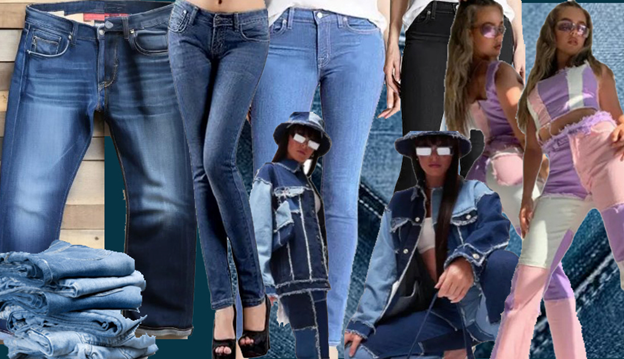
Figure 10 Effects of Enzymatic Washing.35
Together, the innovations of ozone, laser, and enzyme finishing demonstrate the convergence of textile engineering and fashion aesthetics. Integrating these technologies enables the production of denim that is visually and tactically appealing while addressing environmental challenges. Sustainable finishing meets consumer demand for eco-friendly fashion by reducing water, chemical, and energy consumption while maintaining high-quality garments. This study investigates the aesthetic, mechanical, and environmental outcomes of ozone, laser, and enzyme finishing, providing insights that support environmentally responsible practices in denim manufacturing while meeting expectations for fashionable, high-quality products. Research has shown that finishing processes significantly influence denim’s physical, mechanical, and hand properties, affecting garment comfort, durability, and visual appeal. Sustainable finishing technologies mitigate the environmental challenges of conventional methods, making the denim industry more resource-efficient and socially responsible. The literature emphasizes that as consumer preferences shift toward sustainable and aesthetically diverse products, the adoption of eco-friendly denim finishing becomes increasingly essential. Ongoing research into the optimization of enzyme, ozone, and laser treatments provides valuable guidance for balancing environmental sustainability with desired fabric characteristics. Overall, current studies highlight that sustainable denim washing and finishing processes are crucial for meeting contemporary fashion demands while minimizing environmental impact, supporting continuous innovation and the broader adoption of eco-friendly finishing technologies in denim manufacturing.
The structured literature review of 41 selected articles established distinct and complementary findings regarding the performance of ozone, laser, and enzyme finishing technologies across the aesthetic and environmental domains. The synthesis of these findings is presented in Table 1 and Figure 11.
Figure 10 Integrated effects of advanced finishing techniques on denim aesthetics and sustainability.35
Comparative performance synthesis
Table 1 provides a side-by-side comparison of the three sustainable finishing technologies based on the systematic extraction of data defined in the Content Analysis Protocol. This synthesis highlights the unique advantages and operational trade-offs of each method.
|
Aspect |
Ozone finishing |
Laser finishing |
Enzyme finishing |
|
Aesthetic Outcomes |
Uniform faded look, soft hand feel, vintage appearance |
Precise localized effects (whiskers, creases, patterns), high creative flexibility |
Naturally worn look, softened fabric, similar to stonewashing |
|
Water Consumption |
Reduces by up to 80% |
Zero water usage |
Reduces by up to 80% |
|
Chemical Usage |
Low chemical input; eliminates harsh oxidants |
Minimal chemical input |
Low chemical input; reduces toxic discharge |
|
Energy Use |
Lower due to low-temperature processing |
Reduced due to shorter operation time |
Moderate reduction; less mechanical abrasion |
|
Environmental Impact |
Minimal wastewater, reduced emissions |
Minimal wastewater, low GHG emissions |
Reduced effluent, lower environmental footprint |
|
Overall Advantage |
Balanced aesthetic with eco-efficiency |
Precise, reproducible, creative patterns without water |
Soft, aged appearance with sustainable process |
Table 1 Comparative analysis of ozone, laser, and enzyme finishing technologies
Aesthetic and environmental outcomes
Analysis of the extracted data confirms complementary performance across the two key domains:
Aesthetic Outcomes: Data synthesis, relying on metrics such as Color Difference (L*, a*, b*) and the Fading Index (K/S), showed that all three technologies successfully achieve desirable aging and fading effects. Laser finishing was consistently found to enable the highest level of precise, localized effects, which are difficult to replicate manually. Ozone and Enzyme finishing provided effective, scalable solutions for achieving uniform fading and a softened hand feel.
Environmental Impact: A review of resource consumption data confirmed the substantial environmental advantage of all sustainable methods. Laser finishing was the only method consistently documented as utilizing zero water usage. Both Ozone and Enzyme finishing demonstrated reliable capacity to reduce water consumption by up to 80% compared to traditional wet processing. All three methods showed significantly lower chemical input and reduced energy use due to optimized processing parameters.
Integrated effects
The visual representation in Figure 11 illustrates the synergistic potential of combining these technologies. The intersection highlights how integrated application allows manufacturers to achieve optimal aesthetic versatility while collectively driving the minimal environmental impact.
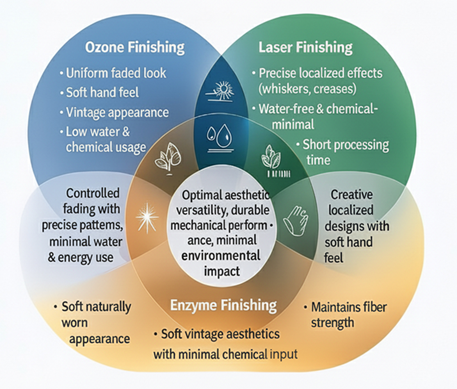
Figure 11 Integrated effects of advanced finishing techniques on denim aesthetics and sustainability
Aesthetic implications of sustainable finishing
The structured analysis confirms that sustainable finishing technologies ozone, laser, and enzymes not only replicate but significantly advance traditional denim aesthetics. The data demonstrates that the industry is no longer forced to compromise visual appeal for eco-friendliness. Ozone washing offers a reliable path to consistent, soft vintage finishes, providing a cost-effective, high-volume aesthetic solution. Conversely, laser finishing represents a paradigm shift toward precision, enabling detailed patterns and whiskers that are unattainable through conventional methods. This shift provides designers with a new, highly controlled vocabulary, allowing for greater creative freedom and reproducibility across production batches. Enzyme finishing successfully bridges the gap between traditional stonewash looks and modern sustainability, retaining the desirable naturally worn texture while mitigating severe environmental consequences.
Environmental significance and resource efficiency
The performance data synthesized in this study underscores the immense environmental value of these technologies, positioning them as essential for circular production models. Laser finishing’s zero-water requirement offers a complete solution for water-scarce regions, while the significant water reductions enabled by ozone and enzyme treatments (up to 80%) directly align with global efforts to minimize industrial water footprints. Furthermore, the systematic reduction in chemical demand specifically the elimination of harsh oxidants improves worker safety and drastically lowers the toxicity of industrial effluent. These improvements demonstrate that adopting advanced finishing is not only an ethical imperative but also a strategic operational advantage due to reduced resource expenditure and simplified wastewater treatment.
Integration and industry implications
The greatest potential lies in the synergistic application of these technologies, as highlighted in Figure 11. By integrating ozone (for overall garment fading), laser (for localized contrast and details), and enzymes (for final hand feel), manufacturers achieve a trifecta of aesthetic versatility, maintained durability, and maximum resource efficiency. This integrated approach is crucial for meeting the rising consumer demand for high-quality, fashionable denim explicitly marked by environmental credentials. The findings validate that embracing innovation allows the denim sector to transition from a resource-intensive legacy model to a responsible, future-proof industry, ensuring profitability is compatible with rigorous sustainability standards.36–39
Limitations and future directions
This study is constrained by its reliance on secondary data, which may vary in methodological rigor and reporting standards across sources. To transition these findings into industrial best practices, empirical validation through pilot-scale or industrial-scale trials is necessary to confirm the combined effects of these technologies under controlled production conditions. Future research should also investigate consumer perceptions of sustainably finished denim, quantifying the market value of aesthetic appeal, tactile quality, and environmental credentials, thereby providing actionable insights to accelerate industry adoption.
This structured comparative analysis of Ozone, Laser, and Enzyme finishing technologies confirms their critical role in advancing sustainable denim production while simultaneously enhancing aesthetic outcomes. The study established that sustainable technologies successfully deliver highly desirable denim aesthetics, offering specialized benefits such as the uniform vintage look from ozone, the precise, localized contrast from laser finishing, and the soft, naturally worn hand feel from enzymes, thereby eliminating the need to compromise visual appeal for eco-friendliness. Furthermore, all three technologies provide robust solutions for reducing the denim industry’s ecological footprint: Laser finishing offers the highest resource efficiency by eliminating water usage entirely, while Ozone and Enzyme treatments provide scalable wet processes that reliably reduce water consumption by up to $80\%$ and minimize reliance on hazardous chemicals. Ultimately, the greatest potential lies in the integrated application of these technologies. This synergistic approach allows manufacturers to achieve the highest degree of creative versatility and aesthetic quality while ensuring maximum resource efficiency, validating a path toward profitable and responsible circular production. In conclusion, the findings provide a clear reference for industry stakeholders, demonstrating that the strategic adoption of Ozone, Laser, and Enzyme finishing is essential for transforming the denim sector from a resource-intensive legacy model into an innovative, sustainable, and future-proof enterprise.
None.
None.
No conflict of interest declared.

©2025 Habib, et al. This is an open access article distributed under the terms of the, which permits unrestricted use, distribution, and build upon your work non-commercially.