Journal of
eISSN: 2373-6445


Narative Review Volume 16 Issue 5
1Nurse and Undergraduate Student in Psychology, Maurício de Nassau University Center of João Pessoa (PB), Master's in Nursing, Postgraduate Program in Nursing (PPGENF), Federal University of Pernambuco (UFPE), Specialist in Public Health Nursing, Federal University of São Paulo (UNIFESP), Brazil
2Estudante da Graduação em Psicologia, Centro Universitário Maurício de Nassau de João Pessoa (PB), Brazil
Correspondence: David Escrig, Psychology Department, Maurício de Nassau University Center of João Pessoa, Brazil, Tel +5583996365740
Received: November 26, 2025 | Published: October 31, 2025
Citation: Caxias MA, Escrig D, Silva LM,et al. Vivences and meanings of psychology students in a spiritist institution for institutionalized elderly in northeast Brazil: an experience report of knowledge in the light of phenomenology. J Psychol Clin Psychiatry. 2025;16(5):231-234. DOI: 10.15406/jpcpy.2025.16.00837
Objective: to reveal the experiences and meanings of psychology students in a Spiritist institution for institutionalized elderly people in Northeast Brazil.
Introduction: the technical visit is a space for experiences of integration between teaching, work and learning, which can enable the realization of knowledge in professional actions and allow the student to interact with people of different identities. Given this diversity the experience of inclusion in the internship field is related to the individuals' perception of their acceptance, respect and appreciation, based on their individual and group identity. Considering that institutionalization often represents the only possibility of survival for the elderly, being fraught with suffering and limitations that interfere with living conditions, the participation of the collective subject makes it possible to replicate feelings and moments that can be explored in a remarkable way for the life of that person, whether the academic or the elderly person themselves.
Method: experience report of a technical visit carried out through a mandatory discipline for professional training in the undergraduate psychology program, which took place in October 2025, at a long-term spiritualist institution for the elderly, in Northeast Brazil. The technical visit was structured following the conceptual model Knowledge to Action Cycle, divided into four phases: 1: planning and organization; 2) theoretical block; 3) practical block; and 4) monitoring the use of knowledge. In phase 4, the final objective was to publish this experience in the public domain for access throughout the global territory, for academic purposes and to contribute to quality training in psychology, demonstrating the importance of mandatory curricular subjects that enable such experiences in the teaching and learning process. Phenomenology was used in this scientific work to thoroughly elucidate the processes evidenced by undergraduate psychology students with institutionalized elderly people.
Results and discussion: the results will be presented and discussed through two thematic categories defined in the study, based on the experience of the process for organizing and executing the technical visit, diagrammed by the mandatory discipline in the training process. The students' experience with institutionalized elderly people and the use of phenomenology to analyze this context will be addressed.
Conclusion: the use of the Knowledge to Action Cycle model for translating knowledge through technical visits proved to be a relevant strategy in enabling undergraduate psychology students to experience the process of their training and provoke individual changes and changes in their future professional practices. The model can also be replicated in other contexts. It was found that Brazilian psychology students understand phenomenological psychology as an approach that also applies to psychology. Various concepts from phenomenology and phenomenological psychology can be used to describe their practices, but they do not correspond to Husserl's proposal for phenomenology and phenomenological psychology.
Keywords: academic training, psychology, aged, phenomenology, knowledge
The internship is a transition from academic life to the world of work, where students have the opportunity to apply the knowledge acquired throughout their studies to carry out activities in professional contexts and recognize the strengths and limitations of professional practice. In the case of psychology training, the internship also provides an opportunity to interact with other professionals, healthcare service users, and those in Long-Term Care Facilities (LTCFs). In this sense, internships and technical visits are understood as a space for experiences and meanings for the integration of teaching, learning, and work. Considering this rite of passage, this study sought to uncover the experiences and meanings of psychology students at a Spiritist institution for institutionalized elderly people in Northeastern Brazil.1–4
Various circumstances lead people to experience different phases of life better or worse. However, old age seems to be the time when coping with the adversities imposed by daily life becomes more complex. Elderly people are prone to loss and dependence throughout their lives, because even if they are in good health, they progressively weaken.5 Concern about the vulnerability of older adults has been growing in recent decades, driven by the intense aging of the population. The challenges facing this reality are particularly acute in developing countries like Brazil, which lack the social resources to serve this segment of the population. It is estimated that, in 2025, among the ten countries in the world with the largest number of elderly people, five will be developing countries, including Brazil.6
This experience report aims to draw attention to the importance of the mandatory curricular internship in the process of training for undergraduate psychology, demonstrating the spheres of experience in relation to institutionalized elderly people in a long-term spiritualist institution in Northeast Brazil. Psychology training in our country is regulated by Resolution No. 05 of the Higher Education Chamber (CES) of the National Education Council (CNES) of March 15, 2011, which establishes the National Curricular Guidelines. Developed through extensive discussion, it is based on the concepts of competencies and skills, organizing them into a Common Core, with its Structuring Axes, and Diversified Parts, with their Curricular Emphases.7
For such experiences and meanings in this experience report, we seek to recover the dialogue between psychology, phenomenology and the different forms of psychology, in order to enrich and expand it, even if it is necessary to highlight their divergences. To this end, we seek to contemplate one of the pillars of meaning, such as the methodological and conceptual applicability of the relationship between psychology and phenomenology and the unveiling of its method. We can approach the phenomenological psychology that Husserl developed throughout his work, integrated with philosophical phenomenology. Seeking to understand the possibility of knowledge, Husserl begins to problematize psychology in the preface to the Logical Investigations of 2014. In this work, the philosopher states that they began with the conviction that the logic of deductive sciences should start from psychology, however, the way in which it was constituted – as a natural, empirical science – did not satisfy him.8–10
The contribution of this study is the possibility of using the conceptual model Knowledge to Action Cycle11 in other contexts as a way of translating knowledge, in order to equip undergraduate psychology students who work in the theoretical-practical and teaching-learning fusion, and also to fulfill one of the mandatory objectives in their training process. Let us reflect on the following research question: what is the importance of enabling moments of experience for psychology students in a Spiritist institution for institutionalized elderly people in their training process?
This is an experience report on a technical visit by university students, carried out through a mandatory subject for professional training in the undergraduate psychology program, which took place in October 2025, in a long-term spiritualist institution for the elderly, in Northeast Brazil, coordinated by the professor of the mandatory curricular subject of a private university.
The technical visit was carried out as a knowledge translation strategy as a partial requirement for the completion of a mandatory curricular subject: “Interdisciplinary Practical Extension Activities I (Psychology)”, based on the need to disseminate and raise awareness among other students about the knowledge of the subject, the results of the study and engage in the implementation of new practices in other services in general, the discipline that gave rise to this experience report aimed to train psychology students to integrate theoretical knowledge of psychology with practice, through projects that involve the external community and other disciplines, providing appropriate, accessible and summarized information on the evidence on the topic and advising on the planning of actions for the institution itself.
The epistemological and methodological foundation that guided this experience report was based on Phenomenology8 which, in its complexity, invites us to return to things, seeking meaning in knowledge based on intentional consciousness and its relational characteristic with the lived world of the participants. The attitude of psychology students highlights the descriptive and comprehensive bias of the phenomenon studied, that is, of institutionalized elderly people, which in a brief analysis reiterates the authorship and subjectivity of those involved in the study. The unique application of the phenomenological method to empirical research is subject to improvement, since it draws on Husserlian inspiration in a philosophical field. The implementation of the analysis is guided by the search for meaning based on parenthetical description (epoché or phenomenological reduction) and the intersubjective/intentional stance throughout the process of constructing knowledge.13
It is not about carrying out an objectification of subjectivity, nor about concluding the study with the singularity of the reports of each subject or of the collective subject, but about carrying out the search for common traits and moving from singularity to an exercise of generality of the experience in the theme, without losing the dimension that it is a temporal and spatial cut of the phenomenon.14
To this end, we followed the following analytical steps: (a) preliminary analysis: transcription, approximation, and corrections of the experiences and their meanings carried out by each student, supported by suspenseful attention; (b) contemplative analysis: careful reading of the transcripts of the conversations and field notebook records, aiming to approximate the participants' experiences, without seeking to include an interpretative meaning in them; (c) descriptive analysis: descriptive compilation of the technical visits. This was a moment of contact with the synthetic description of the students' experiences, with the primary purpose of giving visibility to the lived phenomenon; (d) comprehensive analysis: the research corpus was analyzed through the construction of two units of meaning.15
The conceptual model Knowledge to Action Cycle was adopted, in which the knowledge creation cycle is subdivided into three phases and the action cycle is composed of seven stages, as shown in the circle in Figure 1. It should be noted that these steps are interactive and often occur in an overlapping or disorganized manner. The university technical visit was organized by distributing the components of this conceptual model into four phases, as shown in Figure 1.12
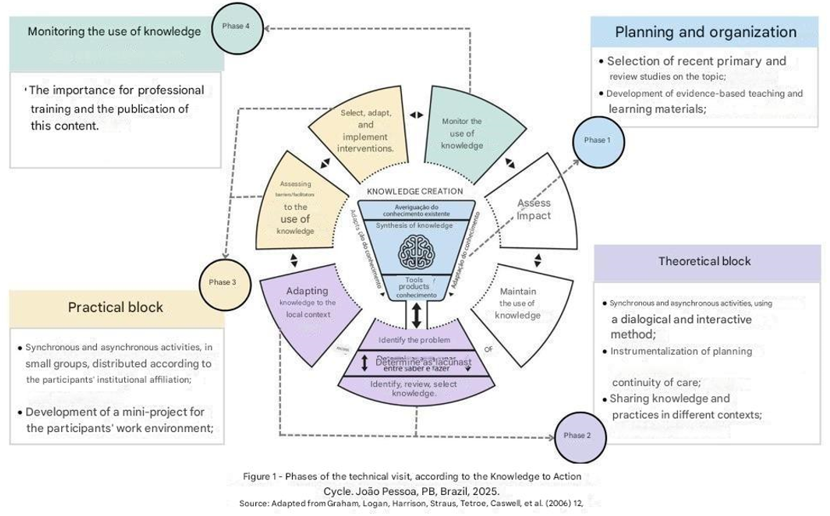
Figure 1 Phases of the technical visit, according to the Knowledge to Action Cycle (In Portuguese).
The report will be described with the categorization in two gaps, where we adopt the conceptual model adapted from the Model in Action Cycle12 and the Phenomenology for reducing the spheres of meaning,15 the phases will be revealed in a detailed and empirical way according to the reductions proposed to the method.
Undergraduate psychology students and mandatory curricular subjects in Brazil
For Psychology training in Brazil, the undergraduate program is regulated by Resolution No. 05 of the Higher Education Chamber (CES) of the National Education Council (CNES) of March 15, 2011, which establishes the National Curricular Guidelines. Developed based on extensive discussions, it is based on the concepts of competencies and skills, organizing them into a Common Core, with its Structuring Axes, and Diversified Parts, with their Curricular Emphases. It also proposes and regulates the creation of two types of Supervised Internships: Basic, in the Common Core, and Specific, in the Diversified Parts. Finally, in its penultimate paragraph, it establishes the requirement for a Psychology Service in the Course Project, where students can carry out community service activities in the form of supervised internships.7
There are institutions in Brazil that seek to diversify the psychology training process by enabling activities outside the classroom, such as technical visits. In this sense, this experience report was experienced by undergraduate students at a private university in Northeastern Brazil that offers a course where the students developed an outreach strategy, transformed into a technical visit, as a partial and mandatory requirement for completion of the course. Thus, the phases will be described based on the students' experiences and the chosen conceptual method model.
The first phase comprised the planning and organization of the technical visit, during which students selected primary studies and recent reviews on the topic from September 2025 to October 2025. This was done to support these studies with evidence-based teaching materials.
In the second phase, students carried out synchronous and asynchronous activities using dialogical and interactive methods, instrumentation on planning for continuity of care, for sharing knowledge and practices in different contexts.
Regarding the third phase, synchronous and asynchronous activities were carried out in fewer groups, since the discipline required the organization of up to 10 students, who, upon arriving at the visit site, would be distributed in smaller numbers according to the participants (elderly). Thus, a mini-route for the activity site was developed with the participants.
Finally, the fourth phase involves monitoring the use of this knowledge, its importance for professional development, and the publication of this content. The organization of the technical visit by the students revealed the wealth of shared knowledge and the theoretical and practical framework for their future professional lives.
Possibilities and limits for experiences and meanings with the collective subject
The students carried out a technical visit in two stages, the first was to explore the chosen location and its characteristics, a Long-Term Spiritist Institution for Institutionalized Elderly People in Northeast Brazil, the location of the place, the structure, the professional components, the schedules and the limitations were explored. This institution's mission is to offer spiritual and emotional support through charity and encourage inner reform based on intellectual and moral evolution through Spiritist knowledge. As a worldview, the institution propagates that it is a beacon of light and transformation based on fraternal support. For its values, the words God, Christ, respect, fraternity, and charity appear as the basis of support for the space. Everyone can participate in the activities, which are open to the public, not just academics, becoming a volunteer in one of the areas of activity, contributing with donations to the campaigns and promoting the work and initiatives of the institution.
The students were welcomed on the first technical visit by the Psychologist responsible for this communication between the institution and the university, providing some guidance, such as the documentation necessary for carrying out the technical visit, preserving the identity of the elderly, respecting the rules and adherence to schedules, appropriate professional attire to occupy that space and reflection on the future activities developed in the next stage at the institution.
As a partial requirement for completing the Interdisciplinary Practical Extension Activities I (Psychology) course, the future psychologists made a second technical visit to the institution and divided into small groups. The objective was to actively listen to the elderly. The initiative had a very favorable outcome, without interventionist intentions due to the lack of a professional license, but rather simply as a student experience for the continuing education process.
Several profiles were observed by the students during the technical visit. For example, the group of elderly people was divided into two categories: male and female. There were lucid, conscious, and oriented elderly people, as well as those who were not. Discussion groups were established, and the elderly were able to introduce themselves, as were the students, by stating their names, their ages, where they came from, whether they received visits from family, where they previously lived, and how they occupied that space. This prompted the students' collective reflection on the future.
Some students developed recreational activities with the elderly, such as the domino game and the educational game "Cada"; they participated together, allowing for collective and diverse interaction, modifying the routine at that moment in an insightful and healthy way. The stories told by the elderly prompt students to reflect on a future, structured life, prompting them to reflect on the following: in my old age, will I be able to live in a long-term care facility? This point sparked intense discussion among the students about the components of human care. Institutionalization often represents the only possibility of survival for the elderly and is fraught with suffering and limitations that interfere with their living conditions.
It was noticed that routine activities were being carried out with the students present, which did not disrupt the institution's routine, such as the distribution and administration of medicines, the application of dressings to those elderly people who for some reason needed this type of more specific care, as well as the exorbitant aroma of food being prepared for distribution among the elderly.
Finally, at the end of the visit, the students bid farewell to the elderly, the institution, the professionals, and the space of rich human and academic experiences, which, incidentally, contributed positively to the educational process, teaching and learning, and the students' lives. Technically, they transcribed all the stages of the experience into a report for the institution's course, achieving success in the continuity of care and the educational process in psychology.
The narratives produced by the students presented situations experienced in practical contexts, which made it possible to broaden the understanding of how the psychological experience of inclusion can be constructed without direct professional intervention, only in the form of active listening in the process of maturing for the future.
This study achieved its objective insofar as, as an experience report, it revealed the experiences and meanings of psychology students in a Spiritist institution for institutionalized elderly people in Northeast Brazil, through a technical visit carried out by a mandatory discipline in the undergraduate psychology training course at a private institution, which demonstrates the importance of structural and mandatory curricular components that enable moments like this, so that transformative experiences are guaranteed in the psychology training process of university students together with the collective subject, with regard to institutionalized elderly people and the teaching-learning process.
The use of the Knowledge-to-Action Cycle model for knowledge translation through technical visits has proven to be a relevant strategy for enabling the transfer of scientific knowledge to undergraduate psychology students and inducing changes in their individual and professional practices. The model can also be replicated in other contexts. In this sense, the technical visit aimed to put therapeutic listening into practice without direct interventions, since the students' first intention was to occupy a hegemonic space, which in the cultural gap is specifically aimed at institutionalized elderly people in that location.
It was found that Brazilian psychology students use several concepts of phenomenology to describe their actions, applied to the objective of this study and the construction of the directed methodology. In this sense, this experience report enabled the understanding of the referred theme, the appropriation of the concepts in the professional practice of the students and the possibility of developing a future psychotherapy.
It is necessary that new studies be described and published on this topic, so that other groups can use them as an academic, methodological and similar reference. Institutionalized elderly people need attention and respect at all times. This space, considered hegemonic, brings this range of opportunities for higher education in various areas, not just in Psychology.
None.
The author declares that she has no competing interests.

©2025 Caxias, et al. This is an open access article distributed under the terms of the, which permits unrestricted use, distribution, and build upon your work non-commercially.