Journal of
eISSN: 2373-6445


Mini Review Volume 16 Issue 5

Retired EU/FP7 Coordinator from University of Southern Denmark, Denmark
Correspondence: Torben Larsen, Retired from University of Southern Denmark, MSc (Econ et Strat Man), Højmevænget 24, DK 5250 Odense SV, Denmark, Tel (+45) 28707135
Received: September 11, 2025 | Published: September 25, 2025
Citation: Larsen T. The triune brain- linked by neuroeconomics and operated as socioeconomics (SE). J Psychol Clin Psychiatry. 2025;16(5):212-215. DOI: 10.15406/jpcpy.2025.16.00834
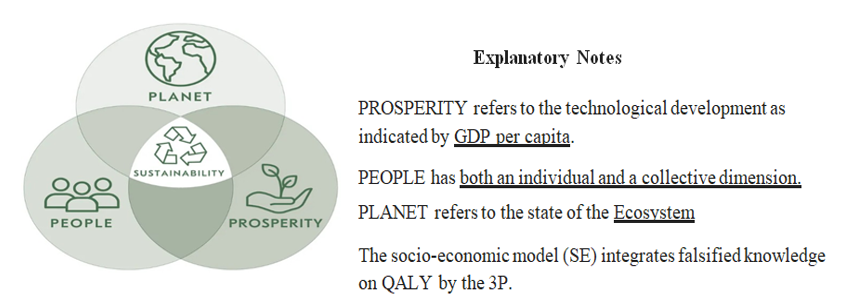
Neuroeconomics explains the integration of the triune brain levels by general risk-willingness on a dimension from Extravert via Conscientious to Neurotic. Socio-economics (SE) synthesises general behavior by the 3P parameters (Prosperity, People and Planet). Searching databases maximizes each of the 3P by the following interventions:
SE is too complex for direct dissemination to lay users! However, preliminary guest-lectures to teachers in Public Administration at a business school, confirm that such indirect dissemination to democratic politicians is possible by teachers in Public Administration or Economics.
Keywords: triune brain, psychological method, neuroeconomics, behavioral economics, sustainable development, 3P management, technology assessment
British Empiricism recommended in the 18th Century falsification to overcome subjective prejudices associated with religion, tradition and personality. This gave rise to a variety of specialist disciplines of science, which implies that the overview of contemporary science is lost and leading international decision-makers now call for a synthesis of specialist science.1 Biology is the broadly scientific study of all living organisms, covering their structure, function, growth, origin, evolution, and distribution. Biology finds that “Survival of the fittest” is the central law of behavior for primates. The Triune Brain Model (TBM) by Paul McLean2 explains the human brain function by the 3 major levels of neurobiological evolution:
TBM has gotten much scientific attention, but recently TBM is rejected as a model for behavioral psychology.3
TBM is an abstract model, wherein the internal integration must be explained, before it can be operated. The vital center integrating PFC and LS is the ventromedial PFC (vmPFC) between PFC and LS in Figure 1.4
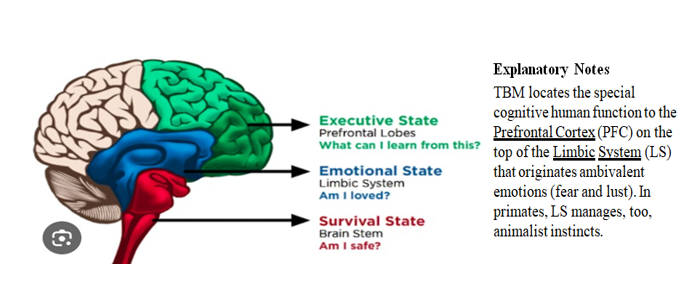
Figure 1 The triune brain model (TBM).2
Neuroeconomics is a multidisciplinary field of behavioral science enabling neural modelling of the vmPFC. General risk-willingness5 is the basal parameter of human cognition, integrating PFC and Limbic System by the vmPFC, see Figure 2, ordering the Big5 Tempers constituting a Neuroeconomic Psychology (NeP).5–7 Moderate Risk-willingness explains creative man (“Pilot in-the-Plane”)8,9 as Open-mindedness with a wide flexibility between Extraversion and Conscientiousness.10 WHO warns that epidemic job-related stress soon becomes the heaviest health burden.11 Figure 2 illustrates, too, the relevance of in-depth relaxation towards Origo to release anxiety and mental conflicts. Already 3000 years ago, Indo-Europeans discovered mantra-meditation as means to reach Nirvana (Origo) freeing imagination. Modern mantra-meditation in a relaxed sitting position in a quiet place, eventually complemented by Biofeedback, is a simple method for destressing with evidenced health effects in more studies, for instance Benson.12
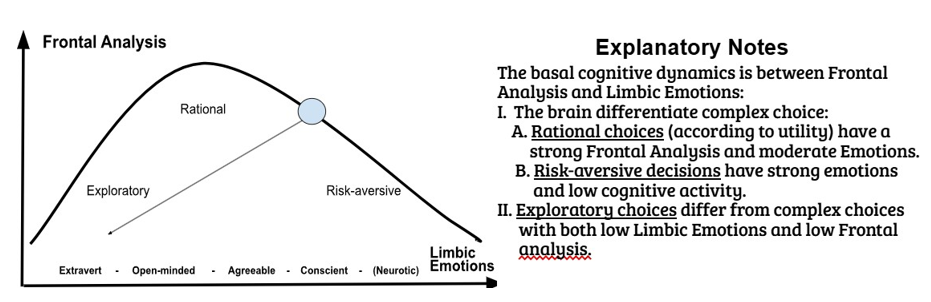
The general parameter of economic behavior of TBM is general risk-willingness.5–7 This study aims to operate a synthesis of TBM, replacing the Neoclassical dogma on “Bounded Rationality” as the central parameter of behavior, see methodology below.
Objectivist natural sciences transcend subjective knowledge by data-based falsification.
In behavioral sciences as Economics, scientists are both observers and actors. Recognition of TBM implies that besides the methodological aspects of falsification, behavioral scientists must be aware of biases by personality, where typical subjective biases like Extraversion give Type 1 Errors, while Conscientiousness give Type 2 Errors5–7 as indicated in Table 1. Behavioral scientists must be impartial basing conclusions exclusively on empirical findings that are representative to the target group under investigation.
|
Positivist dialectics |
Sample-based result |
|
|
Accept |
Reject |
|
|
Thesis |
Positivist knowledge |
Type 2 Error (Subjective conscientiousness) |
|
Antithesis |
Type 1 Error (Subjective extraversion) |
Integrity |
Table 1 Subjective biases in behavioral economics
A special methodological challenge in the operation of TBM is the recognition that Man is not just an individual, but also a social being as presupposed in Socioeconomics (SE) - the positivist discipline that combines individual and social utility for a common outcome.
The concept of QALY (Quality-Adjusted Life Years) is already well-established in Health Technology Assessment (HTA) and serves as an outcome of SE, too, combining quantitative and qualitative outcomes. SE has both a macro- and a microaspect. The macroeconomic goals (MG(X)) of SE are specified as:
SE operates TBM for prioritization of alternative interventions by the following Formula:
Formula 1: 5–7,10,11
Socioeconomic results
International science databases are searched for the most promising QALY interventions by the 3P to operate TBM. This identifies the following long-term interventions as options:
a) Ad PROSPERITY: Life-Expectancy is doubled in the last 200 years. Due to the logarithmic relation to growth, it grows by 3 months p.a. This implies a gain of about 1.700 million QALY per year.16
b) Ad PLANET: Estimates on the severity of future climate damages differ a lot. This study bases on a median forecast, warning that intensified natural disasters by global heating by existing policies will cost $12.5 Trillion USD by 2050 causing the loss of more than 2 billion QALY.17 This implies that the net effect of the 3P becomes negative about 2040! Further, such climate change will exacerbate global health inequities in the most vulnerable populations, too, including women, youth, elderly, lower-income groups and hard-to-reach communities.
Mainstream economics, merited by Nobel Prizes (Pigou 1920 and Norton 2018), recommends a CO2 Tariff on any local pollutant (ET). However, atmospheric heating by CO2 knows no borders, and a national ET loads the national competitiveness with export of national jobs and companies. Subsidizing alternatives to fossil energy (ES) has the same transition incentive as ET without hurting national competitiveness:5–7
The Biden Administration pioneered a Western ES-strategy to make the US carbon neutral in 2050,18 but the present Trump Administration opposes this plan in various ways.
Already, China applies the ES-strategy subsidizing non-fossil energy i.e. electric cars. So, ES instead of ET helps to equalize Western conditions of competition with China.
Other important global threats to the Ecosystem are the special pollution of earth and water by fertilizers used by modern HiTec-agriculture. This implies that alternative forms of ecological agriculture should be subsidized by ES, too.
c) Ad PEOPLE: Job-related epidemic stress costs 2% of GDP, causes 3 million deaths and another million disabilities. In all, implying the loss of 100 million QALY, which is expected to triple by 2050.19
The QALY of PEOPLE depends according to SE, too, on long-term social welfare policy. For instance, QALY is 3 years higher in the EU compared with the US.5–7 In the EU center-oriented economic policies with deals across-the-center lowers economic inequality (Gini-coefficient), see Figure 4. Also, collective services with economies-of-scale, are financed by public taxes such as healthcare, education and social security.
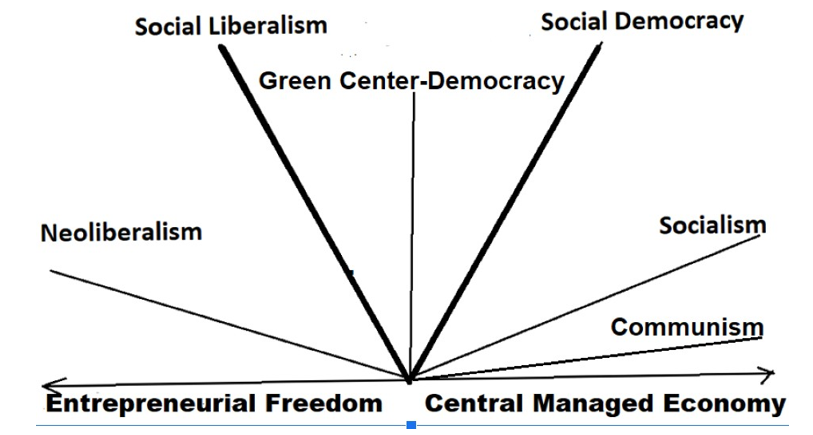
Figure 4 Center-oriented democracy for implementation of SE.
Classical political ideologies form a continuum on regulation of the market economy from Neoliberalism to Communism. A “Green Center-oriented democracy” fulfills Formula 1 by:
Nobel Laureates recommend Universal Basic Income (UBI) as the core of social welfare economy, which is confirmed by empirical studies.20
Already, China has the same QALY as the US by a GDP per capita at one third of the US. Worldwide the most relevant choice of economic-political system seems to be European center-oriented democracy versus Chinese socialist market economy.
Implementation of the Triune Conception of Brain and Behavior (TBM) builds on recognition of the broad functional integration of the Frontal and Limbic Systems. Neuroeconomics explains Fronto-Limbic integration by General Risk-willingness constituting Neuroeconomic Psychology (NeP) ordering the Big5 Tempers. However, man is not just an individual, but also a social being, wherefore operation of TBM presupposes a socio-economic integration (SE) based on the 3P (Prosperity, People, Planet). By 2040, existing policies predict that the negative effects of climate damage and job-related stress, supersede the QALY gained by general growth in GDP, see Table 2. This calls urgently for better overall and international coordination of human interaction on SE! Here, Neuroeconomic Psychology (NeP) can guide individual economic behavior, for instance recommending Stress- management by meditative in-depth relaxation complemented by Biofeedback.7
|
Growth effect |
Essence of results of key studies |
Mill QALY |
|
GDP per Cap14 (PROSPERITY) |
Life-Expectancy has redoubled from 40 to 80 years in the last 200 years with an average economic growth of 2% p.a. in GDP per cap. This corresponds to 2.4 months per person. 15% of the QALY gain is lost by handicaps reducing the gain to 2 months p.a.. By a world pop. 2040 of 9 Billion, the total gain in QALY is: 9 Billion divided by 6. |
+1.500 |
|
Climate damage (PLANET)15 |
World Economic Forum (WEF) estimates the global costs of climate damage are rising exponentially, see Table 7, p. 16 in WEF. |
-1.100 |
|
Stress17 (PEOPLE) |
WHO accounts the QALY lost by Mental Diseases to 150 Mill. 2021 Job-related stress w/Absenteeism + unemployment lowers QALY, too. Total loss of QALY by stress is about 200 mill p.a. raisining >2% p.a. |
-350 |
|
Net growth 2040 |
The calculations presupposes continuation of existing policies |
+50 |
Table 2 Summary of growth effects 2040
The key challenge is that SE is complex compared with the simple theories typically disseminated to laymen in democratic economic-policy. The dissemination of SE has been tested by preliminary Guest-Lectures on SE at a Danish business school. These guest-lectures indicate that both teachers and students in Public Administration can understand SE! To accelerate the final dissemination of SE to lay end-users, supporting politicians by teachers in Public Administration or Economics, a partial financial support is crucial, for instance by 50% from Funds for the common best.
Already, China has the same QALY as the US by a GDP per capita at one third of the US and the QALY in EU is 3 years better than in the US. Worldwide, the most relevant choice of economic-political system appears to be between European center-oriented democracy and Chinese socialist market economy. A positive option for collaboration between EU and China is that EU and China might agree on implementation of a worldwide socio-economic top-priority to subsidies to non-fossil energy alternatives (ES). However, this presupposes that the democratic world finds some extra financial support for public dissemination of SE by guest-lectures, for instance from Funds for the common best.
None.
None.
The author declares that there is no conflicts of interest.

©2025 Larsen. This is an open access article distributed under the terms of the, which permits unrestricted use, distribution, and build upon your work non-commercially.