Journal of
eISSN: 2373-6410


Perspective Volume 16 Issue 1

1Department of Neuro Physiotherapy, Sussex University Hospitals, UK
2Department of Neurosurgery, University of Aberdeen, UK
3Department of Neurosurgery, University of Málaga, Spain
Correspondence: Waldemar A Marcinski, Department of Neuro Physiotherapy, Sussex University Hospitals, Spain
Received: January 10, 2026 | Published: January 27, 2026
Citation: Marcinski WA, Martínez-Soler P, Martínez-Canca JF. Robotics in rehabilitation: a strategic necessity for the NHS in the face of demographic and economic pressures. J Neurol Stroke. 2026;16(1):39-42. DOI: 10.15406/jnsk.2026.16.00650
The National Health Service is navigating a complex and intensifying landscape driven by overlapping demographic, economic, and labour pressures. These dynamics are reshaping care provision across the UK, particularly within physiotherapy and rehabilitation services. Among the most pressing concerns is the combined impact of an ageing population and persistent workforce shortages, both of which threaten sustainability and quality of care. At the same time, rapid advances in healthcare technology, especially in robotic assisted therapy, offer new opportunities to reimagine service delivery. This article explores how integrating robotic assisted therapy into NHS rehabilitation pathways could not only address current challenges but also help shape a more efficient, equitable, and high-quality model of care.
The UK is undergoing profound demographic change, with the proportion of people aged 65 and over projected to reach about 19 percent of the total population between 2016 and 2032.1 This trend is more than a statistical shift. It reflects a fundamental transformation in healthcare demand. Older adults are expected to live with a greater burden of multimorbidity, cognitive impairment, and reduced mobility, all of which require complex and sustained interventions.2 Emergency admissions among people aged 65 and over, particularly those living with multiple conditions, have risen by 35.2 percent over the past fifteen years.3 People aged 75 and over are at the highest risk of needing urgent medical attention.4. As both urgent care use and long-term care needs continue to increase, already stretched primary and secondary healthcare services face escalating pressure (Figure 1).5
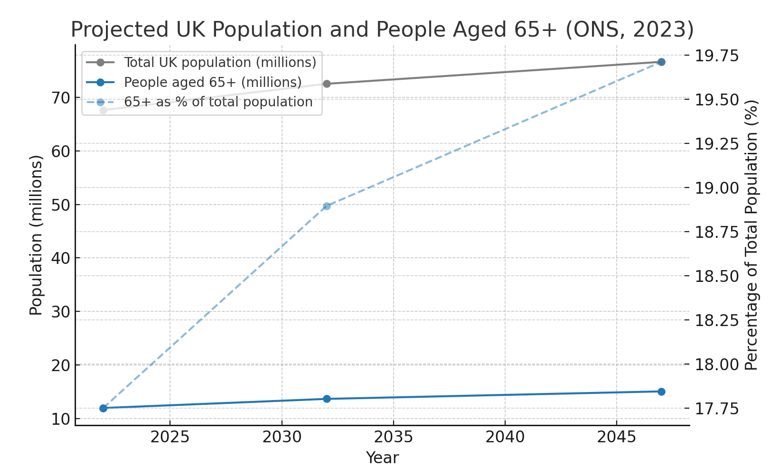
Figure 1 Projected increase in population of people over 65 and over 85 years of age (ONS, 2023).
At the same time, the NHS is facing severe workforce shortages. As of June 2023, the system reported more than 125,000 unfilled posts, including nearly 11,000 medical positions and over 40,000 nursing roles.6 Retention is equally problematic, with staff turnover close to 10 percent and only a slow rise in the number of qualified therapists entering the workforce.7. Social care shows a similar pattern, with a turnover rate of 28.3 percent.8 The overall NHS staffing shortfall is currently estimated at just over 100,000 full time equivalent positions,9 and projections indicate that this figure could reach approximately 160,000 by 2031.9 High turnover and burnout contribute to chronic understaffing, while morale remains at an all-time low.10 In addition to the direct impact on care quality, these shortages carry substantial indirect economic costs, including delayed discharges and prolonged hospital stays. The resulting gaps in provision slow patient flow and increase waiting times. Moreover, with funding stagnating as demand rises, many NHS trusts operate at the edge of financial and operational viability, relying heavily on agency staff or postponing treatment to manage capacity constraints (Figure 2).
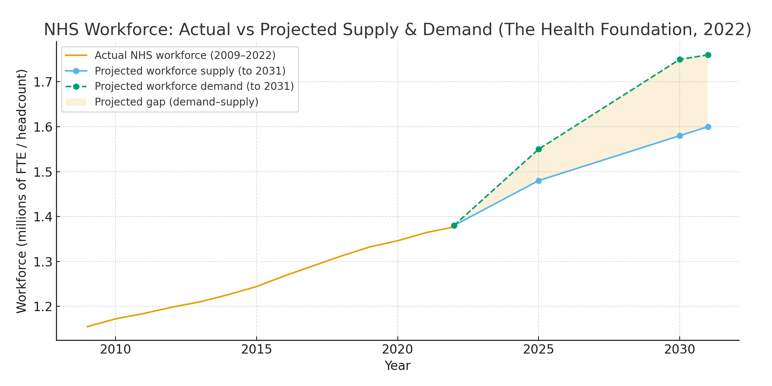
Figure 2 The actual and projected NHS workforce in years 2009 – 2031. (The Health Foundation, 2022).
Although this outline of demographic pressures is not exhaustive, it illustrates the scale of the challenge in meeting current and future care needs. The difficulties facing healthcare systems are complex and multidimensional and are likely to become increasingly pronounced over time. Emerging technologies, however, represent an important element of the response. They have the potential to improve productivity and reduce the physical demands placed on the workforce. In particular, advances in robotic technology offer a promising avenue for developing the transformational capacity required to address these evolving pressures.11
Robotic assisted therapy is often dismissed because of the high capital and maintenance costs associated with the technology. These costs include equipment acquisition, maintenance contracts, and the training required for effective implementation. Purchase prices for RAT platforms typically range from £90,000 to £150,000 per unit, with annual maintenance fees between £8,000 and £12,000. Yet these expenditures should be considered in terms of long-term value. Economic analyses indicate that investment can be offset by reduced staffing demands, greater therapy throughput, and improved patient outcomes.12 As robotic technologies mature and adoption widens, per unit costs tend to fall and economies of scale become attainable, a particularly important consideration for a centrally coordinated system such as the NHS.
Economic modelling provides encouraging evidence for the strategic use of robotic assisted therapy. Gower et al. (2024) reported that a mixed model combining conventional rehabilitation with RAT could reduce costs by up to €49.6 per therapy cycle.13 When Robotic Assisted Therapy was incorporated into approximately 35 percent of sessions, projected savings over three years exceeded €44,000. This configuration also reduced staff workload while maintaining treatment quality within staff to patient ratios of 1 to 3 or 1 to 4. Extrapolated across 1,800 rehabilitation units, such an approach could generate annual savings of more than £80 million for the NHS. Taken together, these findings indicate that RAT has the potential to deliver net financial benefit, provided that service delivery models are organised to support efficient deployment.
Conversely, the influential RATULS trial reported no economic advantage for robotic assisted therapy in upper limb rehabilitation when compared with conventional therapy.14,15 In this study, the cost of robotic treatment was £5,387 versus £3,875 for usual care, with no significant quality adjusted life year (QALY) benefit. RATULS therefore served as a cautionary benchmark.
However, evidence from other publications suggests that the one-to-one staffing model used in RATULS substantially inflated costs. Reported economic estimates vary widely across studies, reflecting differences in protocol design and device characteristics (Figure 3). A consistent theme in the literature is that economic advantage emerges when multiple robotic units are supervised simultaneously by a single therapist. It is also important to note that the device used in RATULS represented an early generation platform with limited distal and hand functionality, a constraint that may have reduced carryover into functional upper limb performance. In addition, the cost calculations were based on 2018 financial data.
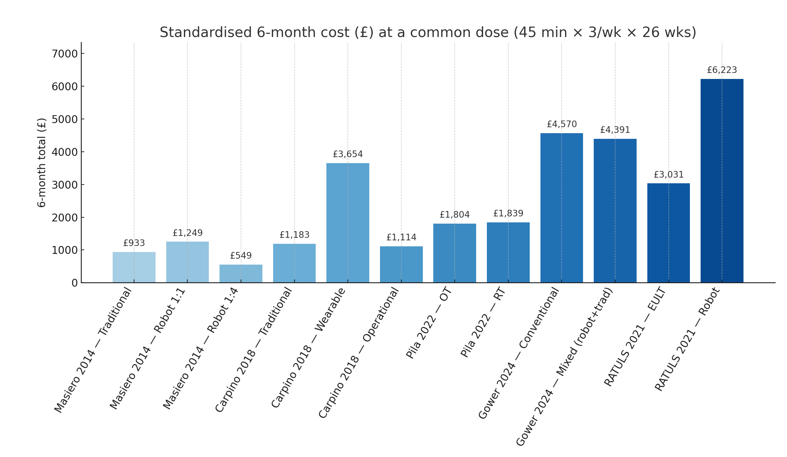
Figure 3 The comparison of cost between traditional and robotic interventions extrapolated over 6-month period (monetary values converted to GBP).
Although RATULS informed the 2023 NICE guidelines, which currently discourage routine clinical adoption, its methodology does not reflect evolving models of efficient RAT delivery. Newer devices, redesigned therapy protocols, and multi patient supervision have the potential to change the economic profile substantially. Financial stakeholders should therefore interpret RATULS not as a definitive judgment on upper limb RAT, but as a demonstration of the importance of cost model optimisation.
Lower limb rehabilitation offers an even stronger economic case for robotic assisted therapy. Carpino et al.16 reported that high frequency gait training using so called operational machines, in which the robot and human end effectors are mechanically coupled, delivered superior outcomes with favourable incremental cost effectiveness ratios.16 When operated for up to twelve hours per day, six days per week, these devices produced negative incremental cost effectiveness ratios, indicating net cost savings. Cost efficiencies of between €1,989 and €4,565 per treatment cycle were observed, depending on device type and training frequency.
These findings suggest that appropriate scheduling and volume can shift RAT from a cost burden to a cost saving intervention. This economic advantage aligns with a strong evidence base supporting the clinical efficacy of robotic assisted gait training for stroke rehabilitation.17–19 Robotic therapy has been shown to be safe20 and consistently associated with improvements in gait velocity, walking independence, step length, cadence, and balance.21 Furthermore, patient acceptance and feasibility ratings are high.22
By simultaneously improving clinical outcomes and reducing the cost of care, RAT has the potential to reshape post stroke rehabilitation. NHS trusts operating high volume rehabilitation services are likely to derive the greatest benefit from this model.
One of the principal advantages of robotic assisted therapy is its capacity to deliver consistent, high volume, task specific practice. This benefit is evident across both upper and lower limb rehabilitation (Figure 4). NICE guidelines recommend three to six hours of daily rehabilitation for optimal post stroke recovery, yet most NHS services fall well short of these targets. Pila et al. (2022) reported that RAT enabled sessions achieved up to 1,023 repetitions per session, compared with an average of only 86 in standard care.23 At approximately 28 movements per minute, RAT provides a tenfold increase in practice intensity, a factor closely linked to neuroplastic adaptation and accelerated functional gains.24,25
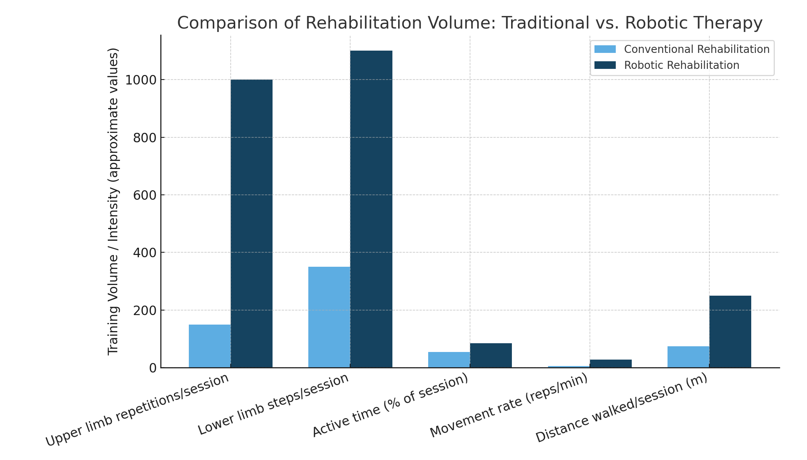
Figure 4 Comparison of rehabilitation volume between traditional and robotic interventions. Rehabilitation volume expressed in units pertinent to the focus of therapeutic intervention.
Evidence indicates that higher therapy doses are essential to maximise the neuroplastic potential of rehabilitation. Robotic technology offers a practical means of delivering this increased intensity without expanding staffing requirements. Engagement is further enhanced through interactive software that acts as a structured interface between the user and the therapeutic task, supporting attention and motivation.
The clinical benefits of robotic assisted therapy are not uniform across therapeutic domains. Evidence for upper limb rehabilitation remains mixed; while some studies report outcomes comparable to enhanced therapy programmes,14 others demonstrate no statistically significant difference.11 Upper limb recovery after stroke is inherently challenging. Successful functional use of the arm and hand depends on finely graded movement, complex neuroanatomical connectivity, and substantial cognitive and attentional engagement.6
Despite these difficulties, robotics is likely to represent one component within a broader upper limb rehabilitation strategy. Complementary modalities, including virtual reality environments,13 gamified training, and intensive conventional therapy,24 may play an equally important role.
By contrast, evidence for gait and lower limb rehabilitation is more consistently favourable, particularly in individuals with severe mobility limitations.17 As noted above, early adoption within the NHS could help shape future rehabilitation practice by addressing current research gaps and establishing a forward-looking hub of innovation.
Technological innovation is expected to continue accelerating, with advances in computing and artificial intelligence likely to reshape many sectors, including healthcare. The convergence of robotic assisted therapy with artificial intelligence, wearable sensors, and gamified virtual environments offers considerable potential. Beyond the virtual reality applications already discussed,13 Garcia Hernandez et al reported a 27 percent increase in patient adherence when RAT was paired with gamified interfaces.21 Robotic systems also provide detailed biomechanical data that enable precise monitoring of progress, personalised treatment planning, and more accurate prediction of recovery trajectories.2 Predictive algorithms have been shown to improve trajectory planning by up to 30 percent, with associated cost benefits.18 Collectively, these developments support a shift toward proactive, data driven rehabilitation.
Despite these advantages, adoption remains comparatively slow. Robotics and AI are expected to influence a substantial proportion of the healthcare workforce over the coming decades, and integrating these platforms will require significant upskilling and adaptation of clinical practice. Such change can understandably provoke concern regarding skill acquisition and evolving professional roles. However, previous technological transitions demonstrate that the healthcare workforce is highly adaptable. Successful integration of RAT will depend on coordinated workforce training, cultural readiness, and regulatory alignment.11
Robotic systems are currently regulated under the UK Medical Devices Regulations 2002, which set stringent requirements for safety, clinical effectiveness, and data protection. Recent developments in the UK’s evolving regulatory framework, particularly the MHRA Roadmap (2024) and updated Medical Devices UK guidance, have important implications for the deployment of robotic rehabilitation technologies within the NHS. These documents introduce enhanced oversight of software driven and AI enabled devices, both of which are integral components of modern rehabilitation platforms used after stroke, spinal cord injury, and other neurological conditions.
Key updates include the formal designation of Software as a Medical Device (SaMD) and the introduction of AI specific guidance. Under these provisions, robotic rehabilitation systems must demonstrate clear algorithmic transparency, clearly defined intended use, and robust post market performance monitoring. The adoption of predetermined change control plans provides a structured mechanism for updating adaptive algorithms while avoiding full recertification, thereby supporting continuous clinical responsiveness.
The NHS may also benefit from the Innovative Devices Access Pathway, which aims to expedite technologies with demonstrable clinical value. Nonetheless, the heightened expectations regarding cost effectiveness, safety, and device traceability require NHS trusts to base procurement decisions on both regulatory readiness and sound clinical evidence. Financial responsibility for acquisition or leasing may need to be shared across multiple stakeholders, including industry partners and research institutions. Current operational planning guidance (NHS, 2025) gives limited emphasis to investment in innovation.5, an understandable position given macroeconomic constraints but one that may restrict opportunities for diversifying revenue streams and necessitate more creative approaches to financing technology adoption. In practice, these changes lay the groundwork for broader adoption of robotics in NHS rehabilitation services but also require developers and providers to align with a more complex, data driven regulatory environment.
Given its scale and central coordination, the NHS is uniquely positioned to lead the integration of robotic assisted therapy across rehabilitation pathways. Large scale trials, coordinated procurement strategies, and the development of a specialist workforce could support the establishment of the NHS as a global centre for robotic rehabilitation research and innovation. Trusts such as University Hospitals Sussex, which already operate hyperacute stroke services, may be particularly well placed to initiate and evaluate these programmes.
The demographic and workforce challenges facing the NHS are structural and continuing to intensify. Incremental change alone is unlikely to meet the needs of an ageing and increasingly complex patient population. Robotic assisted therapy offers a promising, although not yet universally validated, contribution to the solution. Its capacity to increase therapy intensity, enhance workforce efficiency, and interface with emerging technologies justifies continued investment and systematic evaluation.
Economic and clinical evidence indicates that, when deployed at scale and within well designed service models, robotic assisted therapy has the potential to reshape rehabilitation delivery. The NHS now has an opportunity to advance patient outcomes while strengthening the resilience and long-term sustainability of its services.
I would like to express my sincere gratitude to MySussex for their generous support in funding this internship. Their commitment to fostering academic development and professional growth made this opportunity possible and provided an invaluable environment for learning, collaboration, and intellectual exploration. I am deeply thankful for their trust and investment, which have been instrumental in shaping this experience.
The authors declare that there are no conflicts of interest.

©2026 Marcinski, et al. This is an open access article distributed under the terms of the, which permits unrestricted use, distribution, and build upon your work non-commercially.