Journal of
eISSN: 2373-4396


Research Article Volume 19 Issue 2
 Marco Machado,2 Fabiana Pereira Costa Ramos,3 Rosalee Santos Crespo Istoe,3 Valtair Afonso Miranda3
1Universidade Estadual Norte Fluminense Darcy Ribeiro (UENF), Campos dos Goytacazes, RJ, Brazil
2Fundação Universitária de Itaperuna (FUNITA), Itaperuna, RJ, Brazil
3Universidade Estadual Norte Fluminense Darcy Ribeiro (UENF), Campos dos Goytacazes, RJ, Brazil
Correspondence: Greziene dos Santos Silva, Universidade Estadual Norte Fluminense Darcy Ribeiro (UENF), Campos dos Goytacazes, RJ, Brazil
Received: March 31, 2026 | Published: May 7, 2026
Citation: Silva GS, Machado M, Ramos FPC, et al. Exercise prescription in geriatric cardiology: from generic recommendations to personalized medicine. J Cardiol Curr Res. 2026;19(2):58-61. DOI: 10.15406/jccr.2026.19.00643
Population aging represents one of the most significant demographic transitions of the 21st century and is accompanied by a growing burden of cardiovascular disease (CVD). As life expectancy increases, maintaining cardiovascular health and functional independence in older adults has become a major priority for healthcare systems worldwide. Regular physical activity is widely recognized as a cornerstone of cardiovascular prevention and rehabilitation, with strong evidence demonstrating its beneficial effects on cardiorespiratory fitness, endothelial function, blood pressure control, and overall mortality risk. Consequently, international guidelines consistently recommend routine exercise as part of standard cardiovascular care. Despite this robust evidence base, the prescription of exercise in geriatric cardiology often remains limited to generalized recommendations that do not fully account for the heterogeneity of older adults. Variations in functional capacity, frailty status, comorbidities, and physiological reserve can substantially influence both the safety and effectiveness of exercise interventions. As a result, traditional “one-size-fits-all” recommendations may be insufficient for optimizing cardiovascular outcomes in aging populations. Recent advances in digital health technologies, wearable devices, and telemedicine have created new opportunities to move toward more personalized approaches to exercise prescription. Continuous physiological monitoring, combined with functional assessments and cardiopulmonary exercise testing, may allow clinicians to tailor exercise interventions to the specific needs and capabilities of individual patients. In parallel, emerging analytical tools, including artificial intelligence and machine learning, hold promise for integrating multidimensional clinical data to support individualized exercise strategies. This perspective article discusses the evolving role of exercise in geriatric cardiology and argues for a transition from generic activity recommendations toward personalized exercise medicine. We highlight current evidence, limitations in clinical practice, and emerging technological solutions that may enable individualized exercise prescriptions. Ultimately, integrating personalized exercise strategies into cardiovascular care may represent a critical step toward improving health outcomes, functional capacity, and quality of life in older adults.
Keywords: geriatric cardiology, exercise prescription, cardiovascular aging, cardiac rehabilitation, personalized medicine
Population aging represents one of the most significant demographic transformations of the 21st century. Improvements in healthcare, sanitation, and socioeconomic conditions have led to a substantial increase in life expectancy worldwide. As a result, the number of adults aged 60 years and older is rapidly expanding across both developed and developing countries. This demographic shift is accompanied by profound implications for healthcare systems, particularly regarding the growing burden of chronic diseases.
Cardiovascular diseases (CVD) remain the leading cause of morbidity and mortality globally, with prevalence increasing markedly with age. Structural and functional alterations of the cardiovascular system occur progressively throughout the aging process. These changes include increased arterial stiffness, endothelial dysfunction, left ventricular remodeling, and impaired autonomic regulation, all of which contribute to elevated cardiovascular risk in older individuals.1,2
In addition to physiological aging, the accumulation of cardiovascular risk factors—including hypertension, diabetes mellitus, dyslipidemia, and obesity—further amplifies disease burden in older populations. Consequently, strategies aimed at preventing and managing cardiovascular conditions in older adults are increasingly critical for maintaining functional independence and quality of life.
Among available interventions, regular physical activity has consistently been recognized as one of the most effective non-pharmacological strategies for preventing and treating cardiovascular disease. Current international guidelines strongly recommend routine physical activity for adults and older individuals, typically suggesting at least 150 minutes per week of moderate-intensity aerobic exercise or equivalent activity levels.3,4
However, despite robust evidence supporting the cardiovascular benefits of exercise, the practical implementation of exercise prescriptions in older adults often remains limited to generalized recommendations. Such "one-size-fits-all" approaches may fail to adequately address the biological heterogeneity and clinical complexity characteristic of the geriatric population. As geriatric cardiology continues to evolve, there is growing recognition that exercise prescription must move beyond generic advice toward individualized and data-driven strategies.
Over the past several decades, a substantial body of scientific evidence has demonstrated the beneficial effects of regular exercise on cardiovascular health in aging populations. Both observational studies and randomized controlled trials have consistently shown that physically active individuals experience lower rates of cardiovascular events, reduced mortality, and improved functional capacity compared with sedentary individuals.5
Aerobic exercise, in particular, has been extensively studied in the context of cardiovascular prevention and rehabilitation. Regular aerobic training improves cardiorespiratory fitness, reduces blood pressure, enhances endothelial function, and favorably modifies lipid profiles. These physiological adaptations collectively contribute to reduced cardiovascular risk.6
Cardiorespiratory fitness itself has emerged as one of the strongest predictors of cardiovascular and all-cause mortality. In fact, several researchers have proposed that cardiorespiratory fitness should be considered a clinical "vital sign" due to its strong prognostic value across diverse patient populations.7,8
Exercise-based cardiac rehabilitation programs represent one of the most successful clinical applications of structured physical activity in cardiovascular medicine. Meta-analyses and systematic reviews have demonstrated that participation in cardiac rehabilitation is associated with significant reductions in cardiovascular mortality, hospital readmissions, and improvements in quality of life among patients with coronary artery disease and heart failure.9
Beyond aerobic training, resistance training has gained increasing attention as a critical component of exercise programs for older adults. Age-related loss of muscle mass and strength, known as sarcopenia, contributes significantly to functional decline, frailty, and reduced independence in later life. Resistance exercise helps preserve muscle mass, improve metabolic health, and support physical function.10
More recently, high-intensity interval training (HIIT) has emerged as a potentially effective strategy for improving cardiovascular fitness in both healthy older adults and patients with cardiovascular disease. Studies comparing HIIT with moderate-intensity continuous training have suggested that interval training may produce greater improvements in peak oxygen uptake (VO₂ peak), an important marker of cardiovascular fitness.11,12
Collectively, these findings highlight the powerful role of exercise as a therapeutic intervention capable of addressing multiple physiological pathways involved in cardiovascular aging.
Despite the extensive evidence supporting the cardiovascular benefits of exercise, its implementation in routine clinical care remains suboptimal. Many clinicians continue to provide generalized physical activity advice without delivering detailed exercise prescriptions tailored to individual patient characteristics.
The commonly cited recommendation of "150 minutes of moderate-intensity exercise per week," while useful as a population-level guideline, may be insufficient when applied to older adults with complex clinical profiles. Geriatric populations exhibit considerable heterogeneity in health status, functional capacity, frailty levels, and comorbidity burden. As such, standardized recommendations may not adequately capture the needs of individual patients.
Frailty represents a particularly important consideration in geriatric cardiology. Frail older adults often experience reduced physiological reserve and increased vulnerability to stressors. Exercise programs designed without consideration of frailty status may be ineffective or even unsafe.13
Another limitation involves the underutilization of cardiac rehabilitation programs. Despite strong guideline recommendations, referral rates to cardiac rehabilitation remain low, particularly among older adults. Barriers include limited program availability, transportation challenges, financial constraints, and inadequate awareness among healthcare providers.14
Furthermore, adherence to exercise interventions remains a major challenge in older populations. Factors such as mobility limitations, fear of injury, lack of supervision, and low motivation may all contribute to reduced participation in physical activity programs.15,16
These barriers highlight the need for new models of exercise prescription that are both individualized and adaptable to the complex needs of aging patients.
Recent advances in digital health technologies offer promising opportunities to transform exercise prescription in geriatric cardiology. Wearable devices—including smartwatches, fitness trackers, and heart rate monitors—allow continuous monitoring of physiological parameters such as heart rate, activity levels, sleep patterns, and energy expenditure.
These technologies provide clinicians and patients with real-time data that can inform individualized training adjustments and improve adherence to exercise programs. Continuous monitoring may also facilitate early detection of adverse responses to exercise and allow timely intervention (Figure 1).
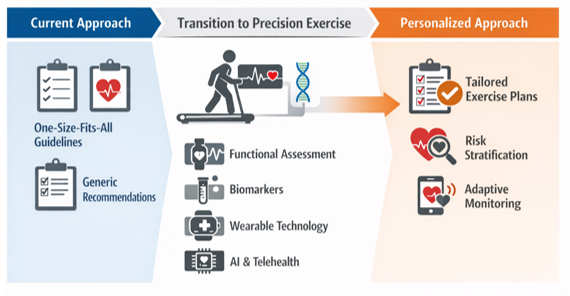
Figure 1 Precision exercise medicine in geriatric cardiology. Conceptual model illustrating the progression from generic exercise guidelines to individualized prescriptions supported by functional testing, biomarker integration, wearable technologies, and remote monitoring.
Telehealth and remote cardiac rehabilitation programs have also gained increasing attention, particularly following the global expansion of telemedicine during the COVID-19 pandemic. Remote rehabilitation programs enable patients to participate in supervised exercise training from their homes while maintaining regular communication with healthcare providers.17,18
Digital platforms may also incorporate behavioral coaching, educational resources, and remote monitoring tools, creating a comprehensive approach to lifestyle modification.
Another promising area involves the integration of advanced physiological assessments into exercise prescription. Cardiopulmonary exercise testing (CPET), for example, allows precise measurement of exercise capacity and physiological thresholds, enabling more accurate determination of appropriate training intensity.19
Biomarkers related to inflammation, oxidative stress, and metabolic function may also play a role in future personalized exercise strategies. Additionally, emerging machine learning and artificial intelligence models have the potential to analyze large datasets combining clinical, physiological, and behavioral variables to generate individualized exercise recommendations.20,21
In addition to traditional physiological and functional markers, molecular pathways involved in aging have gained increasing attention as potential mediators of exercise-induced benefits. Among these, Sirtuin 1 (SIRT1), a NAD+-dependent deacetylase, has been implicated in the regulation of endothelial function, mitochondrial biogenesis, oxidative stress, and inflammation. Exercise has been shown to upregulate SIRT1 activity, which may contribute to its cardioprotective and anti-aging effects. From a personalized medicine perspective, interindividual variability in SIRT1 expression or responsiveness may partially explain differences in exercise adaptation among older adults. Furthermore, emerging evidence suggests that pharmacological or nutritional activators of SIRT1 could potentially enhance the beneficial effects of exercise, although robust clinical data in elderly populations remain limited. Therefore, integrating molecular markers such as SIRT1 into exercise prescription models represents a promising but still evolving area of research.1,22
These developments suggest that the future of exercise prescription in geriatric cardiology may increasingly resemble the broader movement toward precision medicine.
Despite considerable progress, important gaps remain in our understanding of optimal exercise strategies for older adults with cardiovascular disease. One key area of research involves identifying the most effective combinations of exercise modalities for different patient profiles.
Future studies should explore how aerobic training, resistance exercise, balance training, and flexibility exercises can be optimally integrated into comprehensive programs for older adults with varying degrees of frailty and comorbidity.
Another critical research priority involves understanding individual variability in response to exercise interventions. While some individuals experience substantial improvements in cardiovascular fitness following training programs, others show more modest responses. Identifying predictors of exercise responsiveness could help guide more personalized interventions.
Additionally, research is needed to determine the long-term effectiveness and safety of technology-assisted exercise programs, particularly among older adults with limited digital literacy.
Implementation science will also play a crucial role in translating research findings into clinical practice. Interventions designed to increase referral and participation in cardiac rehabilitation programs, particularly among older adults, should be prioritized.
Finally, multidisciplinary collaboration between cardiologists, geriatricians, physiologists, and rehabilitation specialists will be essential for advancing the field of personalized exercise medicine.
Exercise has long been recognized as a cornerstone of cardiovascular prevention and rehabilitation. Yet in geriatric cardiology, its prescription often remains oversimplified, relying on generic recommendations that fail to reflect the complexity of aging physiology and multimorbidity.
As populations continue to age, the limitations of these approaches will become increasingly apparent. The future of exercise prescription must move toward individualized strategies that integrate functional assessments, digital monitoring technologies, and patient-specific clinical characteristics.
In this emerging paradigm, exercise will no longer be viewed merely as a lifestyle recommendation but as a personalized therapeutic intervention—one that can be tailored, monitored, and optimized in much the same way as pharmacological treatments.
Failing to embrace this transformation risks overlooking one of the most powerful tools available for promoting cardiovascular health and preserving functional independence in older adults. Conversely, advancing toward personalized exercise medicine may represent one of the most promising frontiers in the evolving field of geriatric cardiology.
The author(s) declared no potential conflicts of interest with respect to the research, authorship, and/or publication of this article.
The author(s) received no financial support for the research, authorship, and/or publication of this article.
Ethical approval and informed consent were not required for this study, as it did not involve human participants or animal subjects.
No datasets were generated or analyzed during the current study, and therefore data sharing is not applicable.
Not applicable. This manuscript does not include data from individual persons (including individual details, images, or videos).

©2026 Silva, et al. This is an open access article distributed under the terms of the, which permits unrestricted use, distribution, and build upon your work non-commercially.