International Journal of
eISSN: 2574-8084


Research Article Volume 12 Issue 6
 Nandhiya M, Gokul Raj G, Swathi S P
Department of Research and Development, Panacea Medical Technologies Pvt Ltd., India
Correspondence: Avinash Kuppa Rao, Senior Project Manager, Panacea Medical technologies Pvt Ltd, Plot #35, Phase-IV, Malur Industrial Area, Malur, Kolar (D), Karnataka – 563130, India
Received: October 31, 2025 | Published: November 13, 2025
Citation: Rao AK, Nandhiya M, Raj GG, et al. Dosimetric validation of IMRT technique on Siddharth-II using TG-119 test cases. Int J Radiol Radiat Ther. 2025;12(6):135-140. DOI: 10.15406/ijrrt.2025.12.00436
Background: This study aims to report on the effective implementation of the Siddharth-II linear accelerator (LINAC) in meeting quality assurance (QA) standards, following the American Association Of Physics in Medicine (AAPM) Task Group (TG)-119 protocols, utilizing the RayPlan Treatment Planning system (TPS) and the ArcCHECK detector. Materials and Methods: TG-119 provides a set of clinical cases for testing Intensity-modulated radiation therapy (IMRT) planning. We adhered to these protocols by evaluating treatment delivered using IMRT plans on the Siddharth-II LINAC. Dose prescriptions and planning objectives were aligned with TG-119 guidelines. 3D Volumetric dosimetry was performed using a cylindrical ArcCHECK detector made of water-equivalent material. Gamma analysis, with a 3% dose difference (DD) and a 3 mm distance-to-agreement (DTA) criterion, was implemented to assess the accuracy of the dose delivery.
Results: The Siddharth-II system achieved over 98% compliance with the TG-119 goals, demonstrating its precision and reliability in delivering advanced radiotherapy treatments. Gamma passing rates were observed for all test cases, confirming the accuracy of IMRT techniques.
Conclusion: The Siddharth- II LINAC successfully met the constraints outlined by TG-119 protocols. The results confirm the high precision and deliverability of the radiotherapy treatment processes, demonstrating that the established goals are consistently achieved.
Keywords: Siddharth-II LINAC, IMRT, TG-119, gamma index analysis,quality assurance and treatment plan evaluation
The Siddharth-II LINAC is an advanced radiation therapy machine developed to deliver high-precision treatments for a variety of tumor sites. In clinical radiotherapy, such LINACs must fulfill rigorous QA and regulatory compliance requirements before routine clinical use. Guidance from international bodies such as the AAPM, the International Atomic Energy Agency (IAEA), and regional regulatory authorities specify protocols for machine commissioning, performance verification, and clinical delivery accuracy. Recommendations such as AAPM TG-142, TG-51, TG-119, and IAEA TRS-398 outline clear criteria for evaluating treatment systems before patient treatment. Validating new systems against these internationally accepted protocols not only ensures safe clinical integration but also enhances end-user confidence in system performance. Radiation therapy has seen huge advances in recent years, and one of the most important among them is IMRT. Radiation beams are shaped to conform the tumor's geometry, enabling accurate dose delivery while minimizing exposure to adjacent healthy tissues. This approach is especially valuable in areas like the head &neck and prostate, where critical organs are close to the tumor.TG-119 Mynampati et al.1 is one such standard recommended by AAPM to validate the IMRT treatment plans. This guideline provides a set of test cases that assist teams in verifying the seamless integration and accurate performance of their TPS, treatment delivery machine, and QA procedures Nithya et al.2 Several researchers have already used TG-119 for this purpose. Ezzell et al.3 looked at how different centers performed the plan verification using these test cases and helped set common planning goals. Later studies by Karunakaran et al.4 and Yadav et al.5 found that TG-119 helped to maintain the accuracy and consistency when planning and delivering IMRT or VMAT. Bortfeld et al.6 also noted that using TG-119 helps reduce variation in QA across centers. In this paper, we share our experience evaluating the Siddharth-II LINAC, a radiotherapy system we designed and developed in India. Our aim was to test its clinical performance using well-known TG-119 protocols, which are commonly used to verify the accuracy and safety of IMRT delivery. This work builds on our earlier study Sathiyan et al.7 where we reported on the system’s commissioning and technical setup. This study further evaluates the Siddharth-II LINAC capability to deliver IMRT treatments with consistent accuracy, adhering to the established benchmarks outlined in the AAPM TG-119 protocol.
The Siddharth-II LINAC is an advanced radiation therapy system designed developed and manufactured by Panacea Medical Technologies Pvt. Ltd. It features an advanced Multi-Leaf Collimator (MLC) with 30 leaf pairs on each side, offering 1 cm leaf width at the Isocenter for beam modulation and precise tumor targeting. The system delivers 6MV photon beams, supporting advanced treatment techniques like 3D Conformal Radiation Therapy (3D-CRT)IMRT and Volumetric Modulated Arc Therapy (VMAT), enabling precise and customizable radiation delivery. The Siddharth-II incorporates >IGRT technique with on-board kV imaging and Cone Beam CBCT, ensuring accurate tumor localization. This setup enhances treatment precision and minimizes exposure to surrounding healthy tissues. With a maximum leaf speed of 2.5 cm/s and a minimum leaf tip gap of 0.5 cm between opposing banks, the system provides precise beam shaping for tumors of many sizes. The total coverage area of 30x30 cm² allows effective treatment across a wide range of tumor volumes. Additionally, the Siddharth-II features a maximum gantry speed of 6°/s, improving the efficiency of treatment delivery. The advanced large ring gantry with a 150 cm diameter bore, provides ample space for patient positioning and treatment flexibility. The tertiary MLC is mounted on an O-ring gantry, ensuring continuous beam modulation throughout the treatment process. For patient positioning, the Siddharth-II is equipped with a robotic couch offering 6 degrees of freedom, which can be controlled using Android application. The couch supports a maximum load of 185 kg> and has a target isocenter distance of 100 cm, ensuring accurate alignment and optimal precision during treatment. Figure 1 shows the Siddharth-II LINAC.
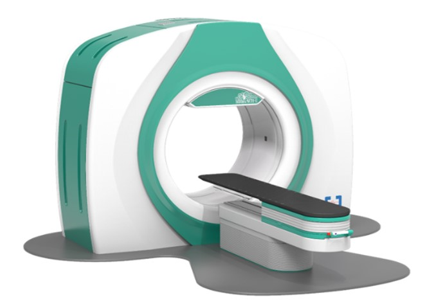
Figure 1 Siddharth-II LINAC.
The RayPlan 12A TPS from RaySearch Laboratories was used in this study. For commissioning the Siddharth-II LINAC, we followed AAPM TG-106 guidelines to ensure accurate beam modeling. Beam data such as percentage depth doses (PDDs), profiles, output factors, and different field sizes were measured and imported into the system. RayPlan uses the Collapsed Cone Convolution algorithm, a well-established technique for accurate dose calculation in radiotherapy treatment planning.
ArcCHECK
In this study, the ArcCHECK Model 1220 system was used to perform QA on the IMRT treatment plans generated in the RayPlan TPS. ArcCHECK is a 3D dosimetry system designed to measure and verify the actual dose delivered during treatment. It includes a cylindrical phantom made of water-equivalent material with 1,386 diode detectors arranged in a spiral pattern, each 10 mm apart. The system allows accurate dose verification by comparing the measured dose with the planned dose for each test case. Measurements were taken every 50 milliseconds, ensuring real-time accuracy. We used Sun Nuclear’s SNC Patient Software version 8.5 for data analysis. This software helped in comparing planned and delivered dose distributions, generating dose maps, and evaluating the QA results using gamma index and other statistical tools. This setup confirmed that the Siddharth-II LINAC system could deliver IMRT plans accurately, meeting the TG-119 guidelines.
Treatment planningAll plans were designed using the dynamic MLC technique, which allows precise beam shaping to accurately target tumors while protecting healthy tissues. The plans were calculated with the LF (Large Filter) beam model, One of its kind of FF beam mode in Siddharth II. Each treatment plan used carefully placed beams to give the right dose to the tumor while protecting healthy areas. For the head and neck case, we used 9 beams placed around the patient at angles from 0° to 320° (every 40°), giving a total dose of 50.4 Gy, with careful dose modulation to avoid critical structures. The prostate plan used 7 beams at angles like 0° to 300° (every 50°), with a dose of 75.6 Gy, focusing on the prostate and reducing dose to the bladder and rectum. The multistructure plan also used 7 beams at angles like 0° to 300° (every 50°) with around 50.4 Gy, customized for the position of each target. The C-shape plan used the same 9-beam setup placed around the patient at angles from 0° to 320° (every 40°), giving 50 Gy and designed to keep the spinal cord safe.
Plan evaluationIn this study, IMRT plans were created using the RayPlan TPS for four standard TG-119 test cases: Head & Neck, Prostate, Multistructure and C-Shape. These were selected to evaluate the planning and delivery performance of the Siddharth-II LINAC under different clinical conditions. All plans were normalized to meet the clinical goals defined in TG-119, ensuring target coverage and organ-at-risk sparing. Each plan was designed using the dynamic MLC technique, which allows precise beam shaping to deliver accurate doses to the tumor while protecting healthy tissues. To further evaluate the quality of each plan, we assessed two important metrics: the Conformity Index (CI) and Homogeneity Index (HI).
Conformity index (CI)
Feuvret et al.8 defines CI is the ratio of the volume covered by the prescribed isodose to the target volume. For test cases prostate, head-and-neck, C-shape, and Multi Target, prescription dose is 75.6 Gy, 50.4 Gy, 50 Gy and 50 Gy, respectively.

CI = 1 indicates that the radiation dose closely conforms to the shape and size of the tumor, which is considered ideal. A CI > 1 suggests the dose extends beyond the tumor, possibly affecting nearby healthy tissues. A CI < 1 means the tumor is not fully covered, which could lower the effectiveness of the treatment.
Homogeneity index (HI)
Clivio et al.9 defined HI as the dose difference normalized to dose prescription (Dpres) between doses covering 5% (D5) and 95% (D95) of the PTV. We also compared total number of monitor units (MU) required for each plan, and the ratio of total number of planned MU of IMRT plans.
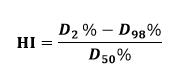
D₂% = Dose received by the top 2% of the target (highest dose)
D₉₈% = Dose received by 98% of the target (lowest acceptable dose)
D₅₀% = Dose received by 50% of the target (middle dose)
Quality assuranceAs part of the validation process, dose distributions for all TG-119 test cases were calculated in the RayPlan Treatment Planning System (TPS). The plans were normalized to meet the clinical objectives defined in the TG-119 protocol. The IMRT plans were then converted into QA plans for the ArcCHECK detector, and dose recalculation was performed for phantom. The ArcCHECK phantom was positioned at the machine isocenter and aligned using room lasers to ensure accurate setup. All QA plans were delivered using the original clinical gantry angles to replicate actual treatment conditions. Patient-specific QA measurements were analyzed using SNC Patient software. Gamma index analysis was conducted using a global gamma criterion of 3% DD and 3 mm DTA. A passing threshold of ≥95% was applied, in accordance with the recommendations of AAPM TG-119. Gamma pass rate of ≥95% was used as the acceptance threshold, confirming that our system delivers treatment plans with high precision and reliability, in line with clinical safety standard.
In the results, we assessed the dose distributions generated for each TG-119 test case to evaluate how effectively the target volumes were covered and how well nearby organs were protected. In the Head & Neck case Figure 2a the radiation was shaped precisely to cover the tumor while sparing critical structures like the spinal cord and parotid glands. For the Prostate plan Figure 2b, the dose focused tightly on the prostate, with a smooth fall-off that helped reduce exposure to the bladder and rectum. The Multi-structure case Figure 2c showed even coverage across all targets, with minimal dose to surrounding healthy tissues. In the C-shape plan Figure 2d, the dose wrapped around the curved target area, avoiding excess radiation to the center, where protection was most important. These results demonstrate that the system successfully created high-quality plans, aligning with TG-119 recommendations and clinical expectations. Figure 3 presents the DVH for this case. It confirms that the target (PTV) received the planned dose, while the spinal cord and parotids remained within safe dose limits. Figure 4 the DVH, shows that the dose to the prostate was delivered accurately, while the nearby organs (bladder and rectum) received minimal exposure. The DVH for this case, showing balance dosing to multiple targets and effective sparing of normal tissues are given below in Figure 5 and Figure 6 represents the DVH for the C-shape case, confirming precise dose and controlled exposure to nearby global approach to ensure uniform dose comparison across the four clinical scenarios. For the Head & Neck IMRT case, the plan met the defined objectives and achieved a gamma pass rate of 96.7% using 3%/3 mm criteria Table 1.The Prostate plan demonstrated strong conformity and delivered a pass rate of 98.8% Table 2. In the Multi Structure case, the dose distribution was evenly balanced across all targets, resulting in a high pass rate of 99.5% Table 3. The C Shape plan, which involves a curved target volume, was also successfully validated with a pass rate of 98.6% Table 4.These consistent results across all four test cases reflect the system’s ability to manage diverse treatment geometries while maintaining high dosimetric accuracy.
|
Task Group 119 |
|||
|
Structure |
Parameters |
Goal (cGy) |
Results (cGy) |
|
Plan Target Volume (PTV) |
D90 |
5000 |
5011 |
|
D99 |
4650 |
4782 |
|
|
D20 |
5500 |
5170 |
|
|
Cord |
Max |
4000 |
3945 |
|
Left Parotid |
D50 |
2000 |
1765 |
|
Right Parotid |
D50 |
2000 |
1739 |
Table 1 Goals and test result for Head & Neck case
|
Task Group 119 |
||||
|
Structure |
Parameters |
Goal (cGy) |
Results (cGy) |
|
|
Plan Target Volume (PTV) |
D95 |
7560 |
7625 |
|
|
D5 |
8300 |
8055 |
|
|
|
Rectum |
D30 |
7000 |
5402 |
|
|
D10 |
7500 |
7402 |
|
|
|
Bladder |
D30 |
7000 |
4218 |
|
|
D10 |
7500 |
6345 |
|
|
Table 2 Goals and test result for prostate case
|
Task Group 119 |
||||
|
Structure |
Parameters |
Goal (cGy) |
Results (cGy) |
|
|
Central Target |
D99 |
5000 |
5029 |
|
|
D10 |
5300 |
5251 |
|
|
|
Superior Target |
D99 |
2500 |
2789 |
|
|
D10 |
3500 |
3110 |
|
|
|
Inferior Target |
D99 |
1250 |
1289 |
|
|
D10 |
2500 |
2338 |
|
|
Table 3 Goals and test result for multi structure case
|
Task Group 119 |
||||
|
Structure |
Parameters |
Goal (cGy) |
Results (cGy) |
|
|
Plan Target Volume (PTV) |
D95 |
5000 |
5073 |
|
|
D10 |
5500 |
5495 |
|
|
|
Cord |
D50 |
2500 |
2362 |
|
Table 4 Goals and test result for c-shape case
|
Cases |
Multi structure |
Prostate |
Head & Neck |
C-Shaped |
|
Gamma Analysis Criteria (%) |
99.5 |
98.8 |
96.7 |
98.6 |
|
Conformity Index (CI) |
1 |
0.991 |
0.988 |
0.990 |
|
Homogeneity Index (HI) |
1.05 |
1.056 |
1.056 |
1.081 |
|
Monitor Unit (MU) |
631 |
551 |
1092 |
1508 |
Table 5 Plan evaluation result
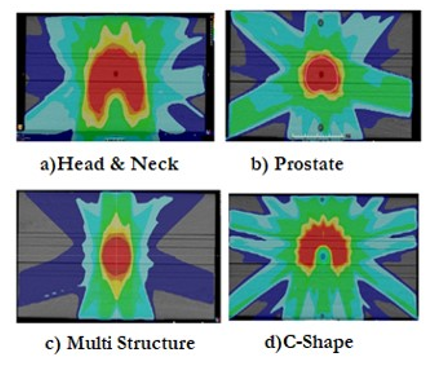
Figure 2 IMRT dose distribution in axial plane for the given test case.
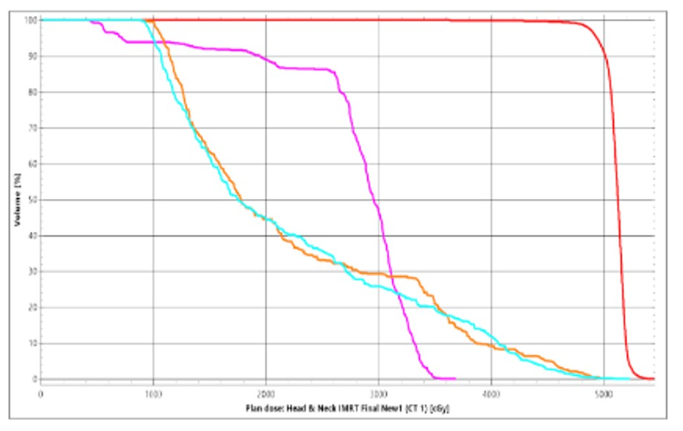
Figure 3 Head & Neck DVH.
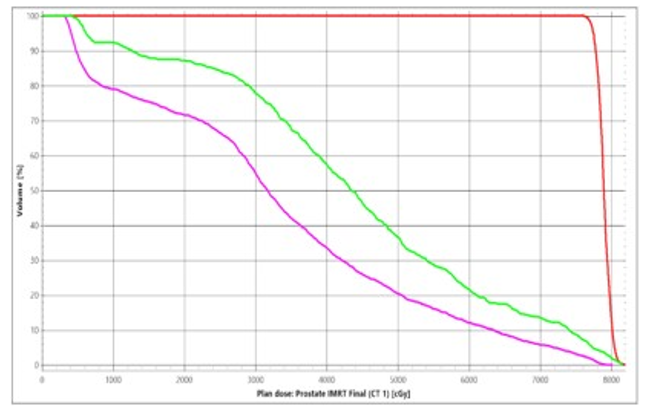
Figure 4 Prostate DVH.
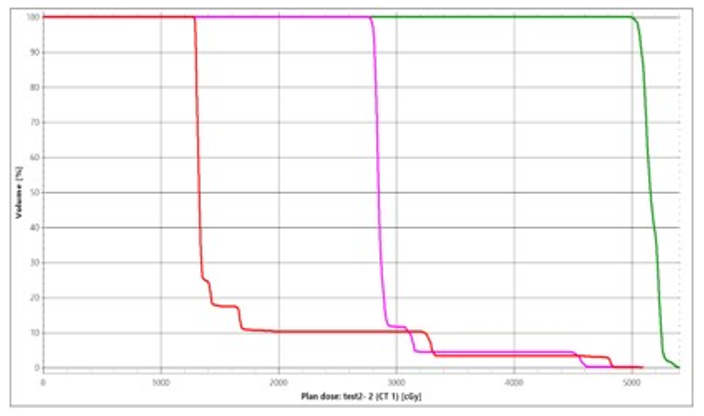
Figure 5 Multi- structure DVH.
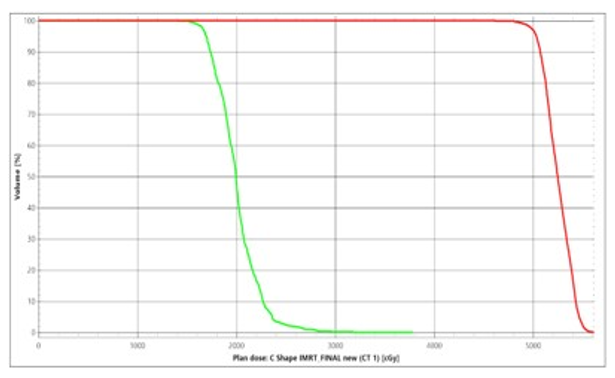
Figure 6 C-shape DVH.
The QA results provided suggestion of the system’s ability to deliver clinically accurate IMRT treatments. All TG-119 test cases showed high gamma pass rates when comparing the planned dose with the measured dose using the 3%/3 mm global gamma criteria. This indicates excellent agreement between the treatment plan and actual delivery. The consistency of these results across all four test cases Head & Neck, Prostate, Multi-Structure, and C-shape demonstrates the Siddharth-II LINAC’s stability and accuracy in handling various clinical scenarios. The conformity and homogeneity of the delivered dose were also within expected limits, confirming that the prescribed dose was effectively shaped around the target while minimizing radiation to nearby healthy tissues. These results validate both the planning system and the machine's performance, giving confidence in its routine clinical use for advanced IMRT treatments.
The Figure 7, Figure 8, Figure 9 & Figure 10 shows the gamma analysis results for each TG-119 test case. These images highlight the close match between planned and delivered doses, confirming the system’s reliability in delivering precise and complex IMRT plans. After the QA analysis, we also looked at how well the treatment plans delivered the dose to the tumor and protected nearby healthy tissues. The results showed that each plan delivered the correct dose to the target area while keeping the dose low to surrounding organs. The dose was well-shaped and even. For all four test cases Prostate, Head & Neck, Multi-Structure, and C-shape we calculated the Conformity Index (CI) and Homogeneity Index (HI) to check the quality of dose coverage. The values are given below Table 5.10-14
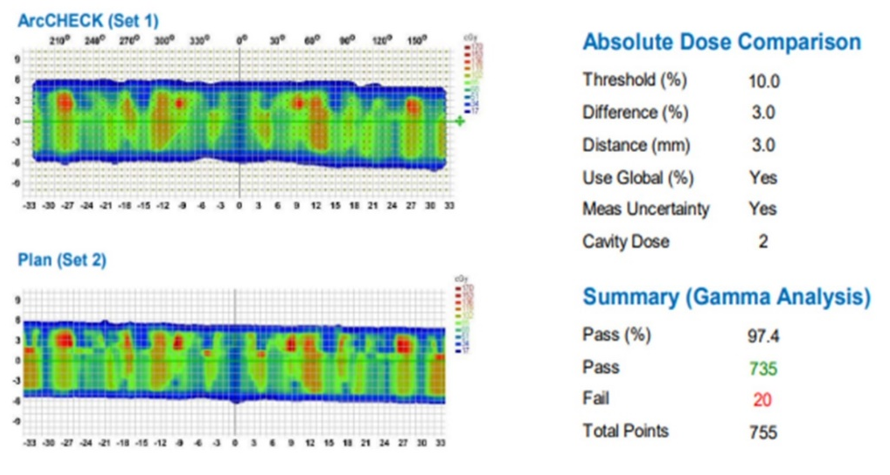
Figure 7 Head-and-neck case gamma analysis showing close agreement between planned and delivered dose.
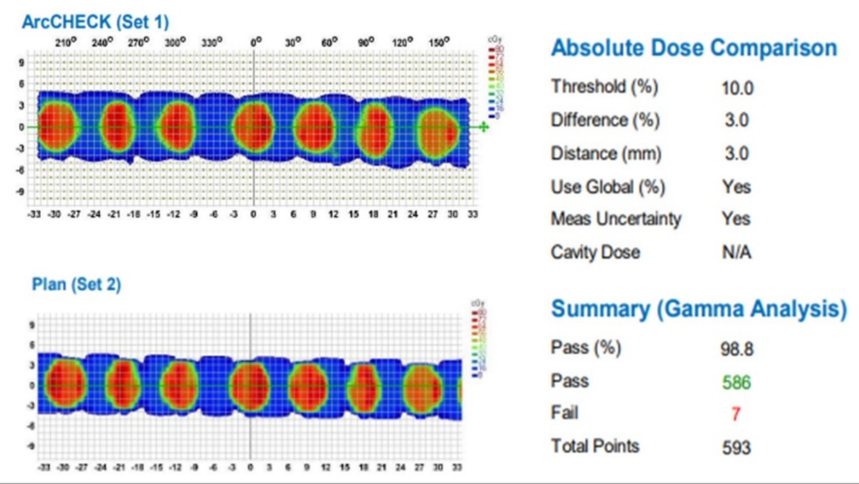
Figure 8 Prostate case gamma analysis results demonstrating precise agreement between planned and delivered dose.
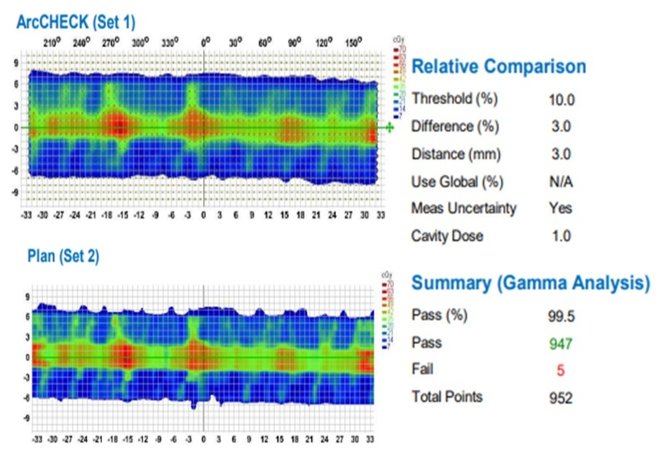
Figure 9 Multi structure case showing reliable gamma pass rate, validating system performance in complex scenarios.
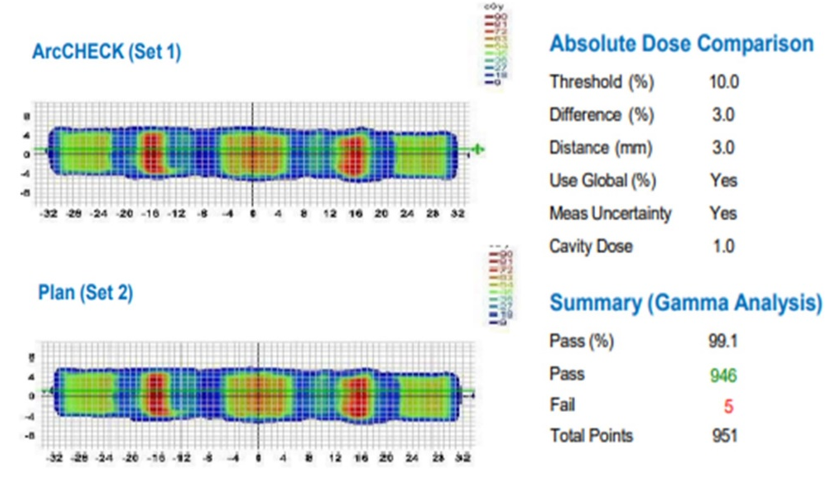
Figure 10 C-shape case gamma analysis confirming delivery accuracy for intricate IMRT plan.
TG-119 test cases are important for the validation of radiotherapy systems before they are put into clinics, according to several investigations. Mynampati et al.1 demonstrated the effectiveness of VMAT planning for preclinical treatment technique testing by assessing it using the TG-119 protocol and comparing its performance to that of IMRT. Nithya et al.2 used TG-119 to investigate the Monaco planning system and found that the document offers a comprehensive prototype for testing the capabilities of TPS to manage advanced IMRT plans. Yadav et al.5 also employed datasets from TG-119 to verify benchmark plans for IMRT and VMAT. Their efforts involved point dose verification with a CC13 ion chamber and planar dose verification with I-MatriXX and OmniPro, and they proved its capability to assess FF and FFF beam deliveries. In our research, TG-119 test cases were utilized to determine the clinical readiness of the Siddharth-II LINAC for planning and delivery of IMRT. Our method and results together, these findings support that Siddharth-II fulfills the criteria for IMRT accuracy and is suitable for routine treatment workflows. In the present study, TG-119 was implemented to assess the clinical readiness and IMRT delivery of Siddharth-II LINAC. In line with earlier research, CI and HI values stayed within reasonable bounds for every test condition. The significance of dosage uniformity for efficient tumor management was underlined by Clivio et al.9 while Feuvret et al.8 stressed the function of CI in protecting healthy tissue. Successful execution of all test cases confirmed the Siddharth-II system’s stability, accuracy, and clinical QA compliance. Treatment plans not only met but surpassed key quality benchmarks. DVH analysis showed consistent and accurate dose coverage was achieved for PTV and effective sparing of OARs. TG-119 test cases validated the system from planning to delivery, with gamma pass rates above 96% (3%/3mm criteria). CI and HI values remained within accepted clinical ranges, averaging 1.05 and <0.12 respectively, indicating conformal and homogeneous dose delivery. These results support the system's readiness for safe, routine IMRT application.
The Siddharth-II LINAC showed consistently strong results in this test, meeting more than 96% of the TG-119 goals. This authorizes to its accuracy and reliability when administering IMRT. Treatment planning was carried out in alignment with TG-119. To ensure a precise correlation between the planned and delivered dosage verification was done using ArcCHECK. Exceptional gamma passing rates, stable MU, and ideal values for the CI and HI were all consistently observed in the treatment plans. These results demonstrate the effectiveness of the QA procedure and validate the Siddharth-II machine suitability for use in cutting-edge clinical radiation. All things considered, this study emphasizes how essential it is to adhere to established QA procedures to guarantee cancer patients receive safe, accurate, and efficient radiation treatment.
None.
There is no Conflict of Interest.

©2025 Rao, et al. This is an open access article distributed under the terms of the, which permits unrestricted use, distribution, and build upon your work non-commercially.