International Journal of
eISSN: 2381-1803


Clinical Paper Volume 19 Issue 4
 Mengyu Han, Eryong Jing, Xiaoran Gao, Jianjun Yu
Effepharm (Shanghai) Co., Ltd, China
Correspondence: Jianjun Yu, EffePharm (Shanghai) Co., Ltd, Room 301, Bld.12, No.2033 Husong Rd. Shanghai, 201601, China
Received: July 01, 2026 | Published: July 14, 2026
Citation: He W, Han M, Jing E, et al. Pharmacokinetics of oral liposomal nicotinamide adenine dinucleotide powder in healthy adults: a randomized, doubleblind, cross-over trial. Int J Complement Alt Med. 2026;19(4):174-176. DOI: 10.15406/ijcam.2026.19.00782
Introduction: Nicotinamide adenine dinucleotide (NAD⁺) is an essential coenzyme involved in cellular energy metabolism, DNA repair, and healthy aging. However, its oral application is limited by poor stability and low bioavailability. Liposomal encapsulation may enhance NAD⁺ stability, absorption, and systemic exposure. This study compared the pharmacokinetic profiles of conventional NAD⁺ and liposomal NAD⁺ (LNAD⁺) in healthy adults.
Methods: In a randomized, double-blind, two-period crossover study, 10 healthy adults received a single oral dose of either conventional NAD⁺ (1 g) or LNAD⁺ (equivalent to 1 g NAD⁺), followed by the alternate treatment after a 7-day washout period. Blood samples were collected over 24 hours, and plasma NAD⁺ concentrations were quantified using LC–MS. Pharmacokinetic parameters, including Cmax, Tmax, AUC0~24h, and half-life (t1/2), were determined.
Results: LNAD⁺ achieved higher plasma exposure than conventional NAD⁺, with a greater Cmax (0.43 μM vs 0.28 μM) and AUC0~24h (6.93 μM·h vs 4.57 μM·h). Peak plasma concentrations occurred slightly earlier with LNAD⁺ (median Tmax: 1.5 h vs 2.0 h). Plasma NAD⁺ concentrations remained consistently higher following LNAD⁺ administration throughout the post-dose period, while the apparent half-life (t1/2) was shorter (15.54 h vs 18.71 h).
Conclusion: Liposomal encapsulation improved the pharmacokinetic performance of orally administered NAD⁺ by increasing systemic exposure and producing earlier peak plasma concentrations. These findings support the potential of LNAD⁺ as a promising oral delivery strategy and provide a foundation for future studies evaluating its pharmacodynamic and clinical benefits.
Keywords: Nicotinamide adenine dinucleotide (NAD⁺), liposomal formulation, pharmacokinetics, oral administration, systemic exposure
Nicotinamide adenine dinucleotide (NAD⁺) is an essential and ubiquitous coenzyme that plays a central role in numerous biological processes, including cellular energy metabolism, DNA repair, apoptosis, maintenance of mitochondrial function, and the regulation of aging.1,2 During aging, as well as under conditions of oxidative stress and chronic inflammation, intracellular NAD⁺ levels decline markedly, leading to metabolic dysfunction, progressive cellular deterioration, and an increased susceptibility to a wide range of chronic diseases, including neurodegenerative disorders, metabolic syndrome, and cardiovascular diseases.2,3 Consequently, strategies aimed at replenishing or enhancing endogenous NAD⁺ levels have emerged as a major focus in the fields of anti-aging research and metabolic regulation. Current approaches primarily involve oral supplementation with NAD⁺ precursors, such as nicotinamide riboside (NR) and nicotinamide mononucleotide (NMN), or direct administration of NAD⁺ itself.2,4 However, oral delivery of NAD⁺ is substantially limited by its poor chemical stability and low bioavailability, which significantly compromise its therapeutic efficacy and hinder its broader clinical application.5
The NAD⁺ molecule contains a chemically labile dinucleotide structure that is highly susceptible to degradation under conditions of elevated temperature, humidity, and unfavorable pH. In aqueous environments, NAD⁺ readily undergoes hydrolysis, resulting in the formation of biologically inactive degradation products and a rapid loss of its active content.6 Furthermore, as a highly polar and relatively large molecule, NAD⁺ exhibits poor permeability across the gastrointestinal epithelium and is readily degraded by digestive enzymes, leading to extremely low oral bioavailability. Even when a fraction of orally administered NAD⁺ reaches the systemic circulation, it is rapidly metabolized by extracellular ectoenzymes into precursor metabolites before efficient cellular uptake can occur, thereby limiting its intracellular bioavailability and biological activity.7 Consequently, the development of advanced delivery systems capable of enhancing the physicochemical stability, gastrointestinal absorption, and intracellular delivery of NAD⁺ is critical for facilitating its clinical translation and expanding its therapeutic and functional applications.
Liposomes are nanoscale delivery vehicles composed of phospholipid bilayers that closely resemble the architecture of biological cell membranes, thereby exhibiting excellent biocompatibility and biodegradability.8 Encapsulation of NAD⁺ within liposomes offers a promising strategy to overcome several limitations associated with its conventional administration. The phospholipid bilayer provides an effective protective barrier against oxygen, moisture, and other external factors, thereby reducing NAD⁺ degradation during storage and throughout gastrointestinal transit. In addition, liposomes can facilitate intracellular delivery through membrane fusion and endocytic uptake, enabling more efficient transmembrane transport of NAD⁺ and potentially enhancing its oral bioavailability.8–10 By protecting NAD⁺ from enzymatic degradation and mitigating presystemic loss during gastrointestinal transit, liposomal encapsulation may also prolong its systemic residence time and improve its metabolic and signaling functions.11,12 Overall, liposomal NAD⁺ represents a promising formulation that leverages advanced nanocarrier technology to enhance the physicochemical stability, absorption efficiency, and in vivo bioavailability of NAD⁺. By enabling more effective intracellular delivery and sustained biological activity, this delivery platform holds considerable potential for supporting therapeutic and nutritional applications in healthy aging, metabolic regulation, and functional nutrition.
Despite increasing recognition of the importance of NAD⁺ in human health, and the growing use of liposomal formulations in dietary supplementation, there remains a paucity of controlled clinical pharmacokinetic (PK) data directly comparing NAD⁺ and liposomal NAD⁺ in healthy adults. This study was designed to evaluate the pharmacokinetics of conventional NAD⁺ and liposomal NAD⁺ in healthy adults. By directly comparing plasma NAD⁺ concentrations following oral administration, we aimed to characterize the impact of liposomal encapsulation on systemic exposure and evaluate its potential clinical utility.
The study protocol, informed consent forms, case report forms, and other study-related documents were reviewed and approved by the Medstar Speciality Hospital Ethics Committee, Bangalore, Karnataka, India, on 23 June 2025. The study was conducted in accordance with the International Council for Harmonisation Good Clinical Practice (ICH-GCP) guidelines, the principles of the Declaration of Helsinki, and applicable regulatory and ethical requirements in India. Written informed consent was obtained from all participants before enrollment. The trial was prospectively registered with the Clinical Trials Registry–India (CTRI No. CTRI/2025/07/092027).
This study employed a randomized, two-period crossover design to compare the pharmacokinetic profiles of oral nicotinamide adenine dinucleotide (NAD+) and its liposomal formulation (LNAD+) in 10 healthy adult participants aged 18–65 years with a body mass index (BMI) of 18.5–25.0 kg/m². Participants were randomly assigned to one of two treatment sequences, with a 7-day washout period between administrations. Subjects received either four capsules of NAD+ (1 g NAD+) or four capsules of LNAD+ (2 g formulation, equivalent to 1 g NAD+). Blood samples were collected before dosing and at 0.5, 1, 1.5, 2, 3, 4, 6, 8, 12, and 24 hours after administration. NAD+ concentrations were quantified in plasma using liquid chromatography–mass spectrometry (LC–MS). Pharmacokinetic parameters, including maximum concentration (Cmax), time to maximum concentration (Tmax), area under the concentration–time curve (AUC0~24h), and elimination half-life (t1/2), were calculated. Only healthy, non-smoking adults without significant medical conditions were enrolled, and participants were instructed to avoid NAD+-containing products and strenuous exercise throughout the study period.
A total of 10 healthy adults completed both treatment periods and were included in the pharmacokinetic analysis. The mean age of the participants was 29.4 years, and 80% were male. All participants were of Asian ethnicity, with a mean body weight of 66.2 kg, mean height of 173.7 cm, and mean BMI of 21.98 kg/m², indicating a normal-weight population.
Mean plasma NAD⁺ concentration–time profiles following oral administration of conventional NAD⁺ and LNAD⁺ are presented in Figure 1. Baseline plasma NAD⁺ concentrations were identical before both treatments (0.10 µM). Following administration, plasma NAD⁺ concentrations increased in both treatments, with consistently higher concentrations observed after LNAD⁺ administration, particularly between 0.5 and 4 hours. Plasma NAD⁺ concentrations gradually declined after reaching peak levels but remained above baseline through 12 hours and approached baseline values by 24 hours (0.13 µM for NAD⁺ and 0.16 µM for LNAD⁺). Compared with conventional NAD⁺, LNAD⁺ produced a higher mean Cmax (0.43 µM vs 0.28 µM), an earlier median Tmax (1.5 h vs 2.0 h), and a greater AUC0-24h (6.93 µM·h vs 4.57 µM·h). The apparent elimination half-life (t1/2) was shorter following LNAD⁺ administration than following conventional NAD⁺ administration (15.54 h vs 18.71 h). The coefficient of variation for Cmax was lower following LNAD⁺ administration than following conventional NAD⁺ administration (18.02% vs 25.2%).
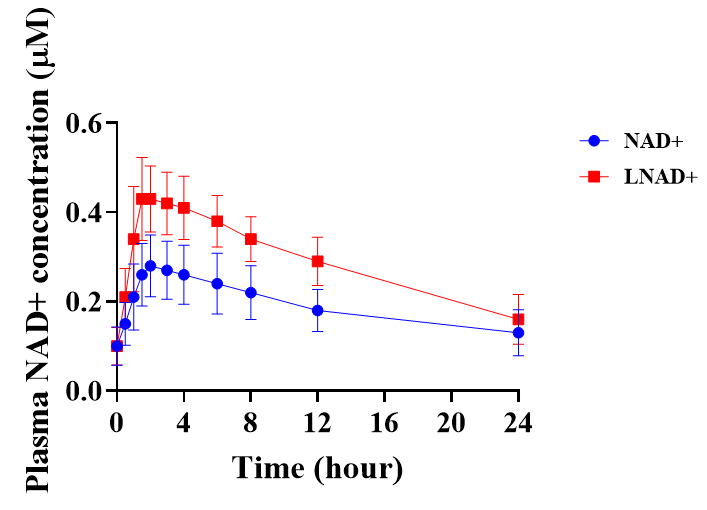
Figure 1 Mean plasma NAD⁺ concentration–time profiles following oral administration of conventional NAD⁺ and liposomal NAD⁺.
This randomized, double-blind, two-period crossover study compared the pharmacokinetic profiles of conventional NAD⁺ and liposomal NAD⁺ (LNAD⁺) following single-dose oral administration in healthy adults. Compared with conventional NAD⁺, LNAD⁺ achieved higher peak plasma concentrations (Cmax), greater systemic exposure (AUC0-24h), and an earlier time to peak concentration (Tmax), indicating that liposomal encapsulation favorably modified the pharmacokinetic profile of orally administered NAD⁺. Although LNAD⁺ exhibited a shorter apparent plasma half-life than conventional NAD⁺, this finding may reflect differences in the distribution or elimination characteristics of the liposomal formulation rather than reduced systemic availability.
The improved pharmacokinetic profile observed with LNAD⁺ is consistent with the proposed advantages of liposomal delivery systems. Liposomes have been shown to protect encapsulated compounds from degradation within the gastrointestinal environment and to facilitate transport across the intestinal epithelium, thereby enhancing systemic exposure following oral administration. Although comparable human pharmacokinetic studies of liposomal NAD⁺ remain limited, the present findings provide preliminary clinical evidence supporting the potential of liposomal encapsulation to enhance the oral delivery of NAD⁺. Nevertheless, the mechanisms responsible for the observed pharmacokinetic differences cannot be determined from plasma concentration data alone and warrant further mechanistic investigation.
The increased systemic exposure achieved with LNAD⁺ may have important implications for future therapeutic and nutritional applications of NAD⁺ supplementation. Because declining NAD⁺ levels have been associated with aging, metabolic dysfunction, and several chronic diseases, improving the systemic availability of orally administered NAD⁺ could potentially enhance its utility as a nutritional intervention. However, pharmacokinetic improvements do not necessarily translate into enhanced biological activity or clinical efficacy. Additional studies evaluating intracellular NAD⁺ concentrations, pharmacodynamic biomarkers, and clinically relevant outcomes are required to determine whether the improved systemic exposure observed with LNAD⁺ results in meaningful physiological benefits.
Several limitations should be acknowledged. First, this was an exploratory single-dose pharmacokinetic study conducted in a relatively small cohort of healthy adults, which may limit the generalizability of the findings. Second, plasma NAD⁺ concentrations were measured as the primary pharmacokinetic endpoint and may not fully reflect intracellular NAD⁺ availability, which is more directly related to biological function. Third, the 24-hour sampling period may not have been sufficient to fully characterize the terminal elimination phase, and the estimated half-life should therefore be interpreted with caution. Future studies involving larger populations, repeated-dose administration, extended pharmacokinetic sampling, and comprehensive pharmacodynamic assessments are warranted to further characterize the pharmacokinetic properties and clinical potential of liposomal NAD⁺.
In conclusion, this randomized crossover pharmacokinetic study demonstrated that oral liposomal NAD⁺ produced higher peak plasma concentrations, greater systemic exposure, and an earlier time to peak concentration than conventional NAD⁺ in healthy adults. These findings indicate that liposomal encapsulation favorably alters the pharmacokinetic profile of orally administered NAD⁺ and may enhance its systemic availability. Although the observed pharmacokinetic improvements are encouraging, the biological and clinical significance of these changes remains to be established. Larger studies with extended pharmacokinetic sampling, repeated-dose administration, and comprehensive pharmacodynamic assessments are warranted to determine whether the enhanced systemic exposure achieved with liposomal NAD⁺ translates into meaningful physiological and therapeutic benefits.
The authors would like to thank all the study participants for their time and commitment. We also acknowledge the investigators, study coordinators, and laboratory staff at Medstar Speciality Hospital for their support in conducting the clinical trial, collecting biological samples, and performing the bioanalytical assessments.
The authors declare no conflict of interest.

©2026 He, et al. This is an open access article distributed under the terms of the, which permits unrestricted use, distribution, and build upon your work non-commercially.