International Journal of
eISSN: 2574-9862


Research Article Volume 9 Issue 2

Bachelor Bryan Yobani Folgar Wampl, Facultad de Medicina Veterinaria y Zootecnia, Universidad de San Carlos de Guatemala
Correspondence: M.V. Gustavo Adolfo González González, Bachelor Bryan Yobani Folgar Wampl. Facultad de Medicina Veterinaria y Zootecnia, Universidad de San Carlos de Guatemala, Tel 0050259415141
Received: April 28, 2025 | Published: May 15, 2025
Citation: González MVGAG. General procedures and guidelines during assisted rearing of African Lion (Panthera leo) neonates in a private collection in Guatemala. Int J Avian & Wildlife Biol. 2025;9(2):53‒56. DOI: 10.15406/ijawb.2025.09.00232
The African lion (Panthera leo) is a well-represented species in zoological institutions worldwide. When lions are kept in permanent captivity, situations may arise that necessitate assisted rearing of newborns. Since the early days of assisted rearing, the American Zoo Association (AZA), through its 1982 book Infant Diet Care Notebook, emphasized that the decision to hand-rear an animal must be carefully evaluated by zoo personnel, considering that each situation is unique and should be assessed individually. This document describes the practices used for the assisted rearing of 31 lion cubs in captivity until weaning, at approximately 3 months of age. During this period, satisfactory methods were developed, resulting in the successful rearing of healthy cubs.
Keywords: Panthera leo, African lion, assisted rearing, lion cub
Recent genetic studies recognize two lion subspecies: Panthera leo leo in central and western Africa and India, formerly found in North Africa, southeastern Europe, the Middle East, the Arabian Peninsula, and southwestern Asia; and Panthera leo melanochaita in southern and eastern Africa. African lion populations have declined significantly in West Africa, and in many African countries they are now restricted to protected areas.1,2 In 2023, the IUCN Red List of Threatened Species assessed and classified lion (Panthera leo) populations as “Vulnerable” under criteria A2abcd. It is estimated that by 2023, their distribution spanned 1,571,296 km², representing only 6% of their historical range. This reflects an estimated 36% decline in distribution since 2002, when their range was estimated at 2,460,986 km². And, most likely, this decline will continue.3
The African lion (Panthera leo) is a species well-represented in zoological institutions worldwide. When lions are in permanent captivity, situations may arise that necessitate the assisted rearing of newborns. The neonate’s own condition (congenital or hereditary diseases, infectious or non-infectious illnesses, and trauma or injuries) may dictate the need for assisted rearing. On the other hand, there are causes affecting the mother’s ability to care for her offspring,4 which include the following: dystocia, vaginal or uterine infections (or both), mastitis, inability to secrete milk, retained placenta, and abnormal maternal behaviors (such as rejection of their offspring) that could endanger the cub’s life.5
Since the beginnings of assisted rearing, the American Zoo Association (AZA), through its book Infant Diet Care Notebook in 1982, emphasized that the decision to hand-rear an animal must be carefully examined by zoo staff, taking into account that each situation is different and must therefore be evaluated separately, keeping in mind the following considerations:
Assisted rearing is important for the management of endangered wild populations maintained in captivity, especially those that give birth to a single offspring per year or species that give birth to offspring after long periods.6
This document describes the practices used for the assisted rearing of 31 lion cubs in captivity until their weaning, around 3 months of age, a period during which satisfactory methods were developed, resulting in the rearing of healthy cubs.
Study area and study animals:
This study was conducted at the following coordinates: North latitude 14°06’02.5’’ and West longitude 90°37’27.6’’, at an altitude of 34 meters above sea level (masl), km 87.5 CA2 highway, Escuintla Department, Guatemala, Central America (C.A.).
Sample size:
A total of 03 lionesses completely abandoned their 31 newborns (20 males and 11 females) across different births occurring from 2002 to 2022. The rearing protocol for the total number of offspring is detailed below.
Assisted rearing protocol:
Medical Evaluation: Immediately after separating the neonate from its mother, it was physically assessed to determine its health status, aiming to identify potential issues such as: cleft palate, wounds, umbilical cord hernias, and physical deformities. Following the physical examination, the umbilical cord was disinfected with iodine (50% iodine and 50% water) in some cases, or chlorhexidine (2% chlorhexidine gluconate) in others.
Housing Conditions — mandatory in this case due to neonates having an immature thermoregulatory center — necessitated the use of a pediatric incubator (Isolette® Isolette Infant Incubator: Air Shields Incubator, Rankin Biomedical Corporation, USA) set to a temperature of 32°C and 60% relative humidity during the first and second weeks; 30°C from the third and fourth weeks onward; and 28°C starting at the fifth week.5 Daily disinfection and cleaning standards were maintained, as well as daily replacement of blankets. The bottles used were human-grade baby bottles. The nipples utilized were Baby Color type (infan-tec®). Both the bottle and nipple fit well into the cubs’ mouths. Bottles and nipples were sterilized daily during the first week and subsequently three times per week.
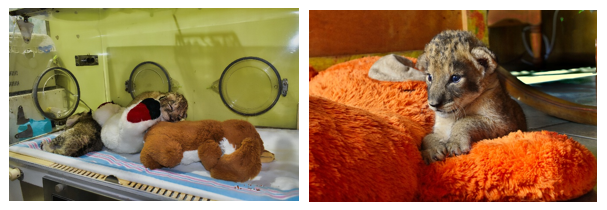
During the first four weeks of life, strict management was implemented based on proper hygiene, adequate storage of ingredients and utensils, and meticulous handling to avoid contaminants.7 Rearing, in all cases, began on the first day after birth. One of the most critical aspects of rearing was the choice of milk substitute. In all cases, KMR® milk (Pet-Ag, Inc. (PetAg® International, Hampshire, Illinois, USA)) was used.
Feeding frequency and schedule:
The daily feeding period was distributed across a 16-hour feeding and 8-hour fasting window, starting at 06:00 hours and ending at 21:00 hours, with three hours between each feeding.
Food intake was calculated as a percentage based on the neonate’s live weight. The consumption percentage that yielded the best results, according to daily weight gain, was achieved by providing food within the range of 18% to 20% of body weight.
Feeding began by offering a calculated amount of food equivalent to 10% of the cub’s body weight during the first week. In the second week, 12% or 14% was provided, depending on each cub’s growth rate. From the third week onward, the food quantity ranged between 15% and 20%. Daily body weight was recorded using a digital scale, reported in grams under 8-hour fasting conditions. After each feeding, defecation and urination were stimulated through anogenital rubbing with a warm, damp cloth. For litters with multiple cubs, individuals were identified either by tying colored ribbons around the neck or by applying drops of nail polish to the hair in the wither’s region. In some cases, cubs were identified with microchips at one month of age.
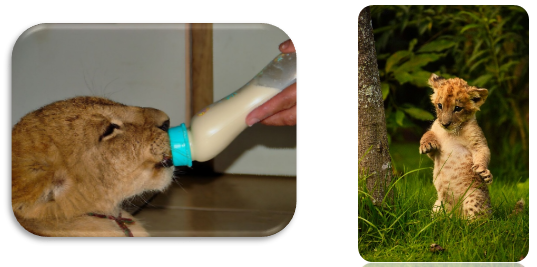
The milk of carnivores tends to be relatively concentrated by mid-lactation. The milk of mustelids and felids contains between 22% and 30% dry matter, 8% to 14% fat, 7% to 12% protein, and 3% to 4% carbohydrates.8 Fat plays a significant role in the nutrition of African lions. Lioness milk is high in fat, suggesting that fat is a critical component for the survival of these predators from birth.9 There are homemade formulas, such as those reported by Iben and Liebetseder in 1994 and Harumi et al. in 1996, which, although used at the time, exhibit deficits in protein, fat, and amino acids such as taurine, and thus were not utilized in this study.5,10 Although milk substitutes for dogs and cats have been used with healthy outcomes in lion cubs,5,11 initial observations indicate slower growth compared to cubs nursed directly by their mothers. Another critical finding is that dog milk substitutes have caused blindness, diarrhea, constipation, and hindlimb weakness in lions reared with these formulas.12
Considering these factors, KMR® milk was the substitute of choice for assisted rearing in this study, during which no nutritional deficiencies were observed. The weight recorded in lion cubs at birth in this study is similar to that published in the lion care manual (Table 1).
|
Males Parent-reared |
Females Parent-reared |
Males Assisted |
Females Assisted |
Males Rearing, Guatemala |
Females Rearing, Guatemala |
|
|
Birth Weight (kg). |
1.5 |
1.2 |
1.3 |
1 |
1.113 |
1.117 |
|
n = 20 |
n = 11 |
Table 1 Birth Weight (kg)
Source: Original data.
The average weight gain recorded daily for lion cubs nursed by their mothers is 100 g/day during days 0–100, while for those fed with a milk substitute, slower growth is reported, with a gain of 70 g/day.11 Other authors mention that the expected gain ranges from 100 to 200 grams per day.5 Tables 2 and 3 detail the results obtained and compare them with data reported by the lion management manual.11
|
Average daily weight gain (grams) - Males |
0–30 days |
30–45 days |
45–70 days |
70–100 days |
|
Parent-reared |
105 |
139 |
||
|
Assisted |
76 |
112 |
258 |
|
|
Assisted (Guatemala) |
158 |
140 |
230 |
232 |
|
Average daily weight gain (grams) – Females |
||||
|
Parent-reared |
96 |
127 |
||
|
Assisted |
69 |
113 |
200 |
|
|
Assisted (Guatemala) |
127 |
121 |
122 |
176 |
Table 2 Daily Weight Gain Comparison (grams)
Source: Original data vs. lion care manual (10).
|
Females |
Males |
|
|
15 days (kg) |
1.949 kg |
1.955 |
|
30 days (kg) |
2.673 |
3.671 |
|
45 days (kg) |
4.05 |
4.515 |
|
60 days (kg) |
6.245 |
7.046 |
|
110 days (kg) |
13.608 |
17.618 |
|
Avg. Weaning Weight (kg) |
9.132 |
7.949 |
|
Avg. Weaning Age (days) |
85 |
71 |
Table 3 Weight and Weaning Data
Source: Original data.
The volume of milk substitute offered for consumption in this study was based on body weight, as suggested in the literature.7,11 Both puppies and kittens consume within a range of 15% to 20% of their body weight, whereas for lion cubs, a range of 12% to 18% is ideal. Episodes of diarrhea may occur when intake exceeds 25% of body weight per day. At this percentage, the neonate gains excessive weight and becomes predisposed to bone abnormalities.5,7,11 Although the lion care manual edited by the AZA11 states that, based on the energy content of commercial substitutes, the volume of milk substitute to be offered should equate to up to 29% of initial body weight, later reducing this volume to 20% at 10 days and 11% at 70 days, this study adopted a contrasting approach. Specifically, it began with a lower value (10% to 12%) and gradually increased to a range of 14% to 18%, and subsequently to 20%.
Feeding schedule and frequency:
The feeding schedule and frequency in this study were based on the maximum stomach capacity of a carnivore, which, in general terms, could be 5–7% of body weight. Consequently, to feed them 20% of body weight, it is recommended to distribute this volume into a minimum of 5 feedings. Some institutions begin by providing 7–10 feedings during the first 10 days.11 The authors of this study chose to provide 6 feedings every three hours over a 16-hour period.
Weaning in captive felids represents one of the most critical phases, primarily because some cubs tolerate poorly solid food, making it essential the gradual introduction of various solid foods.4 The weaning age for lion cubs fed with milk substitutes varies across facilities. For the cubs presented here, the weaning age is detailed in Table 4. The weaning results align with literature, which indicates that weaning begins at 8 weeks of age, though it is also noted that it tends to occur once the incisor teeth erupt, an event typically happening around 5 weeks of age. In comparison, cubs reared by their mothers are weaned at 7–12 months of age.11
|
60 days |
90 days |
106 days |
|
|
Females (Total 11) |
27% (3) |
55% (6) |
18% (2) |
|
Males (Total 20) |
65% (13) |
30% (6) |
5% (1) |
Table 4 Weaning Age Distribution
Source: Original data.
Socialization and Cub welfare:
In the wild, lion cubs naturally engage in extensive play behavior and visual exploration of their environment. Similarly, cubs are regularly groomed by their mother under natural conditions. Beyond the typical motor play of running, rolling, climbing, and pivoting, cubs participate in stalking, ambushing, and grappling—motor patterns they will later use as adults to capture prey. The complex social structure of the African lion makes it unique among wild felids. The Lion Care Manual11 mandates that they be housed in groups large enough to meet their social and behavioral needs.12
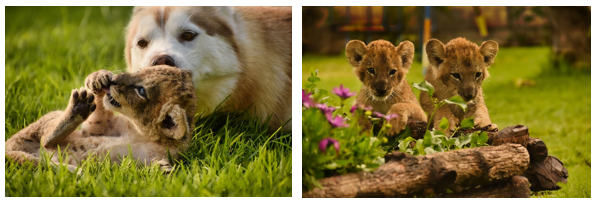
Once the cub begins walking, it is critical to provide sufficient space and time to allow for running and climbing. Additionally, low-height structures should be available. Environmental enrichment must be provided to promote skills such as stalking and attacking.11 In the case presented here, based on the aforementioned protocols, the lion cubs were stimulated with outdoor play sessions for short periods initially, gradually extending these as they aged. Lion cubs born as singletons (sole offspring) were socialized by having them interact with dogs, yielding very positive results.11
This study aims to provide a reference protocol for the hand-rearing of lion cubs regarding nutritional, physiological, and behavioral aspects, as well as to assist zookeepers in delivering improved care for lion cubs abandoned by their mothers. Feeding programs must be adjusted according to individual needs, requiring proper physiological monitoring and continuous weight assessment of the neonates. The authors recommend further research to develop a milk substitute for neonates that is closer in composition to lioness milk.
None.
Special thanks to the Gonzalez Cifuentes family for their unwavering support, assistance, and collaboration throughout this study. And to the feline caretakers, for their noble work.

©2025 González. This is an open access article distributed under the terms of the, which permits unrestricted use, distribution, and build upon your work non-commercially.