eISSN: 2576-4462


Research Article Volume 9 Issue 3

Department of Science of Agriculture, Food, Natural Resources and Engineering (DAFNE), University of Foggia, Italy
Correspondence: Laura de Palma, Department of Agriculture, Food, Natural Resources and Engineering (DAFNE), University of Foggia, Italy, Tel 39 320 4394555
Received: June 20, 2025 | Published: July 3, 2025
Citation: Antoniciello D, Limosani P, Massenzio G, et al. Effect of cold plasma treatments on quality attributes of raspberry homogenate intended for sustainable processed products in marginal lands. Horticult Int J. 2025;9(3):100-102. DOI: 10.15406/hij.2025.09.00330
Soft berries are considered one of the best food sources of bioactive compounds and can be grown even in marginal lands; furthermore, when produced in the limiting agro-environmental conditions of marginal areas, they give fruits with higher concentrations of nutrients and bioactive substances. Berries are easily perishable and therefore, in addition to being used as fresh fruit, they are used to obtain a wide range of processed products. Berries can be vectors of parasites that adhere to the surface of the fruit. Among the recent decontamination technologies, cold plasma is an efficient and environmentally friendly method that acts on the surface of the fruit and, therefore, it is useful for the food safety of both fresh and processed products. A test aimed at evaluating possible effects of cold plasma treatments on the quality attributes of berry fruits and processed products was carried out on raspberry fruits and their homogenate. Cold plasma was applied for 30 minutes and for 60 minutes, in two separate trials, and the quality attributes of homogenates obtained from treated and untreated fruits were compared: no negative effect was observed in terms of total soluble solid concentration, titratable acidity, pH, juicy, polyphenol concentration, antioxidant capacity.
The 2030 Agenda for Sustainable Development, adopted by the United Nations to protect the planet from degradation, includes goals for the sustainable management, production and development of resources, in order to meet the needs of present and future generations.1 In this context, attention is paid to sustainable development in marginal areas, which constitute a significant portion of the planet, that are often depopulated and require targeted approaches to achieve the Sustainable Development Goals (SDGs), particularly those focused on poverty reduction, food security and environmental sustainability.2 Marginal rural areas are also the subject of attention by the European Union to address problems such as land scarcity, offering economic, social and environmental benefits.3 Marginal lands are often characterized by steep slopes, poor soils subject to erosion and water scarcity that give rise to low productivity and make them unsuitable for intensive agriculture.4 In addition to bioenergy crops, highly stress-tolerant food crops (such as halophytes and quinoa), agroforestry, perennial crops and pasture grasses,2 berry species, also called “small berries” in Italy or “soft berries”, can be grown sustainably in marginal and inland areas.5,6,7 Strawberry, raspberry, blackberry, blueberry and currant are the main berry species in the European countries.8
Berries are considered one of the best food sources of bioactive compounds;9,10 moreover, under the limiting agri-environmental conditions of marginal areas, they produce fruits with higher concentrations of total sugars, citric acid and total polyphenols.5 Berry fruits are easily perishable and susceptible to both mechanical damage and fungal decay; in addition, they have a high respiration rate that increases their perishability.11 Given its limited shelf life, the fruit is processed into a wide range of products such as beverages, jam and jellies, purees, frozen foods, ingredients and culinary products. Processing technologies add value to berries by creating new products, increase access to fruits and their nutrients even when they are not in season, and, moreover, offer convenience for consumers.
Berries may be vectors of foodborne diseases caused by parasites which adhere to the fruit and remain there until consumption;12 therefore, it is important to pay attention to food safety throughout the supply chain, from fresh to processed products.8,13 Decontamination includes chemical and physical treatments. Nevertheless, both health and environmental concerns require the reduction of chemicals, and thermal treatments have a negative effect on the final organoleptic and functional properties of foods. Among the most recent technologies, cold plasma is an efficient non-thermal method for the decontamination of the fruit surface or even its derivatives. It involves the generation of an ionized gas (plasma) and active chemical species by applying energy to a starting gas (or gas mixture), using various types of equipment. Ozone and nitrogen are the most commonly used gases.13 The effect of cold plasma varies depending on the operating conditions (in terms of voltage, frequency, type of gas, application time), not only in relation to decontamination, but also to the qualitative characteristics of the fruit and processed products.14,15 Since this type of treatment do not leave residues and has low energy consumption, it is considered environmentally friendly.13
The present paper reports a test aimed at evaluating possible effects of cold plasma treatments on the quality attributes of berry fruits and processed products. For the execution of this test, raspberry fruits and their homogenate, useful to produce other product, such as purees, were taken as examples.
The test was conducted in September 2024 after preliminary trials carried out in 2023. Raspberry samples purchased locally were stored overnight at 3 °C and then divided into six groups of approximately 130 g each. The first three groups were single control replicates, the other three groups were single replicates treated with cold plasma using a Surface Dielectric Barrier Discharge (SDBD) system that generates ozone plasma at a fixed voltage. Based on previous analyses, the application time of 30' was chosen; the distance between the electrodes and the samples was approximately 10 cm. All the replicates were homogenized to obtain a puree. Technological parameters, i.e. total soluble solid concentration (TSS) by a digital refractometer (Digital wine VM-7 Atago Co. LTD, J), pH and titratable acidity (TA) by neutralization with 0.1 N NaOH to pH 7 (Titralyzer Laboraroires Dujardin-Salleron T11-107) were determined, by standard laboratory procedures,16 on an aliquot of the juice obtained centrifuging the homogenized at 4500 rpm for 10 min. The juiciness of the homogenized was also assessed, as a percentage of juice relative to the whole fruit (weight:weight). The concentration of total phenols, flavonoids, and anthocyanins was determined spectrophotometrically (Shimadzu UV 1700, Shimadzu Europe), according to Žlabur and coll.17 after extraction from 5 g of homogenate in MeOH solution (20% H2O, 80% MeOH). On the same extract, the antioxidant activity was analyzed, as Trolox equivalent antioxidant capacity (TEAC), according to Re and coll.18 In order to verify the effect of cold plasma in case a longer exposure time was needed, the same test was repeated, in the following week, applying the cold plasma treatment for 60 minutes.
For each parameter, the difference between values obtained before and after the cold plasma treatment was statistically evaluated with the one-tiled Student t-test. The effect obtained from the 30-minute test and that obtained from the 60-minute test were evaluated separately.
The application of cold-plasma treatment for 30 minutes did not change, or only minimally changed, the technological parameters. In detail, no change at all was found in the concentration of TSS (Figure 1a), and the TA had a minimal and non-significant increase by 4%. Consequently, the TSS:TA ratio varied to the same extent (Figure 1b): this last small difference was the only statistically significant one among the technological parameters. Based on the scientific literature, plasma treatment gases may be able to increase TA, as they can react with fruit moisture to form new acids15 or form nitric acid by interacting with reactive nitrogen species.19 Raspberry juice generally has low pH values ranging between 3 and 4, which favor the microbiological stability; in the present trial, the pH was about 3.1 either before or after the plasma application. The fruit juiciness was not influenced by the treatment (Figure 1c), therefore, the homogenate obtained from these berries did not change its consistency.
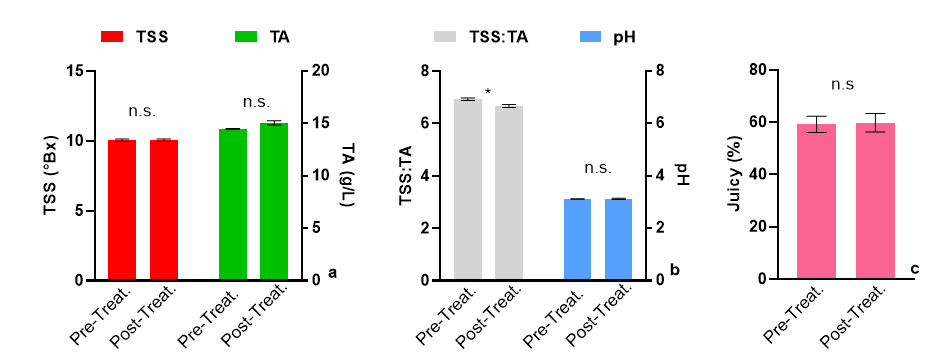
Figure 1 Total Soluble Solid concentration (a), TTS:TA ratio and pH (b), juiciness (c) of raspberry homogenate produced before and after fruit treatment with cold plasma for 30 minutes (n.s. = non-significant; * = significant difference at p < 0.05 by Student’s t-test).
As regards the concentration of phenolic compounds, the 30 minute plasma treatment induced a slight, non-significant, decrease of total polyphenols (-9%) while did not affect at all the total flavonoid and anthocyanin content (Figure 2a). As reported by Fernandes and Rodrigues,20 phenol compounds may be oxidized by the reactive species formed during plasma applications, as probably happened in this trial, or, depending on the operating conditions, be unaffected or even improved by other chemical and physical mechanisms. This substantial invariance of phenol concentration after cold plasma treatment is relevant, given the well-known beneficial effects that the phenolic pool exerts on human health and the interest that this arouses among consumers of berries.10 Total polyphenols are considered the phenolic class most closely related to antioxidant activity;21,22 however, in this trail their tendency to decrease with plasma treatment had no negative effects on the antioxidant capacity, which, on the opposite, slightly increased, non-significantly, by 5% in the treated raspberry homogenate (Figure 2b): the action of other types of bioactive compounds, including organic acids, can support this finding.23
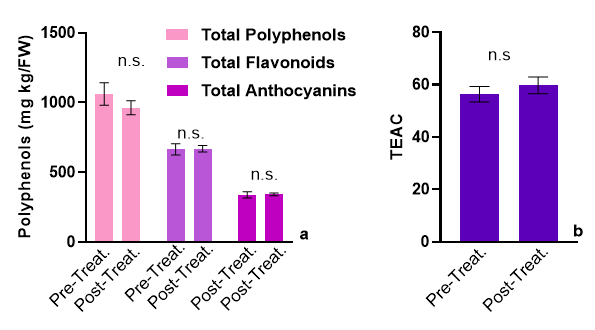
Figure 2 Concentration of total polyphenols, total flavonoids, total anthocyanins (a) and antioxidant activity (b) of raspberry homogenate produced before and after fruit treatment with cold plasma for 30 minutes (n.s. = non-significant; * = significant difference at p < 0.05 by Student’s t-test).
The plasma treatment applied for 60 minutes did not induce any statistically significant difference in the technological parameters. Even with this application time, the juice TSS concentration did not change (Figure 3a) and the TA had a minimal increase (by 3%). Consequently, the TSS:TA ratio decreased at the same small extent (Figure 3b). The pH remained about 3.3. The fruit juiciness showed a tendency to increase by 15% (Figure 3c), possibly due to a higher degree of cell wall disintegration caused by the prolonged treatment; therefore, the homogenate obtained from this treatment was a little “waterier”.
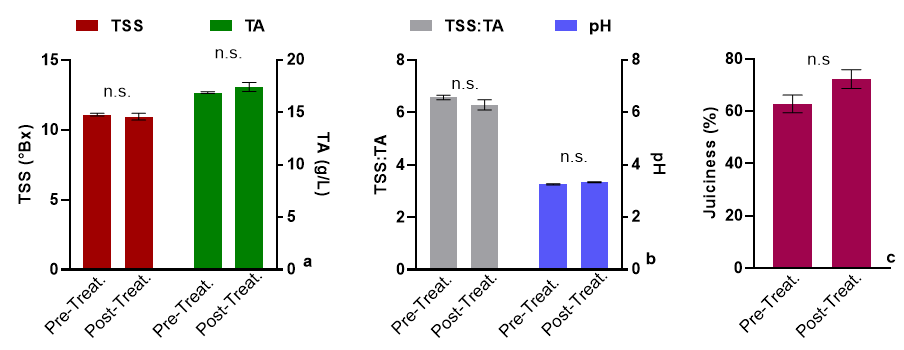
Figure 3 Total Soluble Solid concentration (a), TTS:TA ratio and pH (b) and juiciness (c) of raspberry homogenate produced before and after fruit treatment with cold plasma for 60 minutes (n.s. = non-significant; * = significant difference at p < 0.05 by Student’s t-test).
The concentration of phenolic compounds remained virtually unchanged by this plasma application (Figure 4a), as well as the antioxidant activity (Figure 4b).
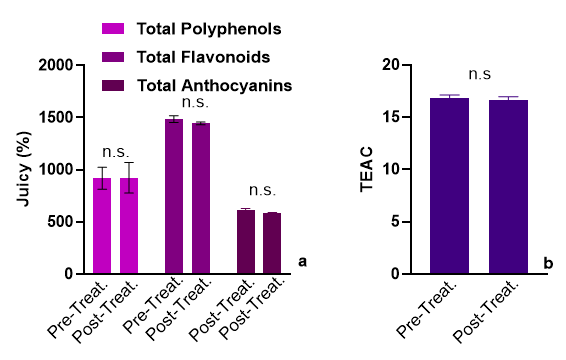
Figure 4 Concentration of total polyphenols, total flavonoids, total anthocyanins (a) and antioxidant activity (b) of raspberry homogenate produced before and after fruit treatment with cold plasma for 60 minutes (n.s. = non-significant; * = significant difference at p < 0.05 by Student’s t-test).
The absence of negative effects of cold plasma on both the phenol content and the antioxidant capacity of the treated fruits, even after 60 minutes of application, highlights the positive potential of using this environmentally friendly technology in the soft berry supply chain, and can contribute to increasing the environmental and economic value of berries produced in marginal areas, as well as consumer interest in these fruits and their processed products.
Berry species can be grown sustainably even in marginal areas that need sustainable development. The consumption of their fresh or processed fruits is very useful for human nutrition because these products combine a low caloric intake and a good richness in fiber with the richness in bioactive compounds, which include polyphenols, flavonoids, anthocyanins and other substances with antioxidant capacity. However, berries require decontamination from parasites that easily adhere to their surface. The fruit transformation processes add value to berry production, especially if, upstream, they include environmentally friendly techniques such as decontamination by means of cold plasma. Therefore, the sustainable production and processing of particularly healthy berries constitute an economically promising chain for marginal areas.
The data obtained in this experimental test show that, under the operating conditions of the trials we carried out, cold plasma treatments applied to raspberry fruits did not substantially modify the quality of their homogenate. These results suggest verifying, on a larger scale, the effect of berry decontamination by cold plasma treatments in order to produce processed products.
The research activities were carried out within the Agritech National Research Center and received funding from the European Union Next- Generation EU (PIANO NAZIONALE DI RIPRESA E RESILIENZA (PNRR)-MISSIONE 4 COMPONENTE 2, INVESTIMENTO 1.4 -D.D. 1032 17/06/2022, CN00000022), and with the support of the Agenzia per la Coesione Territoriale and Fondo di Sviluppo e Coesione through a scholarship for “Municipal doctorates” (XXXVIII cycle). The preliminary trials received funding from PRA-HE 2021 Project. Grant agreement [prot. 0008277, 2021].
None.
Authors declare that there is no conflicts of interest.

©2025 Antoniciello, et al. This is an open access article distributed under the terms of the, which permits unrestricted use, distribution, and build upon your work non-commercially.