eISSN: 2577-8250


Review Article Volume 8 Issue 2
 Xiao Guozeng
College of Horticulture and Gardening, Yangtze University, China
Correspondence: Professor. Xiao Guozeng, College of Horticulture and Gardening, Yangtze University, China
Received: May 16, 2026 | Published: June 1, 2026
Citation: Yezi C,Guozeng X. Gender discipline and spatial practice: garden space and female consciousness in the grand view garden of dream of the red chamber. Art Human Open Acc J. 2026;8(2):51-57. DOI: 10.15406/ahoaj.2026.08.00273
Taking the Grand View Garden (Daguanyuan) in Dream of the Red Chamber as its case study, this paper examines how private gardens of the Ming and Qing dynasties functioned as gendered spatial structures that shaped women’s living conditions and subject consciousness through the combined effects of physical layout, institutional regulation, and psychological discipline. Drawing on theories of spatial sociology and feminist scholarship, the study argues that the garden should not be understood as a neutral aesthetic medium; rather, it constituted a concrete spatial manifestation of patriarchal order. Its enclosed configuration, hierarchical organization, and design strategy of “concealment and revelation” enacted subtle yet pervasive forms of discipline over women’s bodies, behaviors, and mental worlds in everyday life. At the same time, women appropriated this relatively enclosed environment to negotiate limited forms of discursive power and spiritual autonomy through poetry clubs, artistic creation, and social interaction. The garden space thus embodied a dual character, serving simultaneously as a mechanism of discipline and a site of resistance. By introducing a gender-based perspective into the study of traditional Chinese gardens, this paper seeks to provide a historical reflection on contemporary issues concerning gender and space.
Keywords: garden space, female consciousness, gender discipline, dream of the red chamber
The significance of examining women’s living conditions through garden space
In the context of traditional Chinese culture, gardens have long been regarded as spatial embodiments of literati ideals, aesthetic sensibilities, and the ethos of reclusion. Existing scholarship has therefore focused primarily on artistic form, philosophical connotations, and garden-making techniques. However, this research paradigm, centered on the experiences of the garden owner, the literati, and the male subject, has tended to overlook the social dimensions of gardens as lived spaces, particularly the spatial experiences of women as significant users and residents.
The Grand View Garden (Daguanyuan) depicted in Dream of the Red Chamber represents not only the concentrated expression of the Jia family’s authority and aesthetic ideals, but also the principal setting for women’s everyday life, social interaction, and spiritual activities. Its highly enclosed yet spatially intricate organization makes the garden a valuable lens through which to examine women’s conditions of existence during the Ming and Qing dynasties. This paper argues that the Grand View Garden should not be interpreted simply as a “female utopia,” but rather as an institutionalized spatial field in which gender discipline is enacted through specific spatial mechanisms.
In existing studies, gardens are frequently treated as extensions of male culture, while women are reduced to subsidiary figures within the aesthetic imagery of the garden. Relatively little research has systematically investigated how gardens, through the interaction of spatial power and gender institutions, shaped women’s social roles and psychological states in everyday life. Addressing this gap, the present study conceptualizes the garden as a gendered mechanism of spatial governance and, through a close textual analysis of Dream of the Red Chamber, reveals both women’s experiences of discipline and their limited practices of subjectivity within this environment.1
Physical enclosure of space
Restrictions on women’s mobility through the grand view garden’s walls and gatekeeping system:
In Dream of the Red Chamber, the Grand View Garden (Daguanyuan) serves as the principal setting for the daily lives and aesthetic pursuits of the women of the Jia household. At the same time, its spatial organization and ritual arrangements embody mechanisms of regulation and constraint imposed upon women’s activities. Among these mechanisms, enclosing walls and a strictly controlled gatekeeping system constitute the most visible physical manifestations of spatial restriction, jointly producing the “interiorized” character of women’s space in both structural and symbolic terms.
From its inception, the Grand View Garden functioned as an inner garden (neiting yuan). Surrounded by high walls and governed by stringent access controls and hierarchically differentiated rules of entry and exit, it established a clear physical boundary between the “inner” and the “outer” domains. This spatial segregation was not merely intended to ensure security or privacy; rather, it represented the spatialization of the Confucian ethical order encapsulated in the principle that “men manage affairs outside, while women remain within” (nan zhu wai, nü zhu nei).
Women’s daily activities were strictly confined to the interior of the garden. Their movement routes, social interactions, and even temporal routines were subject to institutional regulation. The enclosing walls and gatekeeping system not only restricted bodily mobility, but also reinforced women’s internalization of their prescribed social identities as “insiders” excluded from public affairs and structures of social power. This gendered division of space constituted a fundamental basis for women’s subordinate social status.2
Spatial constraints and behavioral regulation: the limited scope of women’s activity space
In traditional Chinese society, women’s spheres of activity were subject to longstanding restrictions imposed by both institutional arrangements and cultural norms. These constraints were manifested not only in geographical terms, but also in the broader construction and maintenance of the gender order. The limited nature of women’s activity space was shaped by Confucian moral codes, the patriarchal family structure expressed in the principle of “men outside, women inside,” and the conceptual distinction between the inner and outer realms.
Classical texts such as the Book of Rites (Liji) codified these norms through injunctions such as “men and women should remain distinct” and “women should not engage in external social relations,” explicitly prohibiting women from entering public space freely. From birth onward, women were largely confined to the domestic compound, their understanding of the world mediated through the bounded space of the inner courtyard. During adolescence, they were educated in accomplishments such as music, chess, calligraphy, and painting, yet these cultural pursuits remained situated within private spaces such as the inner chambers and boudoirs. Upon marriage, women moved from their natal homes to their husbands’ households, where they continued to inhabit similarly secluded domestic interiors.
From the perspective of cultural construction, this division of space reveals a clear asymmetry in gendered opportunities. Men were encouraged to participate in state affairs, the imperial examination system, and public life, whereas women were educated primarily for domestic responsibilities, including household management and childrearing.
A comparable pattern is evident in Dream of the Red Chamber. Although female characters such as Lin Daiyu and Xue Baochai engage in activities such as garden strolls, poetry composition, and social gatherings, these practices remain spatially confined to the Grand View Garden. While the garden offers women a relatively autonomous environment for artistic and social expression, it remains fundamentally an extension and symbol of patriarchal authority. The apparent freedom it provides is therefore conditioned by an underlying structure of male power and may be understood as a spatial manifestation of the “male gaze” operating within the process of women’s everyday activities.
The explicit demarcation between the inner and outer realms: the spatial logic of concealment and revelation
In the aesthetics of Chinese garden design, the interplay of “concealment and revelation” (cang-lu) has long been regarded as a fundamental compositional strategy.3 Through spatial sequences characterized by changing vistas with each step, sudden openings, and the transition from obscurity to clarity, this design logic creates a sensory experience often described as “artificially constructed, yet seemingly created by nature.” In the Grand View Garden of Dream of the Red Chamber, however, this design principle extends beyond purely aesthetic concerns and resonates deeply with women’s trajectories of movement and behavioral patterns. The structure of concealment and revelation effectively constitutes a spatial system that guides gendered conduct, reinforcing institutional discipline through a rhythm of obscuring, directing, and regulating.4
First, the logic of concealment shapes the hidden circulation routes of women’s everyday life. Architectural elements such as screen walls, winding corridors, narrow passages, covered walkways, and waterside pavilions compel women to move through detours, avoid direct encounters, and follow indirect trajectories. As a result, movement is transformed from direct, rapid, and visible circulation into a mode characterized by slowness, concealment, and nonlinearity. For instance, when Lin Daiyu travels from the Bamboo Lodge (Xiaoxiang Guan) to the Green Delights Studio (Yihong Yuan), she passes through multiple meandering paths and flower-lined corridors, frequently interrupted by curtains, screens, and turning corners. This nonintuitive route structure reduces spatial autonomy and establishes a bodily order in which direct movement is neither possible nor appropriate. From the perspective of Michel Foucault’s theory of spatial discipline, such design subtly directs behavior, rendering the operation of power omnipresent yet largely invisible (Figure 1).
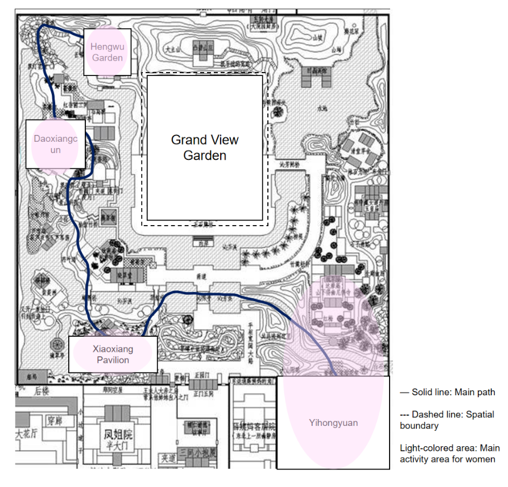
Figure 1 Spatial structure and distribution of women's activities in grand view garden.
Second, spaces of revelation frequently function as sites of institutional observation and emotional display. Women’s conduct becomes visible, ritualized, and subject to both self-monitoring and performative expectations. Courtyard spaces in front of residences such as Qiushuang Studio and the Fragrant Herb Court (Hengwu Yuan) often serve as venues for poetry gatherings, banquets, and formal visits. Within these semi-public settings, women are not only participants in social interaction but also objects through which familial morality and decorum are displayed. Characterized by open terraces, pergolas, and waterside platforms with high visual permeability and accessibility, these spaces operate as stages upon which women perform under conditions of visibility. Their spatial qualities reinforce women’s awareness of bodily comportment and ceremonial obligations, enabling power to be internalized through the intersection of aesthetic pleasure and ritual propriety.
Third, the rhythmic transition between concealment and revelation symbolizes the fluctuating psychological states and social identities of women under patriarchal ethics. Women are permitted to present themselves selectively—for example, by composing poetry or displaying artistic talent during gatherings—yet are more frequently expected to remain restrained, deferential, and within prescribed limits. Thus, Jia Tanchun may oversee garden affairs and household administration, but she never participates in matters beyond the domestic sphere. Similarly, Xue Baochai, despite her literary accomplishment, consistently adopts an image of modesty and ritual propriety rather than overt self-assertion. This intermittent mode of social visibility mirrors garden devices such as shadows glimpsed through lattice windows, reflections on water, and hidden paths behind flowers, all of which suggest a mode of presence that is perceptible but never fully exposed. In this way, garden aesthetics and gender order become mutually reinforcing symbolic systems.
From the perspective of gender and spatial theory, the interweaving of concealment and revelation imposes a form of “soft constraint” upon women. Rather than overtly depriving them of agency, the garden regulates conduct through atmosphere, circulation, and visual boundaries, encouraging self-discipline within conditions of limited freedom. As Elizabeth Grosz argues, space is not merely the backdrop of gendered behavior, but an active participant in the production and reiteration of gender roles. The aesthetics of concealment and revelation in the Grand View Garden thus constitute an aestheticized mechanism of spatial discipline, one that subtly shapes women’s identities, emotions, actions, and social interactions beneath the surface of visual pleasure.
In sum, the design strategy of concealment and revelation not only generates the poetic spatiality of the Grand View Garden but also serves as both metaphor and disciplinary structure for women’s lived experiences. It represents a compromise between aesthetic expression and social order, as well as a concrete architectural projection of gendered spatial institutions. The changing scenery encountered by women as they move through the garden can therefore be understood as a carefully orchestrated rehearsal of proper conduct: how one moves, where one appears, and when one withdraws are all regulated by the combined logic of spatial design and Confucian propriety. Within this flexible structure—in which concealment disciplines and revelation disciplines alike—women’s bodies are guided by circulation paths, emotions are filtered through landscape, and subjectivity is aesthetically shaped and subtly constrained, rendering the garden an exquisite spatial projection of traditional gender order (Figure 2).
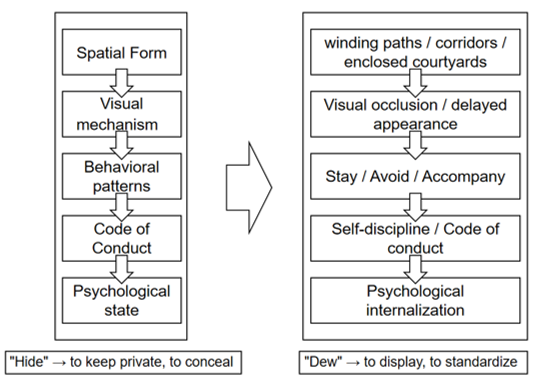
Figure 2 Schematic diagram of the influence of the "concealment-exposure" spatial mechanism of gardens on the behavioral and psychological discipline of women.
Confucian discipline and women’s self-regulation
Compared with the visible forms of physical enclosure embedded in garden space, the psychological constraints experienced by women in traditional society were more subtle and profound. Under the disciplinary force of Confucian ethics, women’s conduct, emotions, and moral self-understanding were incorporated into a closed process that moved from external regulation to internalized self-discipline. As Foucault observes, the most effective form of power is one that leads individuals to identify with and internalize the mechanisms that govern them.
Within the patriarchal order, women were compelled to subject their words, actions, and emotional expressions to continual internal scrutiny according to standards of propriety and legitimacy. Over time, this process generated a deeply rooted mechanism of self-limitation. This “invisible wall” exerted a more enduring influence than any material boundary and constituted the psychological foundation of women’s structural predicament in traditional society.
The influence of garden life on women’s thought and mentality: constraints on freedom and independent consciousness
Through long-term cultural conditioning, women gradually came to accept and even actively maintain the spatial limitations imposed upon them, a phenomenon that may be described as “spatial compliance.” For many women in the novel, the acceptance of spatial restriction is not simply the result of external coercion but also of the gradual internalization of Confucian norms. Xue Baochai provides a representative example. Throughout the narrative, Baochai repeatedly emphasizes moderation, propriety, and emotional restraint. Her criticism of excessive emotional expression and her preference for conformity to social expectations reveal a conscious commitment to maintaining established moral boundaries. Although she possesses considerable intelligence and literary talent, she rarely attempts to challenge the institutional framework within which she lives. Instead, she transforms compliance into a personal virtue.
A similar pattern can be observed in the character of Li Wan. As a young widow, Li Wan devotes herself to household responsibilities and the education of younger generations. Rather than questioning the restrictions imposed upon widowed women, she accepts them as part of her moral duty. Her conduct demonstrates how patriarchal expectations become incorporated into women’s own ethical self-understanding.
Jia Tanchun further illustrates this mechanism when she participates in household management. Her efforts to strengthen regulations and improve administrative order do not challenge the existing gender hierarchy; rather, they contribute to its efficient operation. In this sense, women are not merely passive subjects of discipline but also participants in the reproduction of disciplinary structures. The psychological enclosure of the Grand View Garden therefore operates not only through walls and gates, but also through the internal acceptance and maintenance of normative expectations.
The Grand View Garden appears to provide an idealized and secluded environment in which women’s talents can flourish. In reality, however, it remains a highly regulated and structurally enclosed living space. Within such an environment, women’s consciousness of freedom and independent subjectivity is subtly but persistently suppressed, rendering the construction of an autonomous inner world fraught with contradiction and repression.
From the perspective of gendered spatial theory, as Elizabeth Grosz has argued, space is not a passive container but an experiential structure organized around gender. In the Grand View Garden, expectations of gentleness, quietness, and obedience are embedded in the arrangement of pavilions, halls, and circulation routes. As a result, women’s movements are restricted, while their consciousness is gradually shaped by a flexible disciplinary structure that encourages conservatism, restraint, and diminished self-confidence.
The fixity and closure of women’s social networks within the garden
In Dream of the Red Chamber, the Grand View Garden appears to offer the women of the Jia household an idyllic “realm of daughters,” seemingly removed from worldly concerns. Yet this space remains deeply structured by broader social hierarchies. One of the most significant manifestations of this structure is the fixed and closed nature of women’s social networks. These patterns of interaction are shaped not only by spatial proximity, but also by status hierarchy, family institutions, and cultural capital, producing a social system that is accessible only within clearly defined boundaries.
First, the spatial distribution of residences plays a decisive role in shaping interpersonal relations. The Bamboo Lodge (Xiaoxiang Guan), the Fragrant Herb Court (Hengwu Yuan), and the Green Delights Studio (Yihong Yuan) are located in close proximity, forming the core social circle centered on Lin Daiyu, Xue Baochai, and Jia Baoyu. Daiyu’s frequent visits to Baoyu and her poetic exchanges with Baochai are facilitated by this spatial adjacency. At the same time, such convenience reinforces the exclusivity of the inner circle. Although Xiangling longs to participate in poetic activities, she gains access only through Daiyu’s private instruction, illustrating the difficulty of entering culturally privileged networks.
Second, the hierarchical structure of the Jia household significantly influences the accessibility of social interaction. The Rongxi Hall, where the family matriarch resides, functions not only as a locus of authority but also as the symbolic center of women’s social order. Collective activities such as festival banquets and poetry gatherings are organized under her auspices, with participation largely limited to women of the principal lineage. Figures such as Lady Wang, Wang Xifeng, Li Wan, and Jia Tanchun constitute an institutionalized social circle associated with household governance. By contrast, Zhao Yiniang, despite her status as a concubine of Jia Zheng, remains excluded from these upper-level networks, demonstrating the extent to which social interaction is constrained by formal hierarchy.
Third, cultural exchange within the garden, exemplified by the Begonia Poetry Society organized by Jia Tanchun, provides an important venue for women’s literary expression and intellectual interaction. Yet this space also reinforces mechanisms of exclusion. Membership is largely restricted to educated women of legitimate and elevated status, including Baochai, Daiyu, Li Wan, and Jia Xichun. Although ostensibly open, the poetry society effectively constitutes an elite cultural circle. The phrase “the flowers are in bloom, and all our sisters are gathered” reflects not only a sense of internal cohesion but also the implicit exclusion of those who do not belong to the recognized inner community.
The indirect nature of women’s contact with the outside world
In traditional Chinese society, men typically served as the household’s representatives in external social and political affairs. Consequently, women’s interactions with the outside world were highly dependent upon the social roles and power channels controlled by male family members. This mode of communication, predicated on male mediation, meant that even when women resided within relatively spacious and refined garden environments, they remained unable to establish direct and autonomous connections with the world beyond the domestic sphere. In this sense, the garden functioned as a mechanism that simultaneously provided spatial comfort and obstructed women’s outward social engagement.
In the Grand View Garden of Dream of the Red Chamber, the women’s access to external information, initiation of social contact, and control over social resources all depended upon the permission and coordination of male figures such as Jia Zheng and Jia Baoyu. This arrangement reveals a pronounced degree of social indirectness. Even when women’s status improved, such advancement remained fundamentally contingent upon the political and economic capital of fathers, husbands, or sons. Social connections that belonged to women themselves were largely effaced.
This dependence is particularly evident in the episode of the search of the Grand View Garden. Although Wang Xifeng occupies a central administrative role in carrying out the inspection, her authority derives from Lady Wang, whose decisions are themselves shaped by pressures associated with Jia Zheng and external social opinion. Thus, even female authority within the household remains embedded within and subordinated to a broader patriarchal structure.
Women’s spatial freedom in the feudal garden may therefore be described as a condition of “apparent autonomy but substantive dependence.” Nearly every instance of women’s external communication—whether the transmission of information or physical movement beyond the household—required mediation by male family members. This highly indirect form of social participation obscured women’s agency and produced a complex condition in which spatial openness coexisted with social closure. Women in the garden could compose poetry, paint, and participate in gatherings, yet when access to resources and power beyond the garden was involved, they remained confined to a subordinate position from which they were not permitted to overstep prescribed boundaries.
The derivative nature of women’s social roles and familial responsibilities
In China’s traditional patriarchal clan society, women’s social identities were constructed in profound dependence upon their familial roles. Rather than existing as autonomous social individuals, women were defined through relational categories such as someone’s daughter, wife, or mother. This derivative structure of social identity not only deprived women of meaningful participation in public affairs, but also transformed their domestic responsibilities into instrumentalized and obligatory functions.
This pattern is especially evident in Dream of the Red Chamber, where female characters at different stages of life embody various forms of transferred responsibility and erasure of individual subjectivity. Such institutionalized role dependency compresses the possibility of women’s participation in public life and externalizes the basis of their self-worth.
As Simone de Beauvoir famously observes in The Second Sex, “One is not born, but rather becomes, a woman.” The familial obligations, moral duties, and clan responsibilities borne by women are not natural consequences of biological sex, but functional assignments imposed by social structure. In Dream of the Red Chamber, female characters almost invariably exhibit a mode of existence characterized by living for others. This sacrificial ethic is legitimized by culture and ritual propriety, yet in essence represents a profound extension of gender inequality at the ethical level.
Women are thus constituted not primarily as autonomous beings, but as bearers of responsibility, maintainers of social order, and executors of sacrifice within the familial system. Even when situated within the cultivated and aesthetically rich environment of the garden, they find it difficult to achieve genuine growth in subject consciousness or the construction of an independent selfhood.
Women’s attempts to transcend spatial constraints
Physical space: new developments in women’s artistic and social activities: Although garden space was fundamentally a disciplinary environment structured through a male-centered aesthetic vision, some women nevertheless demonstrated ideological resistance and forms of self-assertion within the fissures of this implicit order. The relatively flexible, enclosed, and semi-private character of traditional garden space afforded women a limited but significant arena for artistic practice and social interaction.
The poetry society constituted one of the most important spatial carriers of women’s artistic expression. In the Grand View Garden, the Begonia Poetry Society, organized under the leadership of Li Wan, was situated in open and scenically distinguished areas of the garden. These locations combined favorable ventilation and natural lighting with an elegant and secluded atmosphere conducive to literary activity. As described in the novel, the setting before Qiushuang Studio, framed by green bamboo and red leaves stirred by the wind, provided an ideal environment for poetic composition.
In addition, the numerous refined chambers and studies dispersed throughout the garden offered important spaces for women’s reading, artistic education, and creative work. Within these residences, women enjoyed relatively independent and private environments for study and self-cultivation. Though modest in scale, these interiors often displayed a high degree of personalization in their furnishings and decorative details, allowing women to express individual aesthetic preferences and cultivate a distinctive intellectual world.5
The expansion of women’s spatial range and the enhancement of mobility
Although the spatial institutions and Confucian moral order governing aristocratic gardens in the Qing dynasty imposed substantial constraints on women’s activities, women’s actual patterns of movement within these environments were not entirely static.6 In practice, their spatial range expanded to a certain extent, and their degree of autonomy was correspondingly enhanced. The Grand View Garden depicted in Dream of the Red Chamber offers a particularly vivid example.
Compared with the more confined spaces of the inner chambers and embroidery rooms, the garden provided women with a broader and more diversified spatial environment. Their activities extended into courtyards, reception halls, pavilions, waterside terraces, and flower-lined pathways. Characters such as Lin Daiyu and Xue Baochai were able to compose poetry, organize literary societies, and gather with companions throughout the garden, thereby enlarging both their everyday sphere of life and their opportunities for social interaction.
In the late Ming period, most women’s artistic and social activities were conducted within the framework of kinship networks, and their creative subjects were typically limited to flowers, birds, and figures. Yet some women engaged more directly with the wider social world, and their spatial practices expanded from small private gardens to publicly accessible scenic landscapes. Women such as Wang Shuduan and Huang Yuanjie, compelled to travel in order to support their families, gained opportunities to experience natural scenery firsthand. They produced some of the few extant landscape paintings by women of the late Ming and frequently participated in literary exchanges with male scholars. Others, such as Weng Ru’an, adopted strikingly unconventional modes of conduct, traveling widely by horseback and boat and traversing scenic regions across Jiangnan. These practices challenged prevailing assumptions that women should remain confined to domestic responsibilities and reflected an emerging awareness of women’s independent capacities and modes of self-realization.
Recent scholarship has demonstrated that although most women in late imperial China remained constrained by kinship structures and domestic obligations, a small number of educated women expanded their geographical mobility through travel, artistic production, and literary networks. Such cases should therefore be understood as exceptional rather than representative, revealing possibilities of agency within a broader framework of gender restriction rather than indicating the disappearance of patriarchal constraints.7,8
Contesting discursive power in the management of garden space: women’s search for expression and participation within enclosed environments
While the enclosed character of garden space constrained women’s everyday activities, it also gradually fostered their pursuit of discursive power and autonomy. Spatial management is, in essence, an externalized form of power. As Michel Foucault argues, space is not only a site in which bodies are disciplined, but also a precondition for resistance.
The walls, gates, and access controls of the Grand View Garden imposed strict limitations on women’s movements, confining their activities to the interior world of the garden. Yet within this highly regulated environment, women became increasingly aware of their lack of voice and sought opportunities for self-expression and subtle forms of resistance through literature, art, and social interaction.
The formation of poetry societies among the women of the Jia household exemplifies this process. These gatherings were not merely expressions of literati taste, but also practical means by which women claimed a form of public expression through poetic composition. Although the rules governing such activities appeared to remain subject to the authority of family elders, women such as Lin Daiyu and Xue Baochai gradually assumed leading roles as organizers, commentators, and arbiters. This shift in discursive authority reflects a loosening of the internal spatial order: in the relative absence of male family members, women were able to establish a semi-autonomous intellectual domain within the garden.
Contemporary feminist spatial theory helps illuminate this dynamic. As Jane Rendell argues, space is not a passive container but a product of intertwined relations of power and gender. Through acts of “re-inscription,” women can generate new forms of agency within disciplinary environments. In the context of the Grand View Garden, women’s self-organization through poetry societies and everyday practices constitutes a rewriting of patriarchal discourse and a reoccupation of space.
The enclosed nature of the garden should therefore not be understood solely as a mechanism of oppression. It also provided the conditions under which rebellious consciousness emerged and discursive authority could be contested. As a result, the garden functioned simultaneously as a physical site of restriction and as a spiritual arena in which women sought expression, participation, and a greater degree of autonomy. This duality underscores the coexistence of domination and resistance within gendered space.
Nevertheless, the emancipatory significance of these activities should not be overstated. Although the Begonia Poetry Society created opportunities for intellectual exchange and cultural participation, access to this space remained highly selective. Membership was largely restricted to educated women of elite status within the Jia household, while figures of lower social standing, such as Xiangling, entered only through the sponsorship and approval of established members. Furthermore, the society remained dependent upon the material resources, spatial privileges, and institutional protection provided by the patriarchal family structure. Consequently, the poetry society functioned less as a space of complete liberation than as a limited sphere of agency situated within existing relations of power. Women gained opportunities for expression, yet they did not acquire genuine autonomy from the social order that defined their lives.
The pursuit of spiritual autonomy: garden life and women’s self-awakening
The garden was not merely a site of confinement structured by power and ritual propriety; it also served as a medium through which women developed intellectual life and articulated inner reflection.9 Through repeated participation in poetic composition, painting, writing, and social exchange, women preserved the integrity of their inner worlds while gradually cultivating aspirations toward freedom, independence, and subjectivity.
The semi-enclosed character of garden space created a relatively concentrated platform for communication and interaction. In the Grand View Garden of Dream of the Red Chamber, the community of young women formed a spiritual collective through poetry societies, collaborative compositions, and inscription practices. Although this collective remained under the protection and constraints of patriarchal authority, it nevertheless generated a distinct sphere of female discourse.
In this process, the garden was transformed from an external physical boundary into a repository of the inner self. Within its poetic and aesthetic environment, women were able to release emotions, articulate reflection, and engage in acts of self-writing. Through such practices, they gradually recognized their own value as independent individuals. The garden thus became both a site of constraint and a catalyst for women’s spiritual awakening.
Women’s living conditions in the Ming and Qing dynasties and the manifestation of female consciousness in garden space
Gardens of the Ming and Qing dynasties were not only material expressions of familial power and hierarchical order, but also important settings for women’s daily lives and spiritual sustenance. High walls, controlled gates, winding paths, and spatial subdivision embodied the ways in which patriarchal society imposed restrictions on women’s bodies and behaviors through spatial organization. Within these environments, women’s social roles were fixed as subordinate components of household and clan order, while their range of movement and social interaction was carefully regulated.
This enclosed and hierarchical spatial arrangement accurately reflects women’s historical condition in late imperial China: they were confined spatially, educated into compliance psychologically, and defined socially as dependent and derivative beings.
Yet garden space did not function solely as an apparatus of oppression.7 Within relatively secluded environments, women created their own cultural spaces and spiritual communities through poetry, gatherings, painting, and theatrical activities. The Grand View Garden vividly illustrates this process. Figures such as Lin Daiyu, Xue Baochai, and Li Wan expressed emotion and talent through literary and artistic practice while gradually developing an internal discursive system and a collective female consciousness.
The evidence presented in this study suggests that the Grand View Garden should be understood neither as a purely oppressive environment nor as a utopian realm of female freedom. On the one hand, its walls, circulation systems, residential organization, and aesthetic logic of concealment and revelation operated as mechanisms of gender discipline that restricted women’s mobility, social participation, and psychological autonomy. On the other hand, the same spatial environment enabled women to establish cultural networks, participate in literary activities, and cultivate forms of self-awareness unavailable in more rigid domestic settings. The history of women in garden space is therefore characterized not by a simple opposition between domination and liberation, but by a continuous negotiation between discipline and resistance. It is precisely within this tension that female subjectivity emerged and developed.
Space and human nature: how garden space shaped women’s social status and psychological states
The garden was more than a physical environment; it constituted an integrated field in which human experience and social order intersected. Through invisible boundaries and carefully orchestrated spatial layouts, gardens profoundly shaped individuals’ social identities and psychological dispositions. The walls, corridors, and meandering circulation systems of Ming and Qing gardens confined women to the “inner” domain, restricting their daily activities to the household and the garden itself.
This spatial structure not only reinforced women’s dependent social roles, but also gradually became internalized as psychological self-restraint and identification with Confucian moral norms. As Foucault emphasizes, spatial discipline acts not only upon the body but also upon the production of compliant subjects through everyday practice.
At the same time, the garden did not entirely negate women’s agency. Its natural atmosphere and aesthetic qualities provided a setting for emotional projection and spiritual refuge. Through poetic inscription, painting, and social gatherings, women expressed feeling and exchanged ideas, thereby creating a relatively free “inner landscape” within the very conditions of discipline.
The garden’s interplay of concealment and revelation symbolized both the regulation of women’s movements and the paradoxical creation of private spaces for self-expression. As Gillian Rose has argued, space is not a neutral container but a site where gender relations and power structures are continually negotiated and reconstituted.
From this perspective, the garden functioned simultaneously as an externalized mechanism of social power and as a mediating field in which women’s subject consciousness gradually emerged. It both reinforced women’s dependent social status and fostered, through contradiction and tension, the early development of rebellious awareness and independent personality. This duality reveals the complex relationship between space and human nature: space disciplines individuals, yet individuals continually seek to transform and transcend spatial constraints.
Implications for contemporary gender issues: historical insights into women’s independence and spatial autonomy
In contemporary urban and landscape design, space continues to exhibit gendered characteristics. Women’s sense of safety, belonging, and opportunities for expression in public environments remain shaped by structural inequalities. Questions of how to avoid relegating women to hidden or subordinate positions, and how to ensure equal rights of use and participation in planning and design, remain central to modern landscape architecture and urbanism.
From a cultural and psychological perspective, the experiences of Ming and Qing women—who created “micro-public spaces” through artistic and social practices within enclosed gardens—suggest that contemporary women likewise require and continue to construct shared environments through which both social identity and individual autonomy can be expressed.8
Space is both a manifestation of power relations and a site of continual re-inscription. By linking historical analysis with contemporary reflection, it becomes clear that spatial autonomy constitutes a fundamental dimension of women’s independence. The study of gardens not only helps illuminate how women in late imperial China pursued spiritual freedom within structures of constraint, but also provides historical insight into how women today may achieve greater autonomy and equality in urban and cultural spaces.
This cross-temporal perspective underscores that women’s independence and spatial autonomy are not issues confined to any single historical period. Rather, they represent enduring social concerns that require sustained scholarly attention and practical engagement.
None.
The author declares no conflicts of interest.
None.

©2026 Yezi, et al. This is an open access article distributed under the terms of the, which permits unrestricted use, distribution, and build upon your work non-commercially.